Overnight drone attacks hit oil and port infrastructure around St Petersburg and Vysotsk, underscoring Kyiv’s expanding campaign against Russia’s energy network and military logistics.

ST PETERSBURG — Ukrainian long-range drones struck oil and port infrastructure in and around St Petersburg overnight, in one of the most significant attacks near Russia’s second-largest city and the birthplace of President Vladimir Putin.
Russian authorities said the region came under a large-scale drone assault, with St Petersburg Governor Alexander Beglov reporting that the city’s oil terminal had been hit but that there were no victims. In the surrounding Leningrad region, officials said the Baltic port of Vysotsk was also struck, while air defenses intercepted dozens of drones during the overnight attack.
The attack appeared to form part of Ukraine’s intensifying campaign to target Russia’s energy infrastructure, a strategy Kyiv has described as an effort to weaken Moscow’s ability to fund and sustain its war. Ukrainian officials said oil facilities and military-linked targets were among the objectives, while President Volodymyr Zelenskyy has framed such operations as “long-range sanctions” against Russia’s war economy.
Vysotsk, located on the Gulf of Finland, is a strategically important Baltic Sea port handling oil, liquefied natural gas and other commodities. Damage reports remained limited, but the strike highlighted Ukraine’s growing ability to reach targets far beyond the front line and into Russia’s northwest, more than a thousand kilometers from Ukrainian-controlled territory.
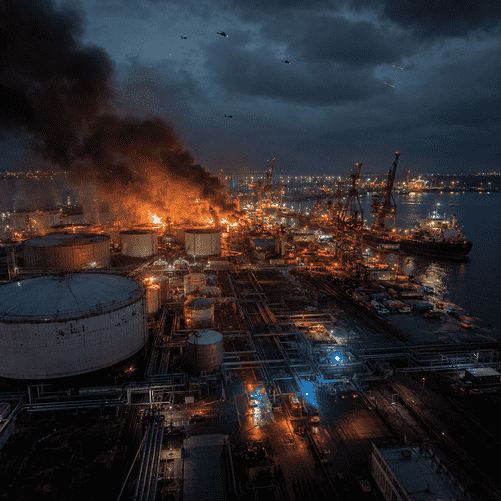
The St Petersburg Oil Terminal is one of the key fuel-handling sites serving the region. Images and eyewitness footage cited by Russian and international outlets showed fire and smoke following the attack, though Russian officials sought to minimize the disruption and said emergency services were responding.
The overnight barrage was not confined to St Petersburg. Russian officials also reported drone activity and damage in other regions, including Bryansk, Crimea and Pskov. Reuters reported that officials confirmed one death each in Bryansk and Crimea, while Pskov authorities said more than 30 drones had been shot down and that minor damage and injuries were recorded in the region.
For Kyiv, the strikes serve both military and psychological purposes. By targeting oil terminals, refineries and logistics hubs, Ukraine is attempting to disrupt fuel supplies and export revenues that help support Russia’s invasion. At the same time, attacks near St Petersburg challenge the Kremlin’s efforts to shield major Russian cities from the consequences of the war.
Moscow has repeatedly accused Ukraine of terrorism over strikes inside Russia, while Kyiv argues that Russian energy and military infrastructure are legitimate targets because they support the war effort. Russia, meanwhile, has continued heavy missile and drone attacks on Ukrainian cities, including a deadly strike on Kyiv earlier this week that killed at least 30 people and damaged residential buildings, medical facilities and a Red Cross warehouse.
The latest strike also carries political symbolism. St Petersburg has long been central to Putin’s public identity and Russia’s global image, and attacks on infrastructure around the city risk undermining the Kremlin’s message that the war remains distant from ordinary Russian life.
Despite the growing reach of Ukraine’s drone program, Russia retains a major advantage in missile stocks, manpower and battlefield pressure in eastern Ukraine. Moscow has claimed recent territorial gains, including around the Donetsk region, though Ukrainian officials have rejected some of those claims as propaganda.
The attack near St Petersburg is unlikely to change the battlefield overnight. But it adds to a broader pattern: Ukraine is increasingly bringing the economic costs of the war onto Russian territory, forcing Moscow to defend oil terminals, ports and industrial sites far from the front.
As the war enters another phase of long-range strikes and attrition, the message from Kyiv is clear: Russia’s energy network is no longer beyond reach.