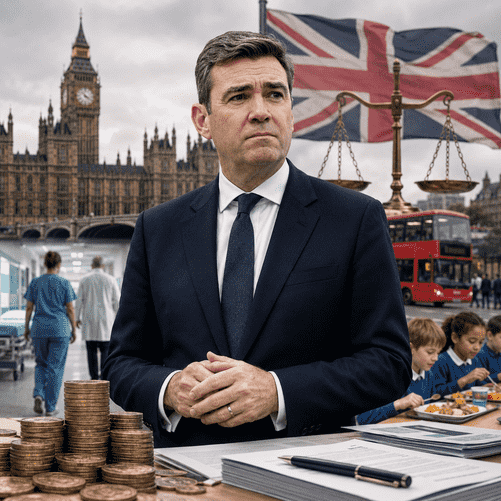
A group of prominent economists has urged Andy Burnham to consider one of the most radical overhauls of Britain’s tax system in decades, replacing income tax, national insurance and several other levies with a single “national contributions” charge.

Andy Burnham is being pressed to pursue a far-reaching fiscal reform agenda as he prepares for a possible move into Downing Street, with leading economists arguing that Britain’s tax system is no longer capable of funding public services effectively.
In an open letter, economists including Jim O’Neill, Jonathan Portes and Danny Sriskandarajah called on Burnham to embrace bold tax and spending reform, arguing that the UK faces deep structural problems that successive prime ministers have failed to solve. The letter warns that taxes are rising while public services continue to deteriorate, with Britain also spending about £100 billion a year on debt interest.
At the centre of the proposal is a new single levy, described as “national contributions,” which would replace six major taxes, including income tax, capital gains tax, inheritance tax and national insurance contributions. Unlike the current system, the levy would apply to all forms of income, whether earned through work, asset sales or inheritance.
Supporters argue that such a system would be simpler, fairer and better suited to the modern economy. They say the current tax framework treats different sources of wealth and income unevenly, placing a heavy burden on workers while allowing other forms of income to be taxed differently. The proposed reform is intended to broaden the tax base and raise additional money for public services.
The plan is linked to a new report, Prosperity 2030, from the Institute for Global Prosperity at University College London. Its authors claim that, depending on the rate chosen, the new system could raise an additional £75 billion a year within five years. They argue that the extra revenue should be used to fund universal public services, including free bus travel and free lunches for all primary schoolchildren.
The report also calls for changes to property taxation, including scrapping stamp duty and council tax and replacing them with a national 1% levy on property values, with the proceeds passed to local authorities according to population. The idea echoes wider calls inside Labour circles for a shift away from outdated council tax bands and toward a system more closely linked to actual property wealth.
But the proposal is likely to face sharp political and technical scrutiny. Tax expert Dan Neidle of Tax Policy Associates questioned the assumptions behind the projected revenue gains, saying he did not see where the figures came from. Any move to abolish income tax and national insurance would also raise major questions about transition costs, public confidence and how different groups of taxpayers would be affected.
For Burnham, the intervention adds pressure at a critical moment. The Guardian reports that he is expected to be confirmed as Labour leader on July 17 and to take over from Keir Starmer as prime minister on July 20. His early economic choices, including who he appoints as chancellor, are likely to determine whether his government pursues cautious fiscal management or a more radical attempt to reshape the state.
O’Neill, a former Goldman Sachs chief economist and former Treasury minister, has worked with Burnham in Manchester and has been discussed as a possible senior adviser. His support for the proposal gives it political weight, though there has been no formal announcement about any role in a future Burnham administration.
The debate reflects a wider dilemma facing British politics: how to fund public services, reduce regional inequality and maintain market confidence at a time of high debt and weak public satisfaction. The proposed single levy is unlikely to be adopted without major revision, but it signals that the pressure for a more ambitious tax settlement is growing.
Burnham has often presented himself as a politician willing to challenge Westminster orthodoxy. The question now is whether he will treat the economists’ proposal as a serious blueprint for government, or as one more radical idea competing for influence before a new administration takes shape.