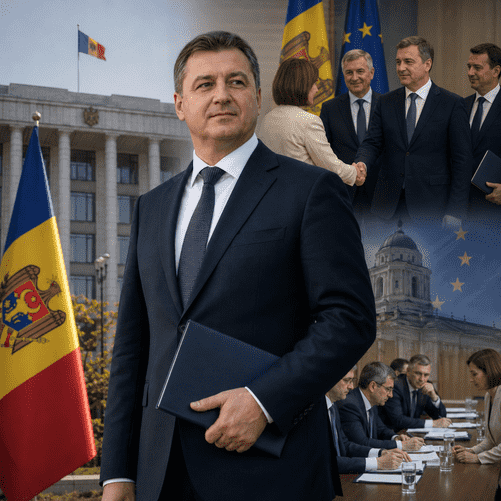
President Maia Sandu has asked the financier to form a new cabinet after Alexandru Munteanu’s abrupt resignation exposed strains within the ruling administration.

CHIȘINĂU — Moldovan President Maia Sandu has nominated businessman and investor Vasile Tofan as the country’s next prime minister, turning to a private-sector figure to restore confidence in a government shaken by controversy and the unexpected departure of its previous leader.
Sandu announced the nomination on Saturday, July 11, following consultations with parliamentary factions. Tofan, a 44-year-old senior partner at the investment firm Horizon Capital, now has 15 days to present a proposed cabinet and governing programme to parliament.
His confirmation is expected because Sandu’s pro-European Party of Action and Solidarity, known as PAS, controls 55 seats in Moldova’s 101-member parliament. Several opposition parties declined to participate fully in the nomination process, arguing that the choice had already been decided by the governing majority.
Tofan said his administration would concentrate on rebuilding public trust, restoring optimism among Moldovan businesses and accelerating the country’s campaign to join the European Union. He has expressed the ambition of securing an EU accession agreement by 2028, an accelerated timetable for a country navigating economic weakness and continuing geopolitical pressure.
The nomination follows the resignation of Alexandru Munteanu on July 3, only eight months after he took office. Munteanu said he could no longer perform his duties in accordance with his principles and convictions but did not publicly explain which disagreements or events had prompted his decision. His departure automatically brought down the government.
Although Munteanu did not explicitly attribute his resignation to any single scandal, it came amid public anger over alleged excessive salaries, questionable appointments and governance failures at state-owned enterprises, particularly MoldATSA, the agency responsible for managing Moldova’s airspace. The controversy prompted Sandu to promise a broad institutional clean-up and intensified opposition criticism of the PAS administration.
Sandu thanked Munteanu for introducing what she described as difficult but necessary reforms. However, the abrupt collapse of his cabinet created a significant political challenge for a governing party seeking to preserve its image as a force for transparency, competent administration and European integration.
Deputy Prime Minister and Economy Minister Eugeniu Osmochescu was appointed acting prime minister during the transition. His interim government will remain responsible for day-to-day administration until parliament approves Tofan and his proposed ministers.
Tofan’s selection reflects Sandu’s continued preference for technocrats and internationally experienced professionals rather than established party figures. Like Munteanu, he comes from finance and investment rather than a long political career. He publicly supported Sandu’s successful 2024 re-election campaign and backed PAS in the 2025 parliamentary election.
That background may strengthen his credibility with foreign investors and European institutions, but it could also leave him vulnerable to accusations that he lacks experience in public administration and is too closely aligned with the presidency.
His immediate economic task will be demanding. Moldova remains one of Europe’s poorest countries and has struggled with weak growth, outward migration, energy insecurity and the consequences of Russia’s war against neighbouring Ukraine. Reviving private investment while improving living standards will be essential if the new government is to reverse growing public frustration.
The country’s strategic direction will also remain central to Tofan’s mandate. Sandu and PAS have made EU membership the defining objective of their government, while pro-Russian political forces have accused the administration of moving too quickly towards the West and neglecting domestic economic concerns.
Moldova’s location between Ukraine and EU member Romania has made it particularly exposed to regional instability, Russian political interference and energy pressure. The European Union has nevertheless reiterated that the change in government will not disrupt its support for Moldova’s accession process.
For Tofan, parliamentary approval may prove easier than establishing public confidence. He will inherit not only the programme of a pro-European government but also the political consequences of the controversies that preceded Munteanu’s resignation.
His success will depend on whether he can demonstrate that Moldova’s European ambitions are accompanied by visible improvements in governance, business conditions and household prosperity. Without such progress, another change at the top may do little to resolve the deeper crisis of confidence confronting the country’s leadership.