With affordable tickets, plus-size casting and a major museum platform, the Irish designer’s V&A show challenged an industry still struggling to make inclusivity more than a slogan.

Sinéad O’Dwyer brought a different kind of runway to London’s Victoria and Albert Museum, placing body diversity, public access and social purpose at the centre of a fashion event that deliberately challenged the industry’s narrow beauty standards.
The Irish designer’s Fashion in Motion show at the V&A was staged on Friday, July 24, and offered members of the public the chance to attend for as little as £5, a striking contrast with the exclusivity that usually surrounds high-fashion presentations. The museum described the event as a showcase of O’Dwyer’s work and her commitment to challenging traditional beauty standards through clothing designed for a wider range of bodies.
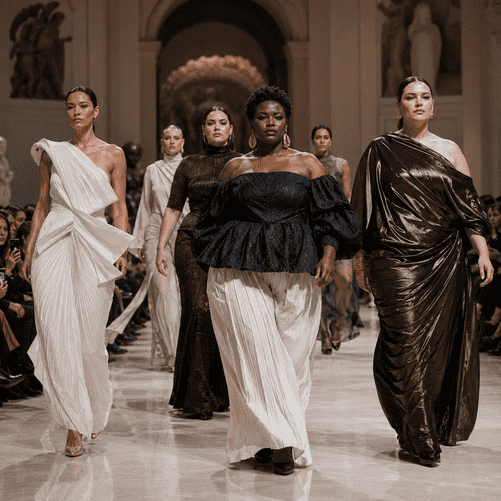
The show featured performers and models in a variety of garments, from underwear and skirt suits to sequins and sculptural pieces. What made the presentation stand out was not only the clothing, but the casting: models appeared in different sizes, shapes and body types, reinforcing O’Dwyer’s long-standing argument that fashion must be designed around real bodies rather than forcing bodies to conform to a single sample size.
O’Dwyer has built her reputation by pushing against the runway’s traditional dependence on very small sample sizes. While many brands create catwalk samples around sizes 4 to 8, O’Dwyer has made a larger body central to her design process, using a size 18 as an important reference point and expanding the idea of who luxury fashion is supposed to serve.
The V&A said O’Dwyer created 15 garments for the event, combining strong visual design with a social message focused on empowerment, accessibility and self-acceptance. That framing placed the show somewhere between a fashion presentation, a performance and a public cultural statement.
For O’Dwyer, inclusivity is not simply a matter of placing a few larger models on a runway. Her practice has focused on the technical side of design: pattern-cutting, fitting and garment construction that take into account bodies often excluded from luxury fashion. In previous seasons, she has worked across a broad size range and has argued that genuine inclusion must begin before casting, at the design table itself.
The accessibility of the V&A show also carried symbolic weight. Fashion weeks and designer presentations are often closed to ordinary consumers, influencers aside, with attendance limited to buyers, editors, celebrities and industry insiders. By offering low-cost tickets in a major public museum, the event opened a traditionally closed space to people who are often expected to admire fashion from a distance but rarely invited into its most visible rooms.
The timing was significant. After several years in which body diversity appeared to be gaining ground, much of the fashion industry has shown signs of retreat. Recent runway analysis by Vogue Business found that at London Fashion Week for autumn/winter 2026, 92.7% of looks were straight-size, while only 6.5% were mid-size and 0.8% were plus-size.
That data helps explain why O’Dwyer’s work remains politically charged inside fashion. The industry has learned the language of inclusion, but its runways still overwhelmingly present a narrow vision of the body. Campaigns may speak about diversity, but catwalks, sample rooms and luxury retail sizing often continue to privilege thinness as the default.
O’Dwyer belongs to a small group of designers who have tried to change that system from within. Alongside names such as Karoline Vitto and Ester Manas, she has been cited as part of a movement of designers using London as a platform for more body-inclusive fashion. Yet the wider industry’s progress has been uneven and, in some seasons, visibly reversed.
The challenge is partly economic and partly cultural. Designing for a wider range of bodies requires more fittings, more pattern work and more technical knowledge than relying on one standard sample size. For large fashion houses, however, those practical barriers are difficult to justify as an excuse, especially when the same brands have the resources to produce complex shows, global campaigns and celebrity wardrobes.
O’Dwyer’s approach suggests that inclusivity can be treated as a creative force rather than a commercial burden. Her garments often use stretch, structure, cut-outs and sculptural shapes to highlight bodies instead of disguising them. The result is fashion that does not merely “accommodate” difference, but builds its visual identity around it.
The public response to such work also challenges an assumption often repeated in luxury fashion: that size-inclusive clothing is somehow separate from aspiration or high design. By placing plus-size and body-diverse models in a museum runway context, O’Dwyer positioned them not as exceptions, but as central figures in contemporary fashion culture.
Her celebrity following, which has included figures such as Cardi B and Björk, has helped bring wider attention to the brand. But the V&A show suggested that her influence may be just as important at the institutional level, where museums, fashion schools and public venues can help redefine whose bodies are considered worthy of serious design.
The broader question is whether the industry will follow. A handful of independent designers can create powerful moments of visibility, but lasting change requires retailers, luxury houses, casting directors, fashion councils and media platforms to adopt body diversity as a standard practice rather than a seasonal talking point.
O’Dwyer’s V&A show did not solve fashion’s inclusivity problem. What it did was expose the gap between what the industry says and what it still does. On one side is a public increasingly unwilling to accept a single ideal body as the face of fashion. On the other is an industry whose most powerful institutions continue to move slowly.
By making the show affordable, public and visibly body-diverse, O’Dwyer offered a direct alternative. Her runway argued that fashion can be technically ambitious, visually striking and inclusive at the same time.
In a sector where progress often appears fragile, the message was clear: body diversity should not be treated as a special theme, a one-off statement or a marketing gesture. It should be part of the basic architecture of fashion itself.