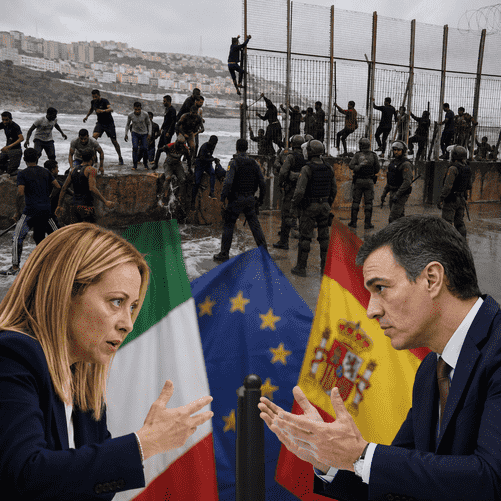
Italy’s threat to restrict Schengen travel with Spain has transformed a migration emergency on Europe’s southern frontier into a widening diplomatic dispute.

A sudden surge of migrant arrivals in the Spanish enclave of Ceuta has triggered an increasingly bitter confrontation between Italy and Spain, raising new questions about border security, European solidarity and the future of the Schengen free-movement area.
Thousands of people crossed into Ceuta from neighbouring Morocco by land and sea on July 30, overwhelming reception facilities and prompting Spain to deploy military personnel to support the police and Civil Guard. At least nine people were initially reported dead, although later accounts placed the toll substantially higher as rescue teams continued searching coastal areas.
The scale of the crossings quickly reverberated beyond Spain. Italian Prime Minister Giorgia Meloni said her government was prepared to adopt “extraordinary measures” to protect Italy’s borders, including the possible suspension of Schengen arrangements with Spain. Italian Foreign Minister Antonio Tajani also called for restricting Spain’s participation in the passport-free travel zone, arguing that uncontrolled migration presented a threat to national security.
Rome’s intervention drew an angry response from Madrid. Spain summoned the Italian ambassador, while Foreign Minister José Manuel Albares accused the Italian government of exploiting a humanitarian and security emergency for partisan political purposes. Spanish officials argued that cooperation, rather than unilateral border restrictions, was needed to manage the situation.
The dispute reflects a broader disagreement between the two governments over migration policy. Meloni has repeatedly criticised Spain’s programme to regularise hundreds of thousands of undocumented migrants, warning that national decisions can have consequences across the European Union once people are able to move freely within the Schengen area. Spanish Prime Minister Pedro Sánchez has defended the measure as an orderly response to labour-market needs and the presence of migrants already established in the country.
Madrid has rejected suggestions that its regularisation policy directly caused the Ceuta crossings. The Spanish government instead blamed criminal organisations for exploiting a recent Supreme Court ruling that prevents authorities from automatically returning some migrants intercepted at sea near Ceuta and Melilla without appropriate legal procedures.
Ceuta and Melilla, Spain’s two enclaves on the North African coast, form the European Union’s only land borders with Africa. Their position has made them recurring focal points for migration pressure, diplomatic tension with Morocco and disputes over European border policy. The Western Mediterranean route includes arrivals to both territories as well as sea crossings to mainland Spain.
The latest emergency has revived memories of the 2021 Ceuta crisis, when approximately 8,000 people entered the enclave during a diplomatic confrontation between Spain and Morocco. As in that episode, the ability of Moroccan authorities to prevent departures has become central to restoring control at the border.
Spain said it had strengthened coordination with Morocco and reached an agreement to facilitate the return of people without permission to remain. Spanish officials also deployed additional security forces and sought emergency accommodation after local facilities became overcrowded.
The Italian threat to suspend Schengen arrangements is politically dramatic but legally and practically complex. Member states may temporarily restore internal border controls when they identify a serious threat to public order or internal security. A broader suspension of another country from the Schengen system, however, would require extensive European consultation and would risk disrupting trade, tourism and the movement of millions of citizens.
Italy’s concerns are based partly on the possibility that migrants registered in Spain could later travel toward France and Italy. France has also tightened controls in response to the crisis, illustrating how pressure at one section of the EU’s external frontier can rapidly produce consequences across neighbouring states.
For Meloni, the confrontation offers an opportunity to reinforce her government’s commitment to stricter border enforcement. Italy has pursued agreements with countries outside the EU, tougher measures against irregular arrivals and an expansion of legal migration channels intended to meet labour shortages while maintaining greater government control over entry. Italy plans to issue almost 500,000 non-EU work visas between 2026 and 2028.
For Sánchez, the crisis presents both an operational and political challenge. His government must restore control in Ceuta while defending a comparatively open migration policy against criticism from Spain’s opposition and conservative governments elsewhere in Europe.
The confrontation also exposes weaknesses in the EU’s shared migration system. Although Schengen allows movement without routine checks at internal borders, the protection of the union’s external frontier remains primarily the responsibility of individual states. When one country is overwhelmed, other governments may respond by restoring their own controls rather than relying on collective burden-sharing.
European institutions are therefore likely to face demands for additional border personnel, emergency financial assistance and a clearer mechanism for distributing asylum seekers. The dispute could also test the migration and asylum reforms intended to combine stronger external controls with greater solidarity among member states.
Behind the diplomatic argument lies a serious humanitarian emergency. Many of those who attempted to reach Ceuta travelled by sea or crossed dangerous border areas, and families with children were reported among the arrivals. The deaths have underlined the risks taken by migrants and the difficulty of balancing border enforcement with legal obligations to protect life and assess asylum claims.
Whether Rome carries out its threat will depend partly on Spain’s ability to stabilise the situation and prevent onward movement. Even without a formal Schengen suspension, temporary controls by Italy or France could create travel delays and deepen political divisions within the EU.
What began as an emergency at the Ceuta border has consequently developed into a wider test of European unity. Italy and Spain agree that irregular migration must be managed, but their dispute shows how sharply they differ over who bears responsibility, which measures are legitimate and how far national governments should go to defend their borders.