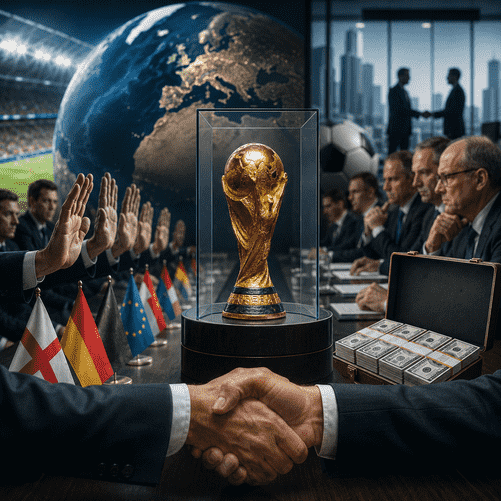
The governing body insists its proposed commercial subsidiary would expand funding without surrendering control, but UEFA and other regional organisations warn that private ownership could permanently reshape world football.

FIFA has vowed to continue consulting its member associations over a controversial plan to bring private investors into the commercial structure surrounding the World Cup, despite an unprecedented boycott threat from European football nations.
The global governing body issued a defiant response on Friday, insisting that “nobody is selling football” and arguing that reports about its proposed FIFA Forward Enterprise had misrepresented the project before national associations had been given a full opportunity to consider it.
FIFA said its original consultation had been disrupted by inaccurate media coverage but would now proceed so that each of its 211 member associations could vote on the proposal after reviewing the facts. It added that the plans could be approved, rejected or amended during that process.
The statement followed a dramatic escalation by UEFA, whose 55 national associations voted unanimously to boycott the World Cup and every other FIFA competition for as long as the investment proposal remained active.
UEFA demanded that FIFA abandon the plan entirely and provide binding assurances that it would not allow private ownership of its competitions in the future. Its position could affect men’s, women’s and youth tournaments, beginning with events scheduled within the coming months.
At the centre of the dispute is FIFA Forward Enterprise, or FFE, a proposed subsidiary that would combine FIFA’s commercial rights with the operational delivery of its tournaments.
Broadcasting, sponsorship, ticketing and licensing activities connected to the World Cup and FIFA’s wider portfolio would be moved into the new organisation. FIFA says it would own and permanently control the subsidiary, while external investors would be permitted to acquire minority, non-controlling interests.
The initial proposal values the enterprise at approximately $20 billion and envisages raising as much as $4.2 billion from the sale of minority stakes. Reports indicate that investors could collectively acquire up to 20% of the company.
FIFA argues that the investment would allow it to generate greater revenue from its competitions and direct substantially more money toward football development.
Under its revised funding proposals, each national association would receive $20 million through FIFA Forward between 2027 and 2030, regardless of whether it individually supports the FFE project. Associations could also voluntarily participate in a separate one-off programme offering an additional $20 million financed through external investment.
The governing body says the money could fund stadiums, training facilities, coaching, grassroots competitions, national teams and women’s football, particularly in countries whose associations rely heavily on FIFA support.
FIFA President Gianni Infantino has presented the plan as a way to unlock the commercial potential of the world’s most popular sport and spread its financial benefits more widely. He maintains that wealth generated by the World Cup should help develop football in every region rather than remain concentrated in established markets.
Critics, however, see the proposed structure very differently.
UEFA argues that allowing investment firms to own even a minority stake in an entity operating the World Cup would introduce a permanent obligation to deliver financial returns. It fears that investor pressure could influence decisions about tournament size, frequency, host locations, broadcasting arrangements and the international match calendar.
“The moment external investors acquire ownership interests in FIFA competitions, football changes forever,” UEFA said, warning that commercial returns and investor expectations would become constant pressures on the game.
European officials are particularly concerned that an investor-backed FIFA could create more competitions, add more teams to existing events or stage major tournaments more frequently.
Such expansion could place additional pressure on players and domestic leagues while reducing the space available for continental tournaments such as the European Championship, Copa América, Africa Cup of Nations and regional Champions League competitions.
The dispute is therefore about more than ownership. It reflects a longstanding struggle among FIFA, the continental confederations, domestic leagues and clubs over control of football’s calendar and its growing commercial revenues.
UEFA has accused FIFA of treating the World Cup as an investment product rather than a shared sporting institution. It argues that FIFA already has significant reserves and should use those funds to increase development payments without surrendering economic interests to outside investors.
FIFA rejects the suggestion that the World Cup itself would be sold.
In its response, the governing body said the new subsidiary would handle commercial and event-delivery operations but would not alter FIFA’s governance structure or give investors influence over how the sport or its tournaments are regulated.
It also stressed that FFE would not be established without majority support from the member associations. Should the proposal fail to secure that backing, FIFA said its commercial activities would continue under the existing model.
Nevertheless, critics have raised concerns about the speed and transparency of the process.
CONCACAF, representing North America, Central America and the Caribbean, rejected the proposal after its member associations expressed concern over what they described as insufficient due process, a compressed deadline and a lack of scrutiny by FIFA’s established governance bodies.
The Asian Football Confederation also said it had not been consulted before the proposal was announced publicly. Its president warned that a project of such significance could not succeed without support from all six continental confederations.
The opposition from CONCACAF is especially significant because the United States, Canada and Mexico had just hosted the 2026 World Cup, an event FIFA described as commercially unprecedented.
Critics have questioned why FIFA needs private capital immediately after staging what CONCACAF called the most profitable World Cup in history.
UEFA’s boycott threat represents the most serious challenge yet to the proposal.
Europe contains many of the world’s most commercially powerful national teams, leagues and players. Six of the top 10 men’s and women’s national teams in FIFA’s rankings are European, including 2026 world champions Spain. A FIFA tournament without European participation would lose much of its sporting legitimacy, broadcast appeal and commercial value.
The immediate consequences could reach beyond the next men’s World Cup.
Brazil is due to host the Women’s World Cup in 2027, while Spain, Portugal and Morocco are preparing to stage the men’s tournament in 2030. European associations are also involved in bids and preparations for future youth and women’s competitions.
A prolonged confrontation could consequently disrupt qualification, sponsorship contracts, broadcasting agreements and tournament planning across several years.
It may also threaten Infantino’s political position. The FIFA president is expected to seek another term in 2027, but the investment proposal has generated rare public criticism from regional organisations that previously supported his leadership.
The Asian confederation’s opposition is particularly damaging because its president, Sheikh Salman bin Ibrahim Al Khalifa, has historically been considered an Infantino ally. Growing resistance across Europe, Asia and North America could make it difficult for FIFA to assemble the majority required to approve FFE.
FIFA maintains that no confederation has the right to speak on behalf of all 211 national associations. Its strategy appears to rely on appealing directly to smaller federations that could benefit substantially from increased development funding.
For many associations in Africa, Asia, Oceania and the Caribbean, an additional $20 million could transform football infrastructure and youth development. That financial incentive may create a divide between wealthier nations concerned about governance and smaller members focused on obtaining resources that are otherwise unavailable.
UEFA’s critics may also face uncomfortable questions about their own commercial interests. European football generates billions of euros through the Champions League and leading domestic competitions, giving its associations and clubs financial advantages that are not shared by most of FIFA’s global membership.
FIFA can therefore portray its proposal as an effort to redistribute wealth and weaken Europe’s dominance over the sport’s economy.
Yet the method of financing that redistribution remains deeply controversial. Private investors do not provide billions of dollars without expecting returns, and FIFA has not yet offered sufficient public detail about their rights, exit arrangements or influence over long-term commercial strategy.
Questions also remain about who the investors would be, how they would be selected and whether their interests could conflict with FIFA’s responsibility to govern the sport for the public benefit.
The governing body is organised as a non-profit association under Swiss law, with its national associations effectively serving as its members. Moving its most valuable commercial activities into a partly investor-owned subsidiary would represent a fundamental change in how those assets are managed.
The consultation will now become a test of whether FIFA can persuade its members that financial expansion can occur without sacrificing institutional independence.
FIFA says it is offering an opportunity rather than imposing an obligation. UEFA believes the proposal crosses a line that cannot safely be reversed once private investors acquire an ownership interest.
Both sides claim to be defending football’s future, but they are working from sharply different definitions of that responsibility.
For FIFA, protecting the game means generating more money and distributing it across all 211 associations. For UEFA and its allies, it means ensuring that the World Cup remains insulated from the demands of outside capital.
The promise that “nobody is selling football” is therefore unlikely to settle the dispute. The central question is not whether investors would own the sport itself, but whether owning part of the company that commercialises its greatest competitions would give them an enduring claim over football’s priorities.
Unless FIFA can answer that concern with detailed governance safeguards, its consultation may deepen rather than resolve the biggest political crisis in world football for years.