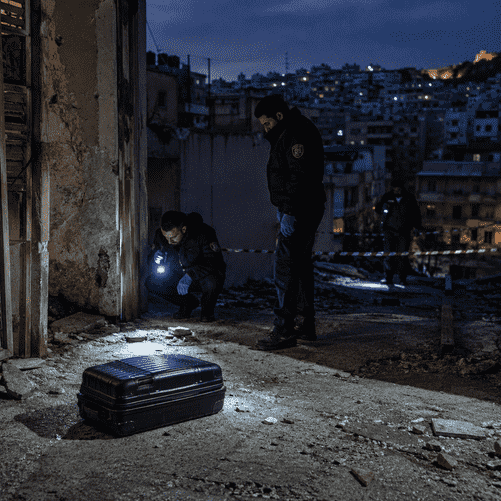
Greek detectives are reconstructing the last days of 38-year-old Elisabeth-Jane Ross after her body was discovered in a derelict building and communications continued from her phone after she was believed to have died.

ATHENS — Greek police have mounted an extensive investigation into the unexplained death of a British woman whose body was found concealed inside a suitcase in an abandoned building in central Athens.
Elisabeth-Jane Ross, 38, was discovered on July 18 in the Kypseli district, a densely populated neighbourhood north of the city centre. Her identity was subsequently established through international fingerprint records, allowing Greek authorities to contact her family and coordinate with British law-enforcement officials.
Ross had travelled to Greece in late June and was last known to have been staying in the Athens area. According to investigators, she left her accommodation on July 15 after saying that she intended to meet acquaintances from the United States. Police have so far been unable to identify or locate those people, leaving a critical gap in the reconstruction of her final movements.
Her remains were found three days later by a homeless man inside a neglected property in Kypseli. The advanced state of decomposition has complicated efforts to establish precisely when and how she died. An initial examination reportedly found no obvious external injuries or evidence of a struggle, while toxicological and further forensic tests remain central to determining the cause of death.
Although authorities have not formally established that Ross was murdered, the concealment of her body has led investigators to treat the circumstances as highly suspicious. Detectives are attempting to determine whether she died at another location before being transported to the abandoned building and who handled the suitcase in which she was found.
One of the most troubling elements of the case concerns Ross’s mobile phone. Messages were reportedly sent from the device after the period in which investigators believe she may already have been dead. Some communications suggested that she wanted to be left alone or was planning to travel elsewhere in Greece. Police are examining whether another person used the phone to delay concern among her relatives and acquaintances.
The device itself has not been recovered, depriving investigators of a potentially important source of location records, communications and digital evidence.
Greek authorities have assigned more than 60 officers to the inquiry, drawing personnel from across the homicide division. Investigators are analysing surveillance footage, travel information, social-media activity and Ross’s contacts in an effort to reconstruct the days between her disappearance and the discovery of her body. Forensic examination of the suitcase has so far produced no decisive lead.
The case has also prompted cooperation with agencies outside Greece. Ross had previously lived or worked in other countries, and investigators are examining her international movements and personal connections to understand why she travelled to Athens and whom she intended to meet.
The British government has said it is supporting her family and remains in contact with the Greek authorities. No arrests have been announced, and police have not publicly identified a confirmed suspect.
Until laboratory results establish the cause of death and detectives account for Ross’s missing days, the central questions remain unresolved: where she died, who concealed her body and why someone may have continued communicating through her phone after her death.