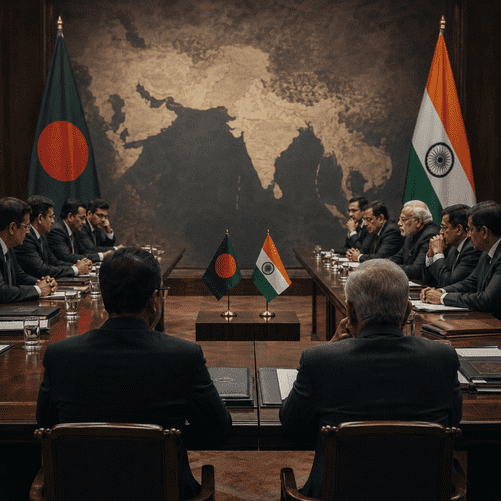
Dhaka says the conditions are not yet right for Prime Minister Tarique Rahman to visit New Delhi, placing the fate of ousted leader Sheikh Hasina at the centre of an increasingly sensitive dispute between two of South Asia’s most important neighbours.

Relations between Bangladesh and India have entered another delicate phase after Dhaka indicated that a planned visit by Prime Minister Tarique Rahman to New Delhi will require a more favourable political environment, with Bangladesh continuing to press India for the extradition of former prime minister Sheikh Hasina.
Bangladesh’s foreign ministry said on Sunday, August 16, that discussions over a possible visit by Rahman were continuing, but made clear that unresolved disputes were complicating efforts to restore the traditionally close relationship between the two countries. Foreign ministry spokesperson Shahidul Karim said that a “propitious environment” would have to be created before the visit could take place.
At the centre of the dispute is Hasina, who fled to India in August 2024 after a mass uprising brought an abrupt end to her government. Her departure transformed what had previously been one of India’s closest political relationships in South Asia into a difficult diplomatic problem.
Bangladesh has formally sought Hasina’s extradition and says it is still waiting for a substantive response from New Delhi. India has said the requests are being examined through its domestic legal procedures, but has not indicated whether the former Bangladeshi leader will ultimately be returned.
The issue carries exceptional political sensitivity in Dhaka. Hasina was sentenced to death in absentia in November 2025 in connection with the violent suppression of the student-led uprising that ultimately removed her from office. She denies the accusations and has repeatedly characterised the proceedings against her as politically motivated.
Tensions intensified again this month after Hasina appeared publicly in New Delhi and declared that she intended to return to Bangladesh in December. She also demanded that restrictions imposed on her Awami League party be lifted. Bangladesh’s foreign ministry reacted sharply, describing the decision to allow her to speak publicly from Indian territory as deeply damaging to bilateral relations and an affront to Bangladesh’s sovereignty.
For India, the dispute presents a difficult strategic calculation. Hasina spent years cultivating close relations with New Delhi while in office, particularly over counterterrorism, border management, connectivity and regional security. Her removal fundamentally altered the political environment in Dhaka and forced India to rebuild relations with political forces that had historically been more suspicious of Indian influence.
That transition became more significant after Bangladesh’s February election, when the Bangladesh Nationalist Party won a decisive parliamentary majority. Tarique Rahman was sworn in as prime minister on February 17, returning the BNP to power after nearly two decades and establishing a political leadership markedly different from the Hasina era.
Rahman has so far signalled that he wants to stabilise relations with India rather than allow the dispute to become permanent. During a meeting with India’s new high commissioner earlier this month, he called for the creation of a “conducive environment” in which the two governments could rebuild cooperation. But the extradition question has increasingly emerged as a test of whether that diplomatic reset is politically possible.
The stakes extend well beyond the fate of one former leader. India and Bangladesh share a border of more than 4,000 kilometres and have extensive economic, energy and transport links. Cooperation between the two countries is also strategically important for India’s northeastern states, many of which rely on transit routes through or near Bangladesh.
Dhaka, meanwhile, must balance its relationship with India against a broader effort to diversify its international partnerships. Bangladesh occupies a strategically important position between India and Southeast Asia and has attracted growing attention from China and other regional powers. Any prolonged deterioration in relations with New Delhi could therefore influence the wider geopolitical balance in the Bay of Bengal.
There is also a powerful domestic political dimension. Hasina remains one of the most polarising figures in Bangladeshi politics. To supporters, she is associated with years of economic expansion and infrastructure development; to opponents, her later years in power became synonymous with increasingly authoritarian government, political repression and the suppression of dissent.
Her continued presence in India therefore has symbolism extending far beyond questions of asylum or extradition. For sections of Bangladesh’s current political establishment, India’s protection of Hasina risks reinforcing longstanding accusations that New Delhi favoured one political faction in Dhaka rather than maintaining an equal relationship with the Bangladeshi state.
For India, however, extraditing a former close partner who faces a death sentence could create its own diplomatic, legal and political complications. Indian authorities must consider domestic law, the bilateral extradition framework and the potential consequences of returning Hasina to face capital punishment.
The result is an increasingly complex diplomatic stalemate. Bangladesh wants a demonstrable Indian response before committing its prime minister to a high-profile visit. India appears reluctant to allow the future of the broader relationship to be dictated entirely by Hasina’s legal position.
Rahman’s proposed visit could therefore become an important indicator of whether the two governments are capable of separating their strategic interests from one of the most contentious episodes in modern Bangladeshi politics.
Both countries have powerful incentives to prevent the relationship from deteriorating further. Trade, transport, water management, energy cooperation, migration and security all require regular coordination, while instability between India and Bangladesh would create wider consequences for South Asia.
Yet the Hasina question has become increasingly difficult to compartmentalise. Her promise to return to Bangladesh later this year, Dhaka’s continuing extradition demands and India’s cautious legal response ensure that the former prime minister will remain at the centre of bilateral politics for months to come.
For now, the diplomatic message from Bangladesh is unmistakable: reconciliation with India remains possible, but a prime ministerial visit cannot be treated as business as usual while the country’s most politically charged extradition request remains unresolved.