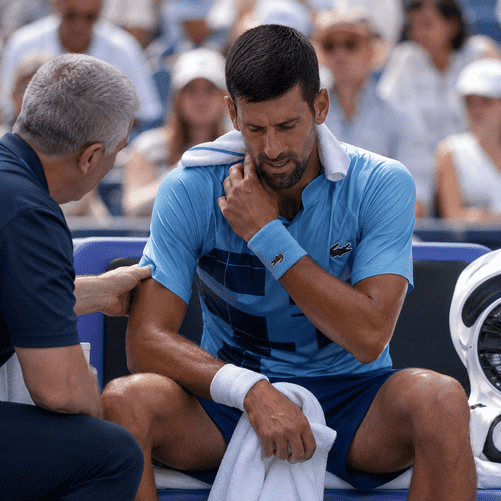
The 39-year-old looked physically distressed in a shock defeat to Thiago Agustín Tirante, reinforcing an increasingly clear late-career pattern: conserving his body through the regular tour while reserving his most formidable tennis for the Grand Slams.

For much of Novak Djokovic’s extraordinary career, physical adversity has been something to overcome rather than something that defined the outcome. In Cincinnati, however, his body became impossible to ignore.
The 24-time Grand Slam champion suffered a startling 2-6, 6-4, 6-4 defeat to Argentina’s Thiago Agustín Tirante in his opening match at the Cincinnati Open, a contest that began with Djokovic appearing completely in control before deteriorating into an uncomfortable demonstration of the physical limits confronting one of tennis’s greatest players at the age of 39. Because Djokovic received a first-round bye, the defeat officially came in the second round, despite being his first match of the tournament.
Djokovic swept through the opening set 6-2 and initially appeared to be moving toward a routine victory. Then the conditions — oppressive heat and humidity — began to take their toll.
During an exhausting game early in the second set, Djokovic required a medical timeout. His blood pressure was checked, he dropped to his hands and knees at stages of the contest and appeared physically sick as the match progressed. The transformation was striking: the controlled, economical movement of the first set gave way to visible discomfort, shortened rallies and increasingly costly mistakes.
Afterwards, Djokovic suggested that the problem extended beyond an isolated reaction to the Cincinnati weather. He disclosed that he has been dealing with a recurring health condition for years and that extreme heat and humidity can aggravate it. He did not provide a specific diagnosis.
The revelation adds another layer to the increasingly complicated final phase of his career.
Djokovic remains capable of producing tennis at a level almost nobody in the sport can match. Yet the periods during which he can sustain that level appear to be becoming more carefully rationed.
That distinction is important.
His Cincinnati defeat should not automatically be interpreted as evidence that Djokovic can no longer compete with the sport’s elite. Recent Grand Slam results suggest almost precisely the opposite.
Earlier this year, Djokovic reached the Australian Open final, defeating Jannik Sinner in a five-set semifinal before eventually losing to Carlos Alcaraz in the championship match. He later reached another major semifinal at Wimbledon. At the Australian Open he also became the first player to accumulate 400 Grand Slam singles victories, another almost absurd statistic in a career built on longevity as much as excellence.
There is therefore a growing separation between Djokovic the tour player and Djokovic the Grand Slam competitor.
At ordinary ATP events, his vulnerability is becoming easier to see. Matches that once might have been routine can become physically awkward. Long exchanges in extreme conditions carry greater consequences. Recovery between tournaments requires more calculation, while playing unnecessary weeks can create risks that outweigh the ranking points available.
At the majors, however, something changes.
The preparation becomes more deliberate. The competitive intensity increases. His tactical concentration sharpens and his willingness to endure physical discomfort becomes substantially greater.
The emerging pattern suggests not so much an overall decline as an increasingly selective deployment of what remains.
Djokovic has already demonstrated that workload management is central to his strategy. He withdrew from the Canadian Open before Cincinnati as part of efforts to protect his body, joining several leading players who skipped the event amid growing concern about the increasingly crowded tennis calendar.
Cincinnati was intended partly to provide competitive preparation ahead of the US Open.
Instead, it produced the opposite problem.
Djokovic now heads toward New York having completed only one competitive match since his Wimbledon semifinal defeat, and that match ended with his physical condition becoming the dominant story.
The US Open begins on August 30, leaving comparatively little time to determine whether his Cincinnati difficulties were principally environmental or evidence of a problem likely to affect him in New York.
Conditions at Flushing Meadows can be equally unforgiving.
Late-summer New York regularly produces intense heat and humidity, while five-set men’s matches can stretch deep into the afternoon or evening. For a player dealing with a condition aggravated by precisely those circumstances, physical management becomes inseparable from match strategy.
Djokovic will know that better than anyone.
His game has always been constructed around remarkable efficiency: exceptional return positioning, elastic defensive movement, precise serving and an extraordinary ability to redirect an opponent’s pace. Those qualities allow him to conserve energy better than players whose games depend upon constant explosive attacking.
But age gradually changes the calculation.
The first difference is often not maximum performance. Great athletes can continue producing extraordinary peaks long after their overall consistency begins declining.
The difference is recovery.
A difficult match may take longer to absorb. Heat becomes harder to tolerate. A minor physical problem can linger. Consecutive tournaments become strategically questionable rather than automatically desirable.
Djokovic increasingly appears to understand that reality.
His objective is no longer to dominate every stage of the ATP calendar in the manner he once did. The rankings still matter, but they have become secondary to the prizes capable of meaningfully changing the historical record.
Above everything stands Grand Slam title number 25.
Djokovic already owns the men’s record of 24 major singles championships. Another would move him beyond Margaret Court’s long-standing total of 24 singles majors and give him the outright record across men’s and women’s tennis under the conventional historical count.
At 39, opportunities are inevitably becoming fewer.
That reality makes the calculation behind his schedule more understandable. Winning another Masters 1000 title would add to an already overwhelming résumé. Winning another US Open would alter tennis history.
The difficulty is that selective competition brings its own risks.
Players typically use events such as Cincinnati to calibrate movement, serving patterns, return timing and competitive instincts before a major. Djokovic has often needed remarkably little match preparation, but even his ability to arrive at Grand Slams almost immediately ready to compete cannot be assumed indefinitely.
Tirante exploited that vulnerability impressively.
The 25-year-old Argentine, ranked around No. 50, did not panic after losing the first set. As Djokovic’s level declined, Tirante maintained his aggression and composure, eventually earning what he described as the biggest victory of his career.
For younger opponents, such matches carry a psychological lesson.
The aura remains, but the certainty does not.
A generation ago, opponents facing Djokovic, Rafael Nadal or Roger Federer frequently knew that even winning the opening stages of a match might not matter. The physical and psychological pressure of maintaining an exceptional level for several hours often became overwhelming.
Djokovic still possesses that intimidation factor, particularly at Grand Slams. But regular-tour opponents increasingly understand that there can be moments when the contest changes — when his movement becomes less assured, his physical condition becomes vulnerable or his error count rises.
Carlos Alcaraz and Jannik Sinner have accelerated that transformation at the very top.
Both have demonstrated that beating Djokovic no longer requires an extraordinary one-off performance. They can confront him with sustained physical intensity, exceptional movement and enough offensive firepower to prevent him from controlling matches solely through experience.
Djokovic himself has acknowledged the challenge presented by the younger generation. Yet his results at the majors demonstrate why writing him off remains premature.
At the Australian Open this year, he survived five sets against Sinner in the semifinal. Such performances provide perhaps the clearest evidence that his competitive ceiling remains extraordinary even while his week-to-week reliability becomes less predictable.
This is increasingly the paradox of late-career Djokovic.
His worst performances look considerably worse than they once did.
His best performances can still look like those of a Grand Slam champion.
That widening gap may define whatever remains of his career.
There are precedents among ageing greats. Roger Federer reduced his schedule significantly during his later seasons and became increasingly selective about surfaces and tournaments. Serena Williams similarly demonstrated that an athlete could appear vulnerable during parts of the regular season yet remain profoundly dangerous once a major championship began.
Djokovic may now be entering an even more extreme version of that model.
The calendar is no longer a continuous campaign. It is becoming a sequence of targeted missions.
The increasingly controversial structure of professional tennis may encourage that behaviour. Leading players have criticised the expansion of Masters 1000 tournaments and the relentless nature of an 11-month season. The Professional Tennis Players Association recently cited injury data while arguing that scheduling reforms are required, while Alexander Zverev has called for Masters events to return to shorter formats.
For Djokovic, however, the issue is more personal than structural.
At 39, he is competing against two opponents every time he enters a tournament: the player across the net and the accumulated mileage of more than two decades at the highest level.
Cincinnati offered an unusually stark picture of the second battle.
Watching Djokovic struggle physically after such an authoritative opening set was difficult precisely because the deterioration happened so quickly. The technical knowledge remained. The competitive instinct remained. The body simply stopped cooperating at the level required.
That does not necessarily predict what will happen in New York.
Indeed, his recent career suggests caution before drawing conclusions from any performance outside a major. Djokovic has repeatedly appeared vulnerable only to become transformed when five-set tennis and history are placed in front of him.
The US Open will provide the next test of whether that transformation remains available.
If Djokovic arrives healthy and survives the opening rounds efficiently, the Cincinnati defeat may eventually be remembered as little more than an unpleasant afternoon in oppressive conditions.
If similar physical problems return, however, Cincinnati may look more significant: the moment when the narrowing margin between an ageing champion’s ambition and his body’s capacity became impossible to overlook.
Djokovic is no longer trying to prove that he can dominate tennis every week.
The question now is considerably narrower — and considerably more compelling.
Can he still summon greatness seven times when it matters most?
At this stage of his career, that may be all he needs.