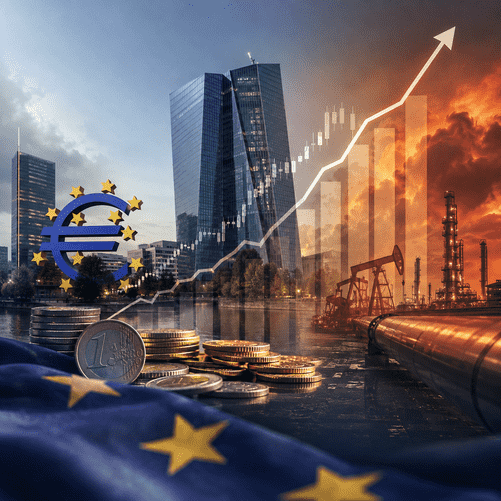
Eurozone growth proved stronger than expected in the second quarter, yet renewed energy-driven inflation is increasing pressure on the European Central Bank to raise interest rates again in September.

The eurozone economy is displaying an uncomfortable combination of resilience and renewed inflationary pressure, confronting the European Central Bank with one of its most difficult policy decisions of the year. Fresh European data show that economic activity accelerated during the second quarter of 2026 even as higher energy costs pushed inflation further above the ECB’s target, strengthening expectations that policymakers will tighten monetary policy again next month.
According to Eurostat figures released on August 14, gross domestic product increased by 0.4% in the euro area during the second quarter compared with the previous three months, while the wider European Union expanded by 0.5%. Employment in the eurozone also edged 0.1% higher, reinforcing the impression that the European economy has absorbed recent geopolitical and energy shocks better than many analysts had anticipated.
The improvement is particularly significant because euro-area GDP had been essentially stagnant during the first quarter. The ECB has acknowledged that domestic demand weakened earlier in the year, with softer household consumption and declining investment, particularly in construction. Economic activity subsequently recovered despite disruption associated with the continuing Middle East conflict and elevated energy prices.
That resilience, however, is creating a monetary-policy dilemma. Eurostat estimates that annual euro-area inflation increased to 2.9% in July, from 2.8% in June, leaving price growth substantially above the ECB’s 2% objective. The renewed inflationary pressure has been closely associated with higher energy costs, as geopolitical instability has kept oil markets under strain.
The result is a significant shift in expectations surrounding European interest rates. A Reuters poll conducted between August 10 and 13 found that 57 of 69 economists — approximately 83% — expect the ECB to increase its deposit rate by 25 basis points to 2.50% in September. Such a move would follow the rate increase delivered in June and the ECB’s decision to pause in July.
Financial markets and policymakers are therefore confronting an unusual economic configuration: inflation is moving in the wrong direction, but the underlying economy remains sufficiently resilient to give the ECB room to act. Higher borrowing costs inevitably carry risks for investment, housing and heavily indebted governments, yet allowing energy-driven price increases to spread into wages and services could make inflation considerably harder to control.
Energy remains the critical variable. Oil prices have remained substantially above their pre-conflict levels as disruption surrounding Middle Eastern supply routes continues to affect international markets. Reuters reported that crude prices have been around 25% above levels prevailing before the current conflict, contributing directly to the acceleration in European inflation.
For European businesses, the consequences extend beyond fuel bills. Persistent energy inflation raises transportation and production costs, compresses corporate margins and can eventually feed into consumer prices. Companies already facing weaker global demand and elevated financing costs may consequently delay investment or pass additional expenses on to customers.
Europe is also dealing with another increasingly visible economic threat: extreme weather. Severe heatwaves this summer have disrupted agriculture, transportation, tourism and electricity generation across several European economies. France has faced constraints on nuclear generation, while low river levels have affected German freight transportation and wildfires have caused extensive damage in southern Europe. Estimates of the eventual economic cost remain highly uncertain, but the disruptions illustrate how climate-related shocks are increasingly intersecting with traditional inflation and growth risks.
The contrasting signals help explain why the ECB’s next decision carries importance far beyond the immediate quarter-point adjustment markets are anticipating. Raising rates would demonstrate that policymakers remain determined to prevent another persistent inflation cycle. Keeping borrowing costs elevated for too long, however, could undermine precisely the economic recovery that has begun to emerge.
There are nevertheless encouraging elements in the latest figures. The eurozone’s 0.4% quarterly expansion suggests that households and companies have maintained a degree of resilience despite higher energy costs, geopolitical uncertainty and restrictive financing conditions. The European economy is no longer simply confronting stagnation; instead, it is navigating a fragile recovery whose durability will depend increasingly on inflation, energy markets and central-bank policy.
The coming months may therefore define the direction of Europe’s economy well into 2027. If energy prices stabilise and inflation begins moving back toward the ECB’s target, the current tightening phase could remain relatively limited. But if geopolitical disruption keeps oil and other commodity prices elevated, policymakers could face the far more difficult prospect of suppressing inflation without extinguishing Europe’s newly recovered growth momentum.
For now, Europe’s economy appears stronger than feared — but that resilience may paradoxically give the ECB exactly the economic space it needs to make borrowing more expensive once again.