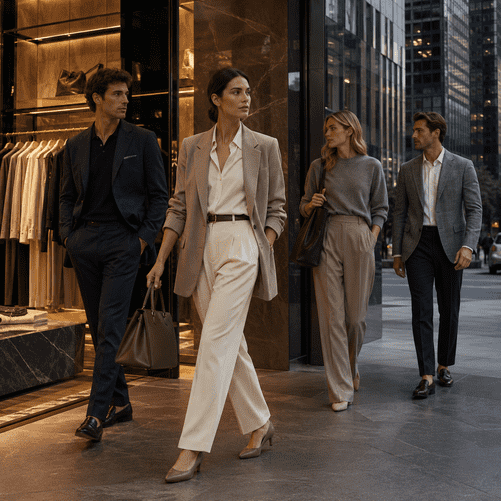
A renewed appetite for polished workwear is lifting brands such as Ralph Lauren and Coach, as return-to-office mandates, Gen Z spending and a rejection of pandemic-era casualwear push tailoring, loafers and structured accessories back into fashion.

The return to the office is reshaping fashion in ways that few brands could have predicted during the height of the remote-work era.
After years in which sneakers, sweatpants and deliberately relaxed silhouettes dominated wardrobes, consumers are once again spending on clothing designed to look polished in public. Tailored trousers, blazers, loafers, structured handbags and refined knitwear are re-emerging as important categories, creating a commercial opportunity for brands positioned between mass-market fashion and traditional luxury.
Among the clearest beneficiaries is Ralph Lauren.
The American fashion group reported first-quarter fiscal 2027 revenue of approximately $2 billion, an increase of 14% on a reported basis and 13% in constant currency. Growth was particularly strong in Asia, where revenue rose 24%, while European revenue increased 7%.
The performance reflects more than the strength of a single brand. It points toward a broader shift in how consumers are thinking about dressing as workplaces become more populated again and the boundaries between professional clothing and everyday fashion begin to blur.
Rather than returning to the rigid corporate uniforms of previous decades, the new workwear aesthetic is noticeably softer.
Suits remain important, but jackets are increasingly relaxed rather than heavily structured. Trousers tend toward fluid or wider silhouettes, while knitwear, fine shirts, leather accessories and practical flat shoes are being incorporated into outfits that can move between an office, restaurant and social setting without appearing overly formal. Recent fashion coverage has identified relaxed suiting, crisp shirting, loafers, low heels and versatile tailoring among the defining elements of the 2026 professional wardrobe.
That shift has produced an unexpected revival for heritage brands whose identities were built around precisely this type of clothing.
Ralph Lauren’s imagery of blazers, Oxford shirts, polo coats and American collegiate dressing once risked appearing conservative during the peak of streetwear and athleisure. Today, many of those same references look newly relevant as consumers seek clothes that feel established, recognisable and durable.
The Financial Times reported on Monday that Ralph Lauren has emerged as one of the major beneficiaries of the return toward smarter dressing, while Coach has also gained from stronger demand for polished accessories and fashion that occupies an accessible space below Europe’s most expensive luxury houses.
Coach’s recent financial performance reinforces that argument.
Its parent company, Tapestry, reported that Coach revenue rose 15% in its latest quarter, while full-year Coach sales increased 24%. Tapestry’s total fiscal 2026 revenue reached approximately $8 billion.
The revival also highlights an important change in the luxury market.
Consumers who once aspired to purchase products from Europe’s largest fashion houses have become increasingly resistant to aggressive price increases. Handbags, shoes and clothing from leading luxury labels have moved beyond the budgets of many middle- and upper-middle-income customers, creating a gap between fast fashion and ultra-luxury.
Brands such as Ralph Lauren and Coach are increasingly occupying that territory.
They can offer strong branding, recognisable design and a perception of quality without requiring consumers to enter the pricing levels associated with major French and Italian luxury houses. That positioning has become particularly attractive as younger shoppers scrutinise value more carefully.
Gen Z is playing a central role in the shift.
Rather than rejecting formal dressing entirely, younger consumers have begun experimenting with traditional codes of professionalism as fashion. Loafers, tailored jackets, shirts, neckties, structured handbags and corporate-inspired silhouettes increasingly appear not simply as workplace requirements but as styling tools.
The phenomenon reflects a broader cyclical movement in fashion. Once a style becomes associated too strongly with one generation or period, younger consumers often reinterpret it precisely because it feels unfamiliar.
After more than a decade dominated by sneakers, hoodies, oversized streetwear and performance fabrics, conventional tailoring can now appear comparatively fresh.
At the same time, the new office wardrobe is not an attempt to recreate the 1980s or 1990s corporate uniform.
Comfort remains essential.
Hybrid work permanently altered expectations about what professional clothing should feel like, and designers are responding with lighter construction, softer fabrics and more flexible combinations. Modern workwear increasingly allows a blazer to be worn with denim, a tailored trouser with knitwear, or a structured handbag with otherwise casual clothing.
The result is a form of informal formality: clothing that signals professionalism without appearing rigid.
That idea is also visible in the Autumn/Winter 2026 collections.
Across the season, designers have revisited tuxedos, slim tailoring, cufflinks, leather and elongated silhouettes. Saint Laurent has explored relaxed interpretations of evening tailoring, while Prada and Celine have pushed men’s clothing toward leaner proportions and more deliberate formality.
The movement therefore extends well beyond the American office.
In Europe, tailoring remains central to many of the season’s strongest collections, while Scandinavian fashion has continued blending minimalist silhouettes with practical footwear and understated accessories. Recent Copenhagen shows and trade fairs have also reinforced interest in carefully styled, commercially wearable pieces rather than purely theatrical runway fashion.
For luxury groups, the implications are significant.
The global luxury sector has struggled with slower growth after years of rapid post-pandemic expansion. Consumers in China have become more cautious, aspirational buyers have been discouraged by higher prices, and some younger shoppers have shifted toward resale, independent designers and products that offer clearer perceived value.
That environment rewards brands capable of selling not merely prestige but usefulness.
A handbag that works for commuting, a jacket suitable for both meetings and evenings, or a pair of loafers that can replace sneakers across multiple settings can feel easier to justify than a highly seasonal statement item.
This may explain why the return of professional dressing looks increasingly durable rather than temporary.
Fashion rarely moves backwards in a literal sense. The revival of workwear is not simply the restoration of old dress codes. Instead, it is absorbing the lessons of the casual era — particularly comfort, versatility and individuality — and combining them with renewed interest in structure and polish.
For brands such as Ralph Lauren, that convergence has arrived at an unusually favourable moment.
The company spent years reducing discounting, closing weaker stores and reinforcing its premium positioning. Those changes are now coinciding with a consumer shift toward exactly the kind of aspirational, traditional wardrobe the brand has sold for decades.
Coach has achieved something similar by rebuilding cultural relevance among younger consumers while retaining the commercial accessibility of its leather goods.
Together, their recent performances suggest that one of fashion’s most important trends in 2026 may not be a radical new silhouette at all.
It may instead be the rehabilitation of dressing well.
As more workers return to offices and younger consumers rediscover tailoring on their own terms, the suit, loafer, structured bag and crisp shirt are moving back toward the centre of fashion — not as symbols of corporate conformity, but as elements of a new, more flexible definition of personal style.