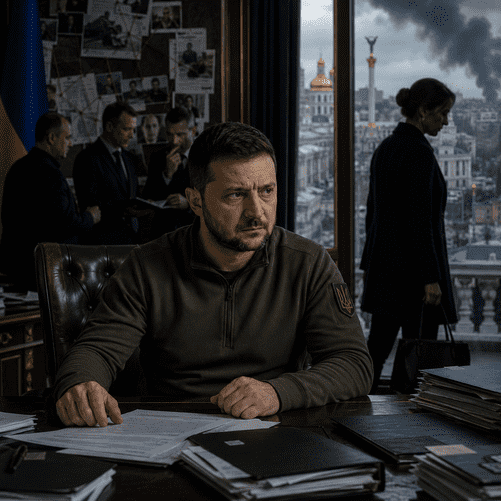
The dismissal of presidential deputy chief of staff Iryna Mudra comes as anti-graft investigators probe senior officials and former defence minister Mykhailo Fedorov openly challenges Ukraine’s wartime political order.

Ukrainian President Volodymyr Zelenskyy has dismissed one of the most senior officials in his presidential administration as a widening corruption investigation intensifies political pressure on the government and fuels an increasingly public debate over leadership, accountability and elections during wartime.
Zelenskyy removed Iryna Mudra, deputy head of the Office of the President, by presidential decree on Wednesday, August 19. The decree provided no explanation for her dismissal. Her office had reportedly been searched by anti-corruption investigators earlier in the day, although authorities have not publicly identified Mudra as a suspect.
The move comes as Ukraine’s National Anti-Corruption Bureau and Specialised Anti-Corruption Prosecutor’s Office investigate an alleged money-laundering operation involving senior political figures and officials connected with a state-owned bank. Investigators say the group handled roughly $3.4 million in illicit funds, with the case linked to a broader corruption investigation that has already shaken Ukraine’s political establishment.
The timing is particularly sensitive for Zelenskyy. Only a day earlier, former defence minister Mykhailo Fedorov, once one of the president’s most prominent political allies, issued a striking public challenge to the government by calling for elections despite the continuation of martial law and Russia’s full-scale war against Ukraine.
Fedorov described Ukraine as facing what he characterised as a systemic crisis of governance and argued that democratic institutions could not remain indefinitely suspended by the war. His intervention represents one of the most significant challenges to Zelenskyy from within the political generation that emerged after the president’s 2019 election victory.
The former minister’s comments have reopened one of Ukraine’s most difficult political questions: when, and under what conditions, national elections should resume.
Ukraine has not held a presidential election since the introduction of martial law following Russia’s invasion in February 2022. Organising a national vote while millions of citizens are displaced, soldiers are deployed along the front and large parts of the country remain vulnerable to missile and drone attacks would present enormous logistical and security challenges. Polling cited in recent reporting also suggests substantial public opposition to holding an election while the war continues.
Nevertheless, the corruption investigations have made the debate increasingly difficult for the government to contain.
Mudra’s departure follows a series of scandals involving current and former officials close to the presidential administration. Earlier investigations have reached figures connected with the energy sector and the state-owned nuclear company Energoatom, while former presidential chief of staff Andriy Yermak has also faced legal scrutiny in a separate money-laundering investigation.
For Zelenskyy, corruption has always carried consequences far beyond domestic politics. Ukraine’s Western partners have provided enormous military and financial assistance since Russia’s invasion, while Kyiv continues to pursue membership of the European Union. Both objectives depend heavily on the government demonstrating that institutions responsible for public procurement, justice and state finances are capable of resisting political interference and large-scale graft.
That makes the independence of Ukraine’s anti-corruption agencies particularly significant. The fact that investigators have continued examining senior figures inside the presidential administration can be interpreted as evidence that the institutions created to combat corruption are functioning. At the same time, the growing number of cases involving individuals close to the centre of power risks damaging the administration’s political credibility.
Zelenskyy now faces a delicate balancing act.
Moving quickly against officials implicated in investigations could reinforce his argument that no individual is protected from scrutiny. But repeated dismissals of senior figures can also create an impression of instability at a moment when Ukraine remains engaged in an existential military confrontation with Russia.
The political consequences are already becoming visible. Fedorov’s transformation from senior government minister into outspoken critic suggests that Ukraine’s wartime political consensus is beginning to fracture. His call for elections may not immediately lead to a vote, but it establishes a potential rallying point for officials, activists and voters who believe the concentration of wartime authority should face renewed democratic scrutiny.
Meanwhile, Zelenskyy has continued reshaping his national-security team. Parliament has approved Maj. Gen. Yevhenii Khmara as defence minister, replacing Fedorov, while Andrii Sybiha remains foreign minister. Khmara’s appointment reinforces the administration’s focus on battlefield effectiveness and long-range operations against Russian military infrastructure, but the leadership changes have also contributed to questions about political stability inside Kyiv.
Ukraine therefore enters a potentially important new phase of the war: military pressure from Russia remains intense, but the political pressures confronting the government are increasingly coming from within.
The dismissal of Mudra alone may prove to be a limited personnel decision. Taken together with the widening anti-corruption investigations, the removal of other senior officials and Fedorov’s extraordinary intervention, however, it points to a broader struggle over how Ukraine should be governed after more than four years of full-scale war.
For Zelenskyy, the immediate challenge is no longer simply demonstrating that Ukraine can continue resisting Russia. It is also convincing Ukrainians — and the country’s international partners — that wartime authority can coexist with institutional accountability, political legitimacy and meaningful democratic oversight.