Lee Cheuk-yan and Chow Hang-tung face up to a decade in prison as Britain and European governments criticise the application of Beijing’s national security law to peaceful political expression.

A Hong Kong court has convicted two prominent pro-democracy activists of inciting subversion over their leadership of the organisation that for decades held the city’s annual candlelight vigil commemorating the 1989 Tiananmen Square crackdown, in a judgment that has drawn renewed international scrutiny of Hong Kong’s national security regime.
Lee Cheuk-yan, 69, a veteran labour activist and former legislator, and human-rights lawyer Chow Hang-tung, 41, were found guilty on Friday, August 21, under the national security law imposed on Hong Kong by Beijing in 2020. Both have been detained since 2021 and face sentences of up to 10 years in prison. The now-disbanded Hong Kong Alliance in Support of Patriotic Democratic Movements of China was also convicted. A third former Alliance leader, Albert Ho, pleaded guilty to the same charge earlier this year.
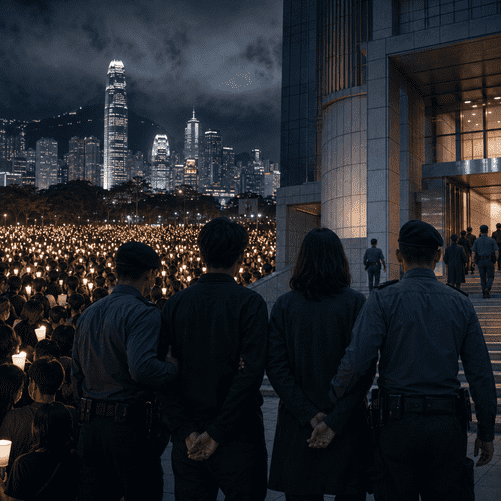
For more than three decades, the Alliance organised mass gatherings in Victoria Park every June 4 to remember those killed when Chinese troops moved against pro-democracy protesters in and around Beijing’s Tiananmen Square in 1989. The events became one of Hong Kong’s most recognisable political traditions and, for many years, represented a rare large-scale public commemoration of the crackdown on Chinese-controlled territory.
The prosecution, however, focused not simply on the vigils themselves but on the Alliance’s longstanding political objective of calling for an end to what it described as “one-party dictatorship” in China. A panel of three national security judges concluded that Lee and Chow had sought to encourage others to undermine the fundamental political system established under China’s constitution and the leadership of the Chinese Communist Party.
Hong Kong authorities strongly defended the verdict. Chief Executive John Lee said the defendants had attempted over a prolonged period to foster hostility toward the Communist Party and China’s central government, describing the conduct as a threat to national security. The Hong Kong government also rejected criticism that the prosecution represented an attack on legitimate rights, saying national-security offences would be pursued according to law and that freedoms could not be used as a justification for acts intended to subvert state power.
The defendants had argued that their advocacy represented peaceful political expression rather than an attempt to overthrow the state. Chow, who represented herself during parts of the proceedings, challenged the prosecution’s interpretation of democratic advocacy, while the court ultimately concluded that the methods envisioned by the Alliance did not need to involve violence to fall within the scope of the national security legislation.
The judgment prompted immediate criticism abroad. Britain’s minister for the Indo-Pacific, Rosie Winterton, said the verdict showed that even peaceful acts of remembrance were now being treated in Hong Kong as national-security threats. The British government argued that the extensive use of the security law against peaceful expression undermined commitments China made under the 1984 Sino-British Joint Declaration, which established the framework for Hong Kong’s 1997 handover. London reiterated its call for the national security law to be repealed and for Hong Kong’s rights and freedoms to be respected.
France and Germany also criticised the convictions and called for Chow’s release, while the European Union said the proceedings reflected a continuing deterioration of freedom of expression, freedom of assembly and the space available for independent civil society in Hong Kong.
The case is among the most symbolically significant prosecutions brought under the national security law since Beijing introduced it following the vast anti-government demonstrations that shook Hong Kong in 2019. The legislation criminalises secession, subversion, terrorism and collusion with foreign forces, and has transformed the territory’s political environment. Many leading opposition figures have subsequently been imprisoned, prosecuted or left Hong Kong, while numerous civil-society organisations and independent media groups have closed.
Public remembrance of Tiananmen has undergone a similar transformation. Authorities initially prohibited the Victoria Park vigil in 2020 and 2021 while citing pandemic restrictions. In subsequent years, large-scale commemorations disappeared as the national security framework expanded, effectively ending a tradition that had attracted tens of thousands of participants at its height.
For Beijing and Hong Kong’s government, the case illustrates the principle that political activity cannot cross legal boundaries established to protect the Chinese state and its constitutional order. For critics of the national security system, however, the verdict demonstrates how the definition of subversion has expanded to encompass forms of political advocacy that were previously tolerated under Hong Kong’s more open civic environment.
That divide lies at the heart of the wider international debate over the future of “one country, two systems,” the arrangement under which Hong Kong was promised a high degree of autonomy and a distinct legal and economic system following the end of British rule.
The convictions of Lee and Chow are particularly significant because the Tiananmen vigil was never merely another opposition demonstration. Over three decades it became an institution of Hong Kong public life, combining political protest with collective remembrance of an event that remains highly sensitive in mainland China.
Its organisers now face some of the most serious penalties available under Hong Kong’s national security framework.
The court has adjourned proceedings until August 28 for mitigation arguments ahead of sentencing. Whatever prison terms eventually emerge, Friday’s judgment marks another decisive moment in Hong Kong’s political transformation — one in which the boundaries between historical remembrance, democratic advocacy and national security are being defined very differently from the city that existed before 2020.