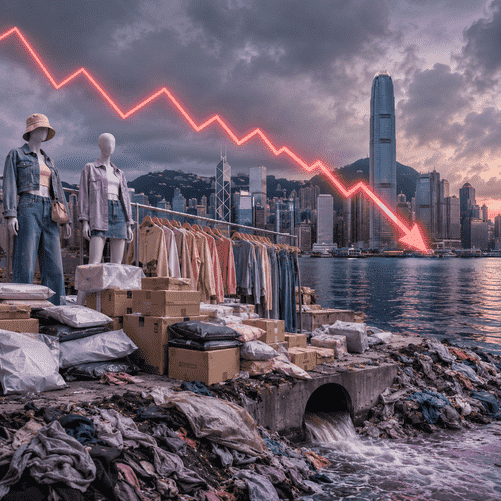
Fast-fashion powerhouse prepares for a sharply discounted market debut as slowing growth, trade barriers and mounting environmental scrutiny reshape investor expectations

Fast-fashion giant Shein is preparing to make its long-awaited stock-market debut in Hong Kong with a valuation of about $27 billion, marking a dramatic retreat from the near-$100 billion price tag the company commanded at the height of its global expansion just four years ago.
The Singapore-headquartered retailer, which was founded in China and built its international dominance around an extraordinarily rapid, data-driven fashion supply chain, launched its Hong Kong initial public offering on Monday. Shein plans to sell about 280 million shares at between HK$47.60 and HK$49.50 each, potentially raising as much as HK$13.86 billion, or roughly $1.77 billion. Trading is expected to begin on September 1.
At the upper end of the price range, Shein would be valued at close to $27 billion — roughly 70 per cent below the $98.2 billion valuation achieved during a private fundraising round in 2022. The reduction illustrates how dramatically investor perceptions of the company have shifted as its once-explosive growth encounters tougher regulation, higher trade costs and intensifying competition.
The IPO nevertheless represents an important milestone for a company that has spent years attempting to gain access to public markets. Shein initially explored a New York listing before turning its attention to London, but both routes became complicated by political and regulatory scrutiny surrounding the company’s supply chain, corporate governance and sourcing practices. Hong Kong eventually emerged as the destination for what remains one of the most closely watched consumer listings of recent years.
The financial picture disclosed ahead of the offering has also made the investment case more challenging. Shein recorded a $99 million net loss during the first quarter of 2026, compared with a $395 million profit during the same period a year earlier. Quarterly revenue rose only modestly, by about 1.1 per cent, to approximately $9.05 billion.
For the full year 2025, revenue increased to roughly $41.9 billion from $38.8 billion in 2024, but net profit fell sharply to about $2 billion. The figures suggest that while Shein remains an enormous global retail platform, its extraordinary expansion phase may be giving way to a more difficult period in which maintaining margins becomes as important as generating sales growth.
Part of that pressure comes from changes to international trade rules. Shein’s model has historically benefited from shipping vast quantities of inexpensive individual parcels directly to consumers. The removal of the United States’ duty exemption for low-value packages has increased costs and disrupted one of the company’s most important markets. The European Union has also introduced additional charges on low-value e-commerce imports, adding another layer of pressure to the economics of cross-border fast fashion.
There are broader structural questions too. Shein’s extraordinary success has depended on using real-time consumer data to identify trends, order extremely small initial production runs and rapidly scale successful products. The strategy dramatically shortened traditional fashion cycles and enabled the company to offer thousands of new products at prices often substantially below established retailers.
But the same model has placed Shein at the centre of an increasingly intense debate about the environmental cost of ultra-fast fashion. Critics argue that continuously introducing huge numbers of low-cost garments encourages disposable consumption, generates textile waste and increases emissions across manufacturing and logistics networks.
Environmental concerns are intertwined with wider scrutiny of Shein’s supply chain. Regulators, lawmakers and campaign groups have repeatedly questioned labour conditions among suppliers and the traceability of raw materials, including allegations relating to cotton sourced from China’s Xinjiang region. Shein has said it maintains supplier standards and auditing programmes, but such issues have followed the company through its repeated attempts to secure a major Western stock-market listing.
Competition has meanwhile become more intense. Chinese e-commerce platform Temu has expanded aggressively in many of the same international markets, while established fashion groups such as Inditex, owner of Zara, continue investing heavily in digital retail and faster supply chains.
For potential shareholders, Shein’s significantly reduced valuation therefore presents two competing interpretations. It could represent a more realistic entry point into one of the world’s largest online fashion businesses, whose global brand recognition, vast customer base and sophisticated supply network remain formidable assets.
Alternatively, the discount may reflect a deeper reassessment of how profitable the ultra-fast-fashion model can remain once tariffs, environmental rules, labour oversight and logistics costs are fully incorporated into its economics.
Europe will be particularly important. The region accounted for roughly one-third of Shein’s net revenue during 2025 and the first quarter of 2026, making it increasingly central as conditions in the United States become more difficult. Shein has also experimented with extending its digital business into physical retail, including opening a permanent outlet in Paris in late 2025.
The Hong Kong flotation will therefore be more than a fundraising exercise. It will provide one of the clearest public-market tests yet of whether investors believe Shein can evolve from a disruptive, hyper-growth e-commerce phenomenon into a mature global retailer capable of producing sustainable profits while navigating increasingly demanding regulatory and environmental expectations.
A company that once appeared capable of approaching a $100 billion valuation will soon discover what public investors believe it is actually worth. At roughly $27 billion, the answer is considerably lower than Shein once hoped — but the IPO will finally give the market the opportunity to decide for itself.