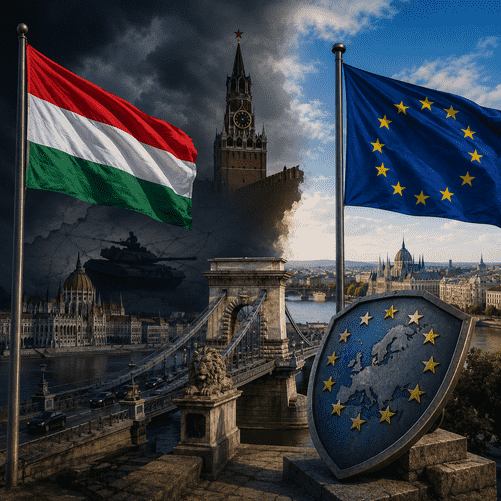
Péter Magyar’s new government has formally described Russia as a danger to Hungary, Europe and the international order, marking one of the clearest foreign-policy reversals since the end of Viktor Orbán’s long premiership.

Hungary has formally classified Russia’s behavior as a threat to the country’s security, Europe and the wider international order, signaling a sharp departure from the Moscow-friendly course that defined much of Viktor Orbán’s time in power.
The new position appears in official guidelines prepared for the Hungarian delegation attending the 81st session of the United Nations General Assembly in September. The document was signed by Prime Minister Péter Magyar and published in Hungary’s official gazette on August 25.
The language is unusually direct. Hungary condemns Russia’s military aggression against Ukraine, expresses full support for Ukrainian sovereignty and territorial integrity within its internationally recognized borders, and recognizes Kyiv’s right to self-defense. The document then states that Russia’s conduct constitutes a threat not only to Hungary, but also to Europe and the global order.
For Budapest, the wording represents far more than a diplomatic adjustment.
Under Orbán, Hungary spent years positioning itself as the European Union member most willing to maintain political and economic relations with Moscow despite Russia’s full-scale invasion of Ukraine. Orbán repeatedly criticized EU sanctions, resisted some forms of military and financial assistance for Kyiv and presented himself as an advocate of immediate negotiations with the Kremlin.
That posture frequently placed Hungary at odds with Brussels, Warsaw and the Baltic states and made Budapest one of the most unpredictable actors inside both the EU and NATO.
Magyar’s government, which took office in May, is now dismantling significant elements of that foreign-policy legacy.
The change is particularly striking because Hungary shares a border with Ukraine and has long portrayed the status of the ethnic Hungarian minority in Ukraine’s Transcarpathia region as a central foreign-policy concern. Under Orbán, disputes over minority-language and education rights repeatedly strained relations between Budapest and Kyiv.
The new government has moved to resolve many of those bilateral disputes while simultaneously adopting a much clearer position on Russian aggression. According to the government guidelines, Moscow’s actions also place the Hungarian minority in the Carpathian region in serious danger.
This does not mean Budapest has abandoned diplomacy.
The document emphasizes that Hungary supports efforts aimed at securing negotiations that can produce a sustainable peace and long-term security guarantees for Ukraine. But the distinction is important: while Orbán frequently framed the war in ways that blurred responsibility between Russia, Ukraine and the West, the new government explicitly identifies Russia as the aggressor and Ukraine as a sovereign state exercising its right to defend itself.
That change could have significant consequences inside the European Union.
For years, Hungarian opposition complicated attempts to maintain a unified European response to Moscow. Orbán’s government delayed or threatened to block sanctions packages and assistance programs, forcing other European capitals into repeated negotiations with Budapest.
Earlier this year, EU leaders sharply criticized Orbán after Hungary obstructed a proposed €90 billion support package for Ukraine, accusing his government of damaging the Union’s unity and credibility.
With Magyar in office, that dynamic may change substantially.
A Hungary more closely aligned with the EU mainstream on Russia would remove one of the Kremlin’s most important sources of political leverage inside the bloc. Decisions over sanctions, financial support for Ukraine and European security policy could become easier to coordinate if Budapest no longer routinely threatens to exercise its veto.
For Kyiv, the shift is equally important.
Hungary’s geographic position gives it strategic relevance as a neighboring NATO and EU member, while its previous disputes with Ukraine created recurring obstacles to deeper cooperation. A more constructive relationship could therefore strengthen Ukraine’s diplomatic position in Europe even if Budapest continues to advocate negotiations rather than an open-ended military strategy.
The symbolism is also difficult to overlook.
For more than a decade, Orbán cultivated a distinctive model of foreign policy based on what he described as pragmatic relations with both East and West. Hungary remained formally anchored inside NATO and the EU while simultaneously developing unusually close relations with Russia and China.
Moscow was particularly important. Hungary maintained substantial dependence on Russian energy and pursued major projects involving Russian companies, including the expansion of the Paks nuclear power plant. Orbán also continued meeting Russian President Vladimir Putin after many European leaders sharply reduced their contacts with the Kremlin.
Those relationships helped create the impression that Budapest was Moscow’s most sympathetic government within the European Union.
Magyar’s new policy challenges that assumption.
By officially identifying Russian behavior as a threat to Hungary itself, the government is no longer treating the war in Ukraine as primarily a conflict taking place beyond Hungary’s immediate national interests. Instead, it is connecting Russia’s conduct directly to Hungarian security.
That rhetorical shift could eventually influence defense planning, intelligence cooperation and energy policy as well as diplomacy.
The question now is how far the Magyar government intends to carry the change.
Declaring Russia a threat is politically significant, but Hungary remains economically connected to Moscow in areas that cannot be transformed overnight. Russian oil and gas have historically played an important role in the Hungarian economy, and major infrastructure projects create long-term dependencies.
A complete strategic reorientation would therefore require more than new diplomatic language. Budapest would need to accelerate energy diversification, deepen security cooperation with European allies and decide how aggressively it is prepared to support future sanctions against Moscow.
There is also a domestic political dimension.
Orbán’s approach to Russia was deeply integrated into his broader political narrative. His governments frequently argued that Hungary should resist pressure from Brussels, preserve independent relations with Moscow and avoid being dragged into what he portrayed as an increasingly dangerous confrontation between Russia and the West.
Magyar is effectively offering a different interpretation of Hungarian sovereignty: that national independence is best protected not by maintaining privileged relations with Moscow, but by reinforcing Hungary’s position inside the European and transatlantic security system.
That distinction could become one of the defining ideological divides in Hungarian politics after Orbán.
The new government’s position also carries wider implications for Central Europe.
Since Russia’s invasion began in February 2022, Poland, the Czech Republic, the Baltic states and several Nordic countries have adopted increasingly hard-line assessments of Moscow as a long-term strategic threat. Hungary remained the major exception.
Budapest’s reversal therefore narrows one of the most visible fractures inside the region.
For Russia, the development represents an uncomfortable geopolitical loss. Orbán’s Hungary provided the Kremlin with something increasingly rare in Europe: a government inside both NATO and the EU willing to publicly challenge the dominant Western interpretation of the war.
If Magyar maintains his new course, Moscow will have lost not merely a sympathetic government, but an important political bridge into European institutions.
For the European Union, the implications could be equally profound.
Hungary has not suddenly become one of Europe’s most hawkish states, and Budapest is still calling for negotiations and a sustainable peace. But the fundamental premise underlying its policy has changed.
Russia is no longer being treated simply as a difficult partner with whom Hungary must continue doing business.
It is now officially being described as a threat.
That single word marks one of the clearest indications yet that post-Orbán Hungary may be preparing to redefine its place in Europe — and that Moscow’s political influence in Central Europe could be entering a significantly more difficult period.