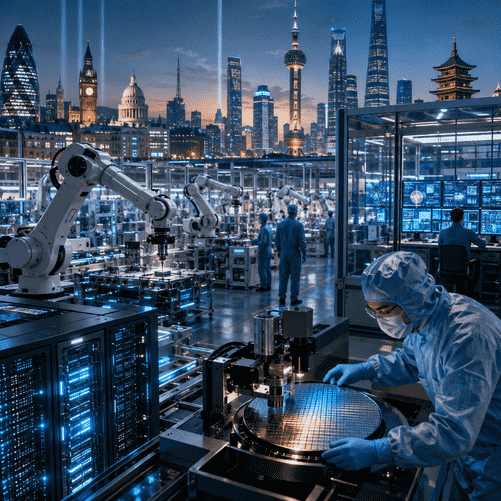
Semiconductors, data-centre investment and artificial-intelligence hardware are helping factories from South Korea to Germany expand, even as trade tensions and the Iran conflict complicate the outlook.

The global manufacturing economy entered September with an unexpectedly strong pulse, driven in large part by one of the defining investment themes of the decade: artificial intelligence. Factory surveys for August showed expansion across several of Asia’s most important industrial economies and the fastest manufacturing growth in the eurozone in more than four years, suggesting that the technology investment cycle is beginning to influence the wider industrial system.
The strongest common denominator is demand for semiconductors, servers, memory chips, cooling systems, electrical equipment and the extensive infrastructure required to build and operate increasingly powerful AI systems.
In Asia, the acceleration was particularly visible. Private-sector manufacturing data showed China returning to expansion, while Japan and South Korea recorded stronger factory activity. South Korea, deeply embedded in the global semiconductor supply chain, has been one of the clearest beneficiaries of the AI investment boom. Its manufacturing purchasing managers’ index remained above the threshold separating expansion from contraction, while exports showed exceptional year-on-year growth.
The transformation taking place is broader than the production of sophisticated processors themselves. Modern AI infrastructure requires high-bandwidth memory, networking equipment, advanced substrates, power-management systems, cooling technology, transformers and enormous quantities of electricity. Each new generation of data centres therefore generates orders across a surprisingly wide industrial ecosystem.
Japan has also benefited. Its manufacturing PMI rose sharply during August, according to the latest survey data, helped by renewed demand for electronic components and capital equipment. China presented a more complicated picture: the private-sector S&P Global survey pointed to expansion, while the official Chinese indicator remained weaker. That divergence suggests that some export-oriented and technology-linked manufacturers are performing considerably better than sectors tied to domestic property and traditional heavy industry.
Europe’s rebound is particularly significant because the continent has endured several difficult years of industrial weakness. High energy costs following Russia’s invasion of Ukraine, weaker Chinese demand, rising competition from Chinese manufacturers and tighter monetary policy all weighed heavily on European factories.
August therefore offered a notable reversal.
Eurozone manufacturing activity expanded at its fastest pace in more than four years, according to the latest purchasing managers’ surveys. Germany and France helped drive the improvement, although Italy and Spain remained weaker. Britain also reported stronger factory employment despite a modest slowdown in overall activity.
The improvement does not mean Europe’s industrial problems have disappeared. German manufacturers continue to face structural challenges in sectors such as automobiles, chemicals and machinery. Chinese competitors are increasingly formidable in electric vehicles, batteries, solar technology and industrial equipment. A major shift in Chinese exports toward Europe has already created concern among European manufacturers that goods previously destined for the American market are being redirected elsewhere following higher U.S. tariffs.
That phenomenon could intensify.
China possesses enormous manufacturing capacity, while domestic consumption remains comparatively weak. Companies unable to sell their full production internally must find foreign buyers, creating downward price pressure internationally. European consumers may benefit from cheaper goods, but European manufacturers can face significant competitive stress.
Trade policy is consequently becoming inseparable from industrial strategy.
Brussels has already moved toward a more defensive stance in sectors including electric vehicles, batteries and strategic technology. Policymakers increasingly argue that Europe must preserve manufacturing capacity in industries considered essential for economic resilience and national security.
At the same time, the AI investment boom presents Europe with an opportunity. The continent remains home to world-leading industrial automation, electrical engineering, semiconductor equipment and precision-manufacturing companies. Even where European firms do not design the world’s leading AI models, they may supply critical components of the physical infrastructure supporting them.
There is, however, another important variable: energy.
The renewed U.S.-Iran conflict has again highlighted the vulnerability of global industrial supply chains to disruptions in the Middle East. With shipping through the Strait of Hormuz severely constrained, oil prices and transportation risks have risen. European industry remains particularly sensitive to energy costs, meaning a prolonged regional conflict could weaken the very manufacturing recovery now visible in the data.
Central banks are watching these forces carefully.
The European Central Bank has repeatedly emphasized that its objective is to stabilise inflation around 2% over the medium term and that interest-rate decisions remain dependent on incoming economic data. A manufacturing recovery could strengthen growth, but a renewed energy shock could simultaneously raise inflation.
That combination would be uncomfortable for policymakers.
Asia faces a different balance of risks. Its technology exporters are benefiting enormously from AI investment, but many economies remain dependent on external demand. A slowdown in the United States or escalation in global trade restrictions could therefore quickly affect factory orders.
China represents the biggest uncertainty. Strong technology manufacturing sits alongside persistent weakness in property and domestic consumption. Beijing has attempted to shift economic activity toward advanced manufacturing, green technology and strategic industries, but this strategy also increases China’s dependence on exports.
The latest data nevertheless underline an important development: AI is no longer merely a software-sector story.
It is becoming an industrial cycle.
Semiconductor fabrication plants must be expanded. Power grids must be reinforced. Data centres require cooling equipment, cables and transformers. Cloud companies need vast quantities of storage and networking hardware. Countries seeking sovereign AI capabilities need domestic computing infrastructure.
That investment is flowing into factories.
The question is whether this industrial boost can become durable enough to offset the forces pulling in the opposite direction: trade fragmentation, geopolitical conflict, weaker consumer demand and increasingly expensive energy.
For the moment, the world’s factories have entered September with considerably more momentum than many economists expected.