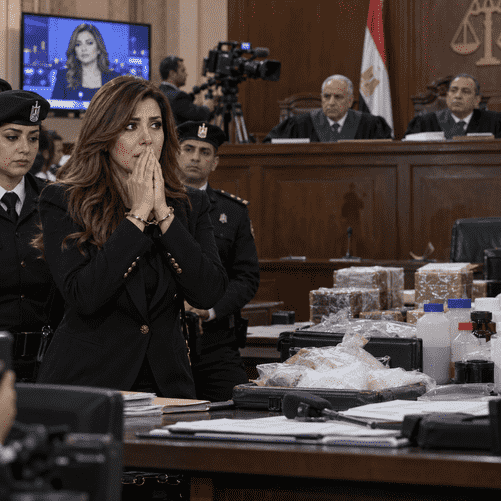
Cairo court sentences the presenter and 11 co-defendants to death over an alleged synthetic-drug operation involving clandestine laboratories, imported chemicals and more than 750 kilograms of narcotics and raw materials.

Egyptian television presenter Sarah Khalifa has been sentenced to death alongside 11 other defendants after a Cairo court convicted them in a major narcotics case involving the manufacture and trafficking of synthetic drugs.
Khalifa, 39, a prominent media personality best known for presenting the television programme Mission Impossible, which focused on crime and security issues, was sentenced to death by hanging on Saturday, September 5. The ruling remains subject to appeal.
The case has attracted considerable attention in Egypt because of Khalifa’s public profile and the scale of the alleged criminal operation described by prosecutors.
According to Egyptian state-linked media, the defendants were accused of establishing an organised criminal network dedicated to obtaining chemical ingredients used to manufacture narcotics, producing synthetic drugs and subsequently distributing them for profit.
Investigators alleged that raw materials used in the manufacturing process had been imported from abroad and transported to locations inside Egypt where they were processed before the finished narcotics were distributed.
Authorities reportedly seized more than 750 kilograms of drugs and chemical raw materials during the investigation. Two residential apartments were allegedly converted into clandestine drug laboratories, while investigators also recovered unlicensed firearms and ammunition.
The scale of the seizures helped turn the prosecution into one of Egypt’s most closely watched recent narcotics cases.
Egyptian prosecutors previously alleged that the wider organisation divided responsibilities between members involved in importing precursor materials, manufacturing synthetic narcotics and distributing the drugs. Investigators said evidence collected during the inquiry included witness testimony and material gathered from searches and forensic examinations.
Authorities also took steps to identify and freeze assets linked to some defendants, examine bank accounts and impose travel restrictions on suspects who were not in custody.
Khalifa has denied involvement in the drug operation.
According to reporting from the courtroom, she reacted emotionally to the verdict and maintained her innocence after the sentence was announced. Her defence has challenged the prosecution’s allegations, and the judgment can now move through Egypt’s appeals process.
Before Saturday’s final ruling, the Cairo Criminal Court had referred the cases of defendants facing capital punishment to Egypt’s Grand Mufti.
Such referrals are a mandatory procedural step before an Egyptian criminal court can formally issue a death sentence. The Grand Mufti provides a religious opinion on the proposed punishment, although the opinion is advisory and does not legally bind the court.
Once that process had been completed, the court reconvened on September 5 and formally imposed the death sentences.
The convictions include allegations not only of manufacturing and trafficking narcotics but also of possessing and carrying firearms and ammunition without licences.
From television personality to defendant in a major criminal trial
Khalifa had established a diverse public and business profile before becoming embroiled in the investigation.
She became known to Egyptian audiences through Mission Impossible, a programme dealing with crime and security-related subjects, an association that has added an unusual dimension to the case given the nature of the charges against her.
Outside broadcasting, she has also been involved in private business ventures, including a cosmetic or plastic-surgery clinic and a production company specialising in entertainment events and parties.
Her celebrity status has consequently ensured that proceedings have received extensive coverage in Egyptian and international media.
But behind the public attention surrounding Khalifa lies a significantly broader prosecution involving dozens of defendants and allegations of an industrial-scale drug manufacturing network.
Earlier court proceedings indicated that prosecutors were examining the activities of 28 defendants accused of participating in a transnational organised crime group responsible for importing substances required to manufacture synthetic drugs.
Prosecutors argued that the organisation operated through a structured system in which individuals were assigned specialised roles.
Some defendants were allegedly responsible for obtaining ingredients overseas, while others handled production, storage or distribution inside Egypt. A residential building was reportedly used for preparing and mixing narcotics before they entered the domestic market.
The prosecution described the alleged scheme as a profit-driven criminal enterprise with serious consequences for public health.
Separate kidnapping and assault conviction
Khalifa’s legal difficulties extend beyond the narcotics prosecution.
The court also sentenced her and other defendants to five years in prison in a separate case involving the kidnapping and assault of a young man.
That conviction adds another layer to an already complex legal case that has transformed Khalifa from a familiar television figure into one of the most prominent defendants currently facing capital punishment in Egypt.
The drug-trafficking conviction, however, carries by far the most serious consequences.
Egyptian law permits capital punishment for several categories of offences, including premeditated murder, certain terrorism-related crimes, some rape offences and serious drug trafficking.
Drug crimes are treated particularly harshly when prosecutors establish large-scale manufacturing, organised trafficking or involvement in criminal organisations.
The country’s continued use of capital punishment has repeatedly attracted criticism from international human-rights organisations, which have called for restrictions or a moratorium on executions and raised concerns about the number of death sentences issued by Egyptian courts.
According to the Egyptian Commission for Rights and Freedoms, Egyptian courts issued 541 death sentences during 2025.
A death sentence, however, does not necessarily mean execution is imminent.
Defendants retain the right to challenge their convictions and sentences through Egypt’s judicial appeals system, and Khalifa’s case is expected to continue through that process.
The distinction is especially important given the intense public attention surrounding the case. Saturday’s ruling represents the criminal court’s judgment, rather than the final exhaustion of all available legal remedies.
A case that has gripped Egyptian media
The proceedings have become a striking intersection between celebrity culture, organised crime allegations and Egypt’s severe narcotics laws.
Khalifa’s background as the presenter of a programme associated with crime and security has inevitably heightened public interest, while the alleged scale of the operation has ensured that the case extends far beyond the circumstances of a single television personality.
More than 750 kilograms of narcotics and precursor substances, two alleged manufacturing laboratories and allegations involving imported materials suggest the kind of organised production network Egyptian authorities have increasingly sought to dismantle.
For prosecutors, the case represents an extensive organised-crime investigation targeting the entire supply chain behind synthetic drug production.
For Khalifa and the other defendants sentenced to death, attention will now turn to the appeals process.
Until those legal avenues have been exhausted, the dramatic judgment delivered in Cairo marks a critical stage rather than necessarily the conclusion of the case.
Yet whatever the eventual outcome, the transformation of one of Egypt’s recognisable television personalities from presenter to death-row defendant has already made the prosecution one of the country’s most extraordinary criminal cases of recent years.