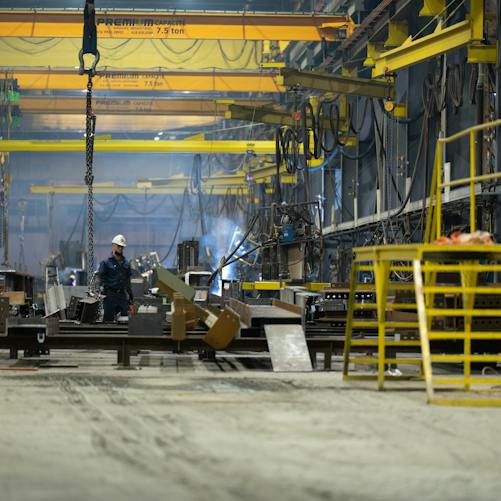
China’s August data have exposed an increasingly stark split inside the world’s second-largest economy: factories linked to advanced manufacturing and global technology demand are accelerating, while households remain cautious, investment is contracting and the property downturn continues to suppress confidence. Industrial output rose 5.2% from a year earlier in August, but retail sales increased only 0.4%, fixed-asset investment fell 7.2% over the first eight months, and real-estate investment dropped 19.9%. The result is an economy still growing, but with momentum concentrated in production, exports and technology rather than the broad domestic demand Beijing has spent years trying to strengthen.

A recovery that is becoming more uneven
The headline figures released by China’s National Bureau of Statistics on September 15 presented two very different pictures of economic activity. On the supply side, industrial production strengthened after a softer July, with output at large industrial companies rising 5.2% year on year and 0.54% from the previous month. Manufacturing itself expanded 6.1%, while equipment manufacturing grew 12.1% and high-tech manufacturing surged 16.7%. Production of lithium-ion batteries rose 57.2% from a year earlier, industrial robot output increased 34.6% and 3D-printing equipment climbed 29.9%. Those are the kinds of numbers Beijing can point to as evidence that its long campaign to move China up the technological value chain is producing tangible results.
The demand side looked far weaker. Retail sales, one of the most closely watched gauges of household spending, rose just 0.4% in August from a year earlier, slower than July’s 0.6% increase and below the 0.8% gain economists polled by Reuters had expected. On a seasonally adjusted monthly basis, retail sales slipped 0.13%. For the first eight months of 2026, total consumer-goods retail sales were up only 1.1%. Even that modest increase concealed a sharp divide between categories. Sales excluding automobiles grew 2.5% in August, while communication equipment sales at larger retailers climbed 27.3%. By contrast, department stores, specialty shops and brand-exclusive stores were all down over the January-to-August period, with brand-exclusive outlets falling 10%.
That divergence matters because China’s central economic challenge is no longer simply whether it can produce sophisticated goods. It is whether the income, confidence and spending power of households can expand fast enough to absorb more of what the country produces and to reduce dependence on property investment and foreign demand. Beijing has repeatedly described stronger domestic consumption as an objective, but August’s numbers suggest the transition remains incomplete. Technology is creating growth islands inside the industrial economy, yet those gains are not spreading evenly enough to revive broad consumer activity or persuade households to borrow aggressively again.
Technology is carrying more of the industrial load
The strongest element in the August report was the performance of industries tied to automation, electrification and artificial-intelligence infrastructure. China’s policy framework has for years channelled capital toward semiconductors, batteries, robotics, electric vehicles, data infrastructure and advanced machinery. That strategy has become even more important as the property model that powered growth for much of the previous two decades has weakened. Instead of relying on apartment construction, land sales and household leverage, policymakers are trying to build an economy in which higher-value manufacturing, research, software and exportable technology provide the next major engine of expansion.
The latest data indicate that the industrial part of that shift is functioning. High-tech manufacturing grew more than three times as fast as total industrial output in August, while equipment manufacturing expanded by more than double the overall industrial rate. Investment in high-tech industries also rose 5.2% during the first eight months even as aggregate fixed-asset investment contracted sharply. China is therefore not experiencing a uniform investment collapse. Capital is being redistributed toward the sectors Beijing considers strategically important, while property, parts of traditional manufacturing and weaker regions absorb much of the contraction.
This pattern has significant implications beyond China. Stronger output of batteries, robots, electric vehicles and other advanced industrial products increases the supply of goods in sectors where European, Japanese, South Korean and American companies are also competing for market share. It can lower global equipment costs and accelerate the deployment of clean energy and automation. At the same time, it intensifies trade tensions because foreign governments increasingly worry that weak demand inside China is encouraging companies to push excess capacity into overseas markets. The more domestic spending lags industrial production, the more important exports become as an outlet for Chinese factories.
Exports are cushioning domestic weakness
China’s August trade data underline that external demand is already playing that cushioning role. Customs figures released earlier this month showed exports rising 25% year on year in U.S. dollar terms, while imports increased 28.2%. The monthly trade surplus reached $119.09 billion. High-tech exports were among the strongest components, supported by overseas demand for autos, semiconductors and products linked to artificial-intelligence investment. The resilience of trade means China has been able to maintain factory utilisation and industrial employment even while domestic consumption remains subdued.
For Beijing, that is both a source of strength and a source of vulnerability. Export demand provides growth without requiring households to take on more debt, and China’s manufacturing ecosystem has proved capable of serving fast-growing global markets. But foreign demand is not entirely within China’s control. Tariffs, anti-subsidy investigations, geopolitical restrictions and efforts by other countries to build local supply chains can all limit access. The United States and European Union have already placed trade barriers on selected Chinese products, while other economies are examining safeguards of their own. A growth model that leans more heavily on exports therefore becomes increasingly exposed to political decisions abroad.
The scale of the imbalance is also beginning to shape international economic diplomacy. China’s trade surplus is on course to remain historically large, and policymakers in Europe and elsewhere argue that stronger Chinese household demand would create more room for imports while reducing pressure on overseas manufacturers. Chinese officials counter that their competitiveness reflects investment, infrastructure and industrial efficiency rather than simply weak domestic demand. Both arguments can be true at once: China has built extraordinarily competitive supply chains, but the domestic economy is also failing to generate consumption at a rate comparable with the expansion of productive capacity.
Consumption remains the missing link
The August retail numbers show why household demand remains the weakest link in the rebalancing effort. Consumer spending is not collapsing, and several categories continue to grow. Rural retail sales rose 1.6% in August, compared with a 0.2% increase in urban areas. Catering revenue increased 1.1%, while sales of beverages and staple foods also advanced. Online retail sales of goods and services rose 4.6% over the first eight months, with services outperforming physical goods. Yet these pockets of strength are not enough to produce the kind of broad acceleration that would materially shift the economy away from manufacturing and investment.
Households face several reasons to remain cautious. The property downturn has reduced confidence in what was long the most important store of wealth for the Chinese middle class. Labour-market uncertainty encourages higher savings. The surveyed urban unemployment rate edged up to 5.3% in August from 5.2% in July. Wage growth is uneven, and weaker demand for homes has reduced activity across construction, furnishing, home appliances and other property-linked sectors. When households are unsure about employment or the value of their largest asset, they are less likely to make discretionary purchases or borrow for consumption.
The credit data reinforce that interpretation. Chinese banks extended only 60 billion yuan in new loans in August, according to Reuters calculations based on People’s Bank of China data. That was a recovery from a record 340 billion yuan contraction in July, but far below the 400 billion yuan economists had expected and dramatically lower than the 590 billion yuan recorded a year earlier. Household loans, including mortgages, contracted by 202.9 billion yuan in August after shrinking by 460.3 billion yuan in July. Weak borrowing is therefore not simply a symptom of tight bank supply; it also points to limited appetite among consumers for new debt.
Property is still the central drag
Nothing weighs on household confidence and investment more heavily than the continuing housing downturn. National Bureau of Statistics data showed real-estate development investment falling 19.9% in the first eight months of 2026 from the same period a year earlier. Residential investment was down 19.7%. New construction starts fell 24.8%, while completed floor space dropped 23.7%. Sales of newly built commercial property by floor area declined 12.1%, and sales by value fell 13%. Those figures describe a sector that is still contracting at a pace capable of offsetting gains elsewhere in the economy.
Home prices offered only limited reassurance. Reuters calculations based on the official 70-city survey showed new home prices falling 0.1% in August from July, the third consecutive monthly decline of that size. Prices were 3% lower than a year earlier, although that represented an improvement from the 3.2% annual fall in July. The biggest cities performed better: new home prices in first-tier cities rose 0.1% month on month, while lower-tier markets remained under pressure. Shanghai’s new-home price index was 3% above its level a year earlier, but many other cities were still recording substantial declines.
The government has taken steps to stabilise the market. Financial regulators have extended the maximum mortgage term to 40 years from 30, and policymakers are encouraging developers to move away from the presale model that left some buyers exposed when construction stalled. Local authorities have also used a range of purchase incentives, financing support and inventory-reduction programmes. Yet the basic difficulty remains that households do not expect homes to deliver the same near-guaranteed capital appreciation they once did. A structural change in expectations cannot be reversed quickly by cheaper mortgages or administrative adjustments.
Property’s importance extends far beyond developers. Local governments historically relied on land sales for revenue. Banks hold mortgages and developer loans. Construction supports steel, cement, machinery, household appliances, furniture and a large network of services. Home ownership also influences household perceptions of wealth. When the housing market weakens, the effects therefore spread through fiscal balances, corporate investment and consumption. That is why economists watching China often treat property stabilisation as a prerequisite for a more durable recovery in domestic demand.
Investment is contracting outside the favoured sectors
The broader investment figures were among the most concerning parts of the August release. Fixed-asset investment excluding rural households fell 7.2% over the first eight months, the steepest decline since the early pandemic period, according to Reuters. The official data show weakness across much of the economy: primary-industry investment fell 2.4%, secondary-industry investment dropped 2.9% and tertiary-industry investment fell 9.9%. Manufacturing investment declined 2.3%, while infrastructure investment was down 4%. Foreign-invested enterprises reduced fixed-asset investment by 4.3%.
There were again important exceptions. Investment in information transmission rose 28.4%, aviation transport increased 16.7%, water transport rose 14.7% and intellectual-property products grew 9.2%. Those figures fit the wider pattern of capital moving toward digital infrastructure, logistics and high-value technology. But they also highlight how concentrated the expansion has become. A small number of strategic sectors are being asked to compensate for falling property investment and caution across private business. The longer that pattern persists, the greater the risk that capacity in favoured industries will grow faster than profitable domestic demand.
Regional data add another layer of concern. Investment fell across all major geographic groupings in the first eight months. The northeast recorded a particularly steep 25.5% decline, while the eastern, central and western regions also contracted. That breadth suggests the slowdown is not limited to a few property-heavy provinces. It reflects a wider reluctance by companies and local governments to commit capital in an environment of uncertain demand, high geopolitical risk and pressure to manage debt.
Higher inflation does not mean demand has revived
Price data released several days before the activity figures add another complication. China’s consumer price index rose 0.8% from a year earlier in August and 0.4% from July, while producer prices increased 3.8% year on year and 0.4% month on month. At first glance, that might appear to suggest that the economy has finally escaped the deflationary pressures that troubled policymakers in previous years. The composition of inflation, however, points to a more cautious conclusion. Food prices were still 1.4% lower than a year earlier, while non-food prices increased 1.2%. Producer prices were lifted especially strongly by energy and raw-material costs rather than by a broad surge in final consumer demand.
The distinction matters because inflation generated by more expensive inputs can squeeze households and companies instead of signalling economic strength. The Middle East conflict has pushed energy costs higher, and China remains one of the world’s largest importers of crude oil even as electrification reduces demand growth in parts of transport. Higher fuel and feedstock prices raise costs for manufacturers, logistics groups and consumers. If companies cannot pass those costs on because household demand is weak, profit margins come under pressure. If they do pass them on, real household purchasing power can suffer. Neither outcome is equivalent to the kind of demand-led inflation that would indicate consumers are spending freely.
August’s producer-price data show this tension clearly. Prices for means of production rose 5% from a year earlier, including a 17.8% increase in mining and quarrying prices and a 6.7% increase for raw materials. By contrast, producer prices for consumer goods fell 0.5%. That gap suggests cost pressure is building upstream while competitive conditions remain intense closer to the consumer. Chinese factories may be paying more for energy and materials while still finding it difficult to raise prices for finished household products.
For policymakers, that reduces the room for simple solutions. Weak demand would normally argue for easier monetary policy, but higher imported energy costs and a global tightening cycle complicate aggressive rate cuts. The central bank must also consider the yuan, capital flows and financial stability. Fiscal policy can target consumption more directly, but authorities remain wary of creating permanent spending commitments. The result is a policy environment in which the case for supporting domestic demand is strengthening at the same time as the external inflation backdrop makes broad easing more complicated.
Beijing’s policy dilemma is becoming sharper
The authorities now face a familiar but increasingly difficult policy choice. They can deliver more fiscal and monetary support to lift demand, but large-scale stimulus risks adding to debt, sustaining inefficient investment or reigniting financial imbalances. Or they can tolerate a slower adjustment, allowing property excesses to unwind and resources to move toward technology and advanced industry. That path may produce a healthier structure over the long term, but it also risks prolonged weakness in household confidence and slower overall growth in the meantime.
Beijing has so far favoured targeted support rather than a single overwhelming stimulus package. Government bond issuance has accelerated, infrastructure funding has increased and authorities have expanded interest subsidies for some consumer and small-business loans. The central bank has pledged support but has not signalled an imminent, aggressive cycle of policy-rate or reserve-requirement cuts. The approach reflects concern that broad credit easing may be less effective when households and companies are reluctant to borrow. If the problem is confidence rather than liquidity, cheaper money alone may not generate spending.
That distinction is crucial. In earlier downturns, China could stimulate growth by directing banks to lend and local governments to build. The resulting investment created immediate demand for materials, labour and equipment. Today, the property correction and already high infrastructure base make that formula less powerful. Many economists therefore argue that fiscal support needs to shift more directly toward households, social protection and services. Measures that reduce the need for precautionary saving could have a larger effect on consumption than another round of construction lending.
Why households still save so much
China’s high household savings rate is often discussed as a cultural characteristic, but it is also strongly shaped by the economic system. Families save for healthcare, education, retirement and housing because public provision is uneven and future expenses can be difficult to predict. Migrant workers do not always enjoy the same access to urban social services as registered residents. Pension coverage and benefit levels vary. A more generous and portable social safety net could therefore support consumption by reducing the amount households feel they must hold in reserve.
That is a slower and more complex reform agenda than simply cutting interest rates. It requires changes to fiscal transfers, local-government financing, the household registration system and the distribution of national income between the state, companies and families. It also requires policymakers to accept a larger role for consumption and services relative to heavy industry. The August data show that China has made faster progress on the production side of rebalancing than on the income side. It is producing more sophisticated goods, but the share of growth generated by confident household spending remains limited.
The imbalance can become self-reinforcing. Weak consumption makes companies cautious about investing for the domestic market. That encourages policy to support export-oriented manufacturing instead. Stronger factory capacity then increases the need for foreign buyers, while trade tensions make external demand more uncertain. Breaking that loop requires households to become a more reliable source of final demand, not merely beneficiaries of occasional subsidies or trade-in programmes.
The global AI boom is giving China breathing room
One reason the imbalance has not produced a sharper slowdown is the extraordinary global investment cycle around artificial intelligence. Data centres, advanced electronics, power equipment, batteries, networking hardware and industrial automation are all experiencing rising demand. China is deeply embedded in many of those supply chains even where the most advanced computing chips are restricted. Its strengths in power electronics, manufacturing equipment, components and scale give Chinese companies opportunities to benefit from the capital spending boom.
That external technology cycle helps explain why industrial output can accelerate even when domestic retail sales barely move. Orders linked to export markets and capital goods can keep factories busy without requiring Chinese consumers to spend more. The same dynamic is visible in the strong production figures for industrial robots and batteries. It also explains why technology investment continues to rise while property investment collapses. From Beijing’s perspective, this validates its effort to build “new growth drivers.” From a macroeconomic perspective, however, it does not eliminate the need for a stronger consumer base.
There is also a cyclical risk. Technology booms do not move in a straight line. If global AI investment slows, if foreign governments tighten procurement restrictions or if competing capacity comes online elsewhere, some of the demand supporting Chinese factories could weaken. The more the economy depends on a narrow set of fast-growing industries, the more exposed it becomes to swings in those markets. Diversifying the sources of demand is therefore not only a matter of trade diplomacy; it is a form of macroeconomic risk management.
A more difficult environment for Europe
For Europe, China’s uneven recovery creates a particularly challenging combination. Weak Chinese household and property demand reduces sales opportunities for European luxury groups, automakers, chemical companies and industrial machinery producers that once counted on sustained expansion in the Chinese market. At the same time, China’s advanced manufacturing capacity is increasingly competing with European companies in third markets. European firms can therefore face softer demand inside China while confronting stronger Chinese competition abroad.
The automobile sector illustrates the shift. Chinese electric-vehicle and plug-in hybrid producers have expanded exports rapidly, supported by dense battery supply chains and intense domestic competition. European manufacturers are being forced to lower costs and accelerate product development just as some of their Chinese sales weaken. Similar dynamics are emerging in solar equipment, batteries, machinery and parts of the electronics industry. Europe benefits from lower-cost technology imports, but it also faces pressure on industrial employment and investment.
This is one reason European policymakers increasingly connect China’s domestic imbalances with trade policy. If Chinese consumption were growing more rapidly, European exporters could benefit from stronger demand and China would rely less heavily on external markets to absorb industrial capacity. Beijing rejects the idea that trade policy should be used to manage another country’s internal economic structure, yet the spillovers are unavoidable. China is simply too large for a major shift in its balance between production and consumption to remain a domestic matter.
The housing downturn may last longer than expected
Perhaps the most consequential question raised by the August data is how long the property adjustment will continue. For several years, policymakers and investors have looked for signs that falling prices, weaker construction and developer distress were nearing a floor. There have been periodic improvements in major cities, and the annual decline in national home prices is now less severe than earlier in 2026. But the investment, sales and construction data remain weak enough to suggest that stabilisation will be gradual rather than dramatic.
Oxford Economics now expects the housing downturn to persist through the current Five-Year Plan, with residential investment not recovering until 2031, according to research cited by Reuters. The consultancy cut its 2027 growth forecast to 4.3% and expects the property drag to remain significant even as public investment strengthens. That is only one forecast, not an official projection, but it captures the growing possibility that housing will not return to its old role as a growth engine.
If that view is correct, China’s rebalancing challenge becomes even more urgent. The economy cannot wait indefinitely for property to recover. New industries must generate more jobs and income, services must expand, and households need greater confidence to spend. The transition could ultimately create a more resilient economy, but it will involve winners and losers across regions, sectors and income groups. Policymakers must manage that adjustment while still meeting annual growth goals and preserving financial stability.
Growth is slowing, but not collapsing
It is important not to mistake imbalance for recession. China’s economy is still expanding, industrial production is growing at a solid pace and exports are strong. Second-quarter gross domestic product grew 4.3% from a year earlier. That was the slowest pace in more than three years and below the lower end of the government’s 4.5% to 5% annual target range, but it still represents substantial additional output for an economy of China’s size. Services are growing faster than goods retail in some categories, and several technology sectors are expanding rapidly.
The problem is the quality and distribution of that growth. A recovery driven heavily by factories, exports and state-supported strategic investment may be more vulnerable to trade restrictions and may do less to lift household confidence than one built on rising wages and domestic services. The central question is therefore not whether China can produce growth, but whether it can broaden it. August’s figures suggest the answer remains uncertain.
Markets reacted relatively calmly to the release. Chinese equity benchmarks were only modestly lower and the yuan weakened slightly, indicating that investors largely expected a mixed picture. That subdued response should not obscure the importance of the underlying trend. When a major economy can post double-digit growth in high-tech manufacturing while consumer spending barely advances and investment contracts, the composition of growth becomes as important as the headline rate.
What to watch next
The next several months will show whether August marked the beginning of a stronger industrial upswing or simply another month in which exports and technology masked domestic weakness. September retail sales will be critical, particularly during periods of holiday travel and discretionary spending. Credit growth will show whether households are becoming more willing to borrow. Property sales in major cities will indicate whether recent support measures are restoring confidence. And fixed-asset investment will reveal whether the contraction is beginning to stabilise outside technology and transport infrastructure.
External conditions will be equally important. High oil prices linked to Middle East conflict raise costs for Chinese businesses and consumers. Global monetary tightening increases financial pressure and can slow demand in export markets. Trade relations with the United States and Europe remain uncertain, particularly in technology and clean-energy products. China has benefited from a powerful global appetite for advanced manufactured goods, but a durable rebalancing cannot depend indefinitely on foreign demand absorbing the gap left by weak domestic spending.
For Beijing, the challenge is to preserve the strengths that August’s industrial figures clearly reveal while building an economy less dependent on those strengths alone. China’s factories are becoming more technologically capable, its exporters are highly competitive and its investment in strategic industries is producing measurable output gains. Yet households remain cautious, property is still shrinking and broad investment is weak. The September 15 data therefore tell a story not of simple slowdown, but of an economy being rebuilt unevenly in real time.
A transformation with global consequences
That transformation will influence far more than China’s own growth rate. It will shape the price of electric vehicles and batteries, the competitiveness of European manufacturers, demand for commodities, global trade balances and the pace at which artificial intelligence infrastructure is deployed. It will affect multinational companies deciding where to build factories and investors deciding whether China is primarily a consumer-growth story, an export powerhouse or a strategic-technology platform.
The answer, increasingly, is that China is all of those things at once, but not in equal measure. The old property-centred model is receding faster than household consumption is rising to replace it. Advanced manufacturing is filling part of the gap, supported by exports and government policy. That makes the economy more technologically sophisticated, but also potentially more exposed to trade conflict and global capital-spending cycles.
August’s figures make the trade-off unusually clear. China can point to factories producing more robots, batteries and advanced equipment, and to exports rising at a pace many countries would envy. Yet it must also confront declining property investment, shrinking household borrowing and retail sales growth close to zero. The next phase of China’s economic story will depend on whether policymakers can turn industrial strength into broader prosperity — and whether households begin to feel secure enough to spend rather than save.