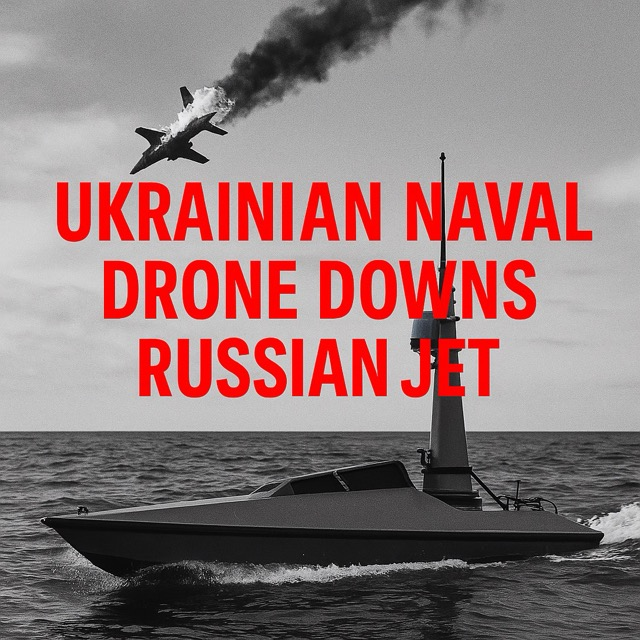
A new era of warfare as unmanned sea-based systems prove effective against airborne targets

In a development that could redefine modern naval warfare, Ukrainian forces have confirmed that one of their unmanned naval drones successfully downed a Russian fighter jet over the Black Sea. The incident marks the first known case of a sea-based drone neutralizing an airborne military aircraft, sending shockwaves through defense circles around the world.
The drone, reportedly part of Ukraine’s expanding fleet of domestically developed autonomous surface vessels, was equipped with advanced tracking systems and a short-range anti-aircraft missile launcher. Military officials state the jet was flying a low-altitude reconnaissance mission when it was detected, locked on, and destroyed by the drone’s onboard weapons system.
While Ukraine has previously used naval drones to attack Russian warships and disrupt supply routes, this incident suggests a significant leap in capability. Analysts point out that integrating anti-air capabilities into maritime drones gives smaller nations asymmetric leverage in contested zones such as the Black Sea.
The downed aircraft is believed to be a Sukhoi Su-30, a twin-engine fighter jet used by the Russian Navy for maritime patrol and strike operations. Video footage released by the Ukrainian Ministry of Defense appears to show the drone’s targeting system tracking the aircraft before a successful launch. Russian military sources have neither confirmed nor denied the loss, adding to the mystery and tension surrounding the engagement.
This event underscores the rapidly shifting nature of military innovation during the ongoing conflict. Ukraine’s creative use of technology—from drone swarms to AI-powered surveillance—is reshaping how modern warfare is conducted. Western allies are reportedly studying the strike closely, seeing it as a potential case study for future naval combat doctrine.
The implications for Russia are serious. Naval dominance, long seen as one of its key strengths, may now be vulnerable to relatively inexpensive, unmanned systems. For Ukraine, this achievement is both tactical and symbolic—demonstrating their resilience and adaptability in the face of a far larger adversary.
Experts suggest that such innovations could soon become common among militaries around the world. The blending of sea, air, and digital warfare elements in one compact platform highlights a future where conflict is increasingly autonomous, multi-domain, and driven by software as much as hardware.
As the war in Ukraine continues to evolve, the success of the naval drone serves as a stark reminder: the battlefield is no longer limited by traditional lines or legacy systems. In this new era, ingenuity and adaptability may prove more decisive than raw firepower alone.