A major infrastructure breakdown leaves international rail passengers stranded at Europe’s busiest terminals during peak holiday travel, raising fresh questions about resilience on the UK–Europe rail link.

Eurostar rail services between the United Kingdom and continental Europe were thrown into chaos after a power supply failure in the Channel Tunnel forced the suspension of trains, stranding hundreds of passengers and triggering widespread delays at key international stations.
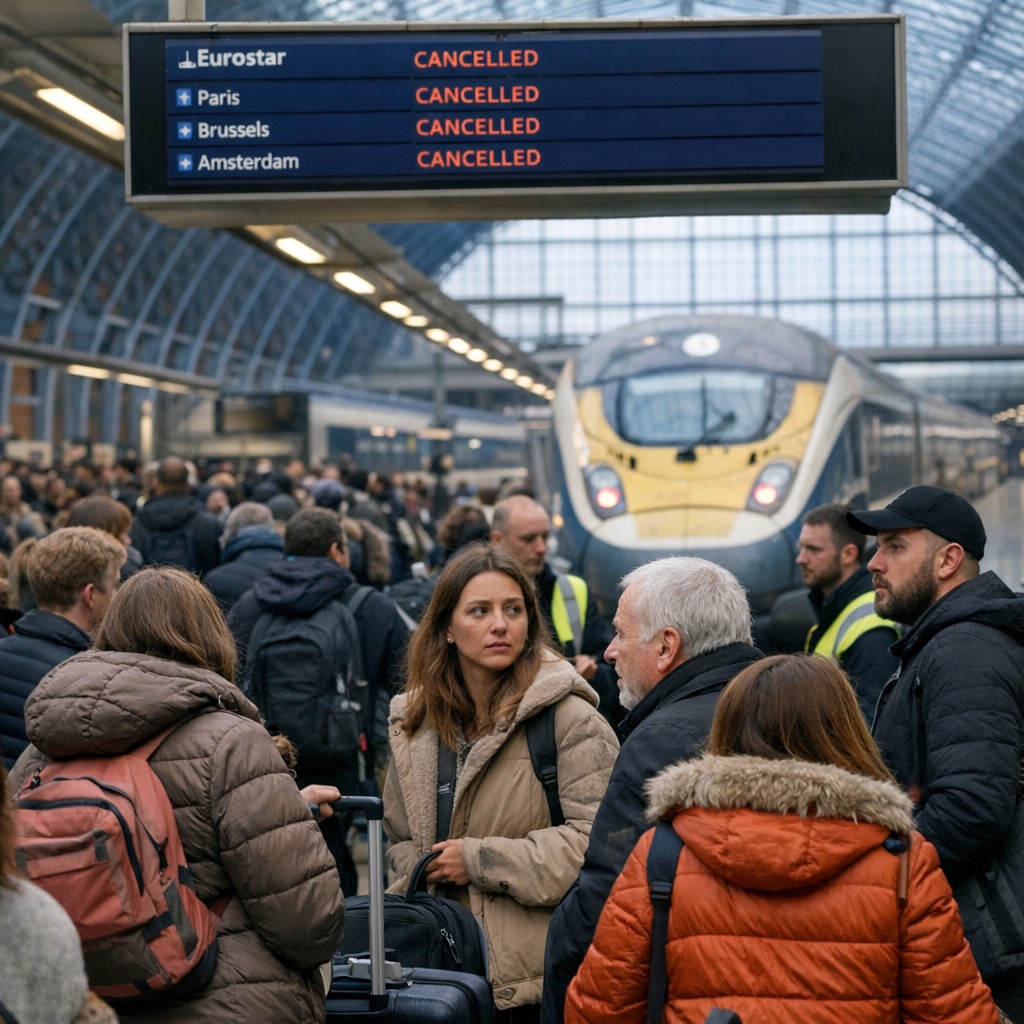
The disruption unfolded as travellers packed terminals for the New Year holiday period, traditionally one of the busiest times of the year for cross-Channel journeys. At London’s St Pancras International and Paris’s Gare du Nord, long queues formed as departure boards flickered with cancellations and revised information, while staff struggled to manage frustrated crowds.
Eurostar confirmed that the interruption was caused by a failure in the power systems supplying the Channel Tunnel, the vital undersea rail artery linking the UK with France and, beyond it, Belgium and the Netherlands. The company said safety protocols required all affected services to be halted while engineers assessed and worked to restore power, effectively freezing traffic through the tunnel.
Passengers described scenes of confusion and uncertainty. Many reported receiving limited information in the early stages of the disruption, with updates changing rapidly as the situation evolved. Families travelling for holiday reunions, business passengers returning after the festive break, and tourists hoping to begin the New Year abroad all found themselves facing hours-long waits or being forced to rebook for later dates.
“I understand that safety comes first, but the lack of clear communication made it much worse,” said one traveller waiting at St Pancras, surrounded by suitcases and temporary barriers. Similar accounts emerged from Paris, where Gare du Nord, already operating at near-capacity, struggled to absorb the backlog of delayed international passengers.
Eurostar said it deployed additional staff at stations to assist customers and arranged for ticket flexibility, allowing affected travellers to rebook on later services without extra charge or request refunds. However, with trains suspended and capacity limited once services began to resume, alternatives were scarce. Flights between London and Paris filled quickly, while ferry crossings also experienced knock-on pressure as stranded rail passengers sought other routes.
Transport analysts noted that while the Channel Tunnel has an overall strong safety and reliability record, incidents affecting its power or signalling systems can have disproportionate impacts due to the concentration of traffic and the lack of immediate detours. “There is no real substitute when the tunnel goes down,” said one European rail expert. “Unlike road networks, rail infrastructure of this scale has very few redundancies.”
The disruption also reignited debate over the resilience of international transport infrastructure at a time of growing demand for rail as a lower-emission alternative to short-haul flights. Eurostar has benefited from increased passenger numbers in recent years, driven by environmental concerns and the convenience of city-centre to city-centre travel. Events such as this, critics argue, underline the need for continued investment in infrastructure maintenance and contingency planning.
Officials involved in managing the tunnel stressed that safety systems worked as intended and that restoring power required careful, staged checks before trains could safely resume operations. Engineers carried out inspections inside the tunnel, a complex and time-consuming process given its length and the technical systems involved.
By late in the day, Eurostar indicated that some services were gradually restarting, but warned that residual delays and cancellations were likely to continue into the following day as trains and crews were repositioned. Passengers were advised to check travel updates before heading to stations and to allow extra time for their journeys.
For many travellers, the disruption served as an unwelcome reminder of how quickly international travel plans can unravel. As the New Year approached, scenes of people sitting on station floors, charging phones and scanning for updates, contrasted sharply with the promise of smooth, sustainable rail travel across Europe.
While services were expected to stabilise, the incident left lingering questions for operators and policymakers alike: how to ensure that one of Europe’s most important transport links can withstand technical failures, and how to better support passengers when it cannot.