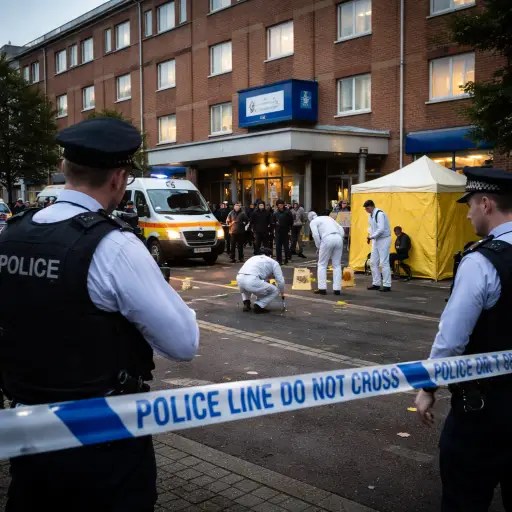
The jailing of a Sudanese asylum seeker for the murder of a hotel worker has reignited scrutiny of Europe’s migration systems and the pressures facing host communities.

On a cold winter morning, a British courtroom delivered a sentence that reverberated far beyond its walls. A Sudanese man, who had sought refuge in the United Kingdom, was jailed for the murder of a hotel worker at a facility used to house asylum seekers. The killing, brutal and sudden, shocked a quiet town and placed a harsh spotlight on the complex realities of migration, security, and integration across Europe.
The victim was an employee at a hotel contracted by the government to accommodate asylum applicants while their claims were processed. Such hotels, once symbols of hospitality and transience, have increasingly become focal points in a strained asylum system. In this case, the building became the scene of a violent crime that left a family grieving and a community searching for answers.
Prosecutors told the court that the attack was unprovoked and devastating. The judge described it as a “senseless loss of life,” emphasizing that the victim had simply been doing their job. The defendant, who had fled conflict in Sudan, was found guilty after evidence showed he carried out the fatal assault inside the hotel where he was residing.
The sentence brought a measure of closure to the victim’s relatives, but it also ignited fierce public debate. In Britain, where asylum hotels have multiplied amid backlogs in the immigration system, critics argue that overcrowding, poor mental health support, and long periods of uncertainty create dangerous conditions. Supporters of refugee protection counter that the vast majority of asylum seekers are law-abiding and vulnerable, and that crimes like this are tragic exceptions rather than the rule.
Government officials were quick to condemn the murder while defending current policies. They reiterated that public safety remains paramount and that serious crimes are met with the full force of the law, regardless of an offender’s immigration status. At the same time, ministers acknowledged the strain on accommodation facilities and the need for reforms that move asylum seekers out of hotels and into more stable housing.
Across Europe, the case has been closely watched. Countries from France to Germany are grappling with similar challenges: rising numbers of displaced people, limited housing, and political polarization around migration. Incidents of violence, though rare, tend to dominate headlines and fuel narratives that conflate refugees with criminality, complicating efforts at integration.
Human rights organizations warn against drawing sweeping conclusions. They stress that many asylum seekers arrive after experiencing trauma, war, and displacement, often with inadequate access to mental health care once in host countries. “This case shows the cost of neglect,” said one advocate, pointing to under-resourced support systems rather than migration itself as the deeper problem.
For residents living near asylum hotels, emotions are mixed. Some express fear and frustration, saying they were never consulted about large facilities opening in their neighborhoods. Others have rallied in solidarity, laying flowers for the victim and calling for calm and compassion in the aftermath of the killing.
The tragedy has also renewed questions about the privatization of asylum accommodation. Hotels and contractors, critics say, are ill-equipped to function as long-term residences for people in legal limbo. Staff members often receive minimal training for dealing with residents who may be distressed or isolated, increasing risks for everyone involved.
As the convicted man begins his prison sentence, the broader issues remain unresolved. Europe’s asylum systems are under pressure from global instability, while domestic politics grow ever more heated. Balancing humanitarian obligations with public safety is proving to be one of the defining challenges of the moment.
For the family of the hotel worker, the debates offer little comfort. Their loss stands as a stark reminder that policy failures can have human consequences. For governments, the message is equally clear: without comprehensive reform, tragedies like this will continue to test societies already struggling to reconcile fear, responsibility, and compassion.