As artificial intelligence accelerates, the battle for computing power is quietly reshaping global influence

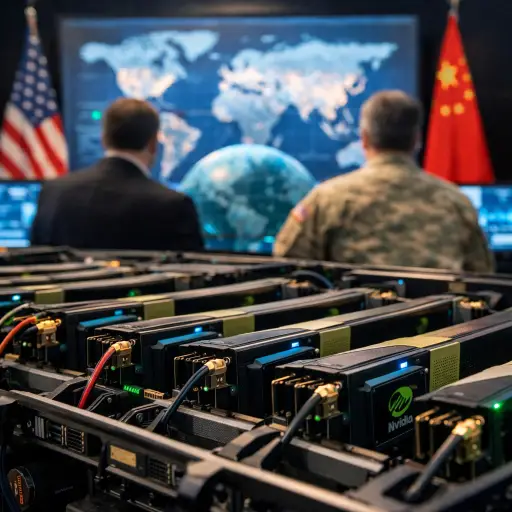
In data centers stretching from California to the Middle East, rows of high-performance processors hum with a significance that goes far beyond technology. At the center of this transformation sits Nvidia, whose advanced chips have become the backbone of the artificial intelligence boom—and, increasingly, a strategic asset in global geopolitics.
What was once a niche component designed for gaming graphics has evolved into one of the most critical resources of the digital age. Today, Nvidia’s chips power everything from large language models to autonomous systems, drug discovery platforms, and military simulations. The surge in demand has been so intense that governments and corporations alike are treating access to these processors as a matter of national priority.
The reason is simple: modern AI requires immense computational power. Training advanced models involves processing vast datasets through billions of calculations, tasks that only specialized chips—like Nvidia’s GPUs—can perform efficiently. As a result, these chips have become indispensable infrastructure for any nation or company seeking to lead in artificial intelligence.
This shift has elevated semiconductors from industrial components to strategic assets, comparable in importance to energy resources in previous eras. Just as oil defined geopolitical alliances and conflicts throughout the twentieth century, advanced chips are now emerging as the currency of influence in the AI-driven economy.
Governments have taken notice. In Washington, policymakers increasingly view control over advanced semiconductor technology as essential to maintaining technological leadership. Export restrictions have tightened, particularly targeting the flow of high-end AI chips to rival powers. These measures are designed not only to protect domestic innovation but also to slow the advancement of competing AI ecosystems abroad.
The implications are far-reaching. By limiting access to cutting-edge chips, the United States is effectively shaping the pace and direction of global AI development. Countries that can secure a steady supply of advanced processors are positioned to accelerate breakthroughs, while those without face significant constraints.
At the same time, demand continues to surge across multiple sectors. Technology giants are racing to build massive AI data centers, each requiring thousands of high-performance GPUs. Startups, too, are competing for limited supply, often facing long wait times and soaring costs. In some cases, access to Nvidia chips has become a bottleneck that determines whether an AI project can move forward at all.
This scarcity has created a new kind of power dynamic. Nations are investing heavily in domestic semiconductor capabilities, seeking to reduce dependence on external suppliers. Partnerships are forming between governments and private companies to secure supply chains, while new fabrication facilities are being planned or constructed at unprecedented scale.
Yet despite these efforts, Nvidia remains uniquely positioned. Its technological lead, built over years of research and ecosystem development, has proven difficult to replicate. The company’s hardware is tightly integrated with its software platforms, creating a powerful advantage that extends beyond raw performance. For developers and organizations, switching away from Nvidia often means significant technical and financial costs.
This dominance has not gone unnoticed. Regulators are beginning to scrutinize the concentration of power within the AI hardware market, raising questions about competition and long-term resilience. Still, for now, Nvidia’s position appears secure, reinforced by relentless demand and a pipeline of increasingly powerful chips.
Beyond economics and policy, the rise of AI chips as strategic assets is also reshaping global alliances. Countries are negotiating access to technology as part of broader diplomatic relationships, while corporations are aligning their investments with geopolitical realities. In this new landscape, computing power is not just a tool—it is leverage.
There are also broader implications for security. Advanced AI capabilities, enabled by high-performance chips, have applications in intelligence analysis, cybersecurity, and defense systems. As a result, control over these technologies is increasingly intertwined with national security considerations. The line between commercial innovation and strategic capability is becoming harder to draw.
At the same time, concerns are growing about inequality in access to AI infrastructure. Wealthier nations and large corporations are better positioned to secure the necessary hardware, potentially widening the gap between technological leaders and those left behind. This raises fundamental questions about who will benefit from the next wave of AI-driven transformation.
Looking ahead, the trajectory is clear: demand for advanced chips will continue to rise, and their strategic importance will only deepen. Whether through domestic production, international partnerships, or policy interventions, governments are racing to ensure they are not left out of the AI future.
For Nvidia, this moment represents both an opportunity and a responsibility. Its technology sits at the heart of a global shift that is redefining power in the digital age. As AI continues to evolve, the company’s chips are no longer just components—they are instruments of influence.
In this emerging order, control over computation may prove as consequential as control over natural resources once was. And as nations position themselves for the future, one thing is becoming increasingly clear: the race for AI dominance is, at its core, a race for chips.