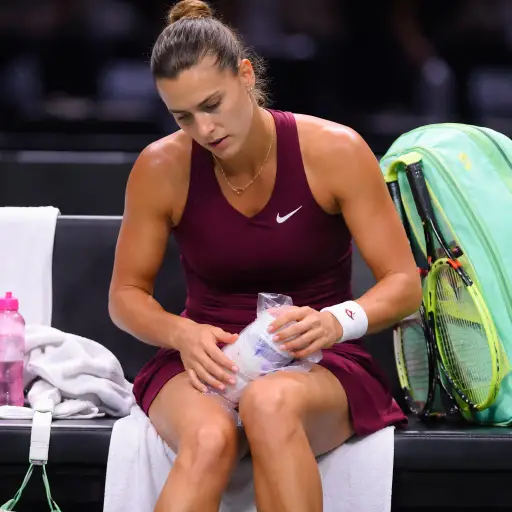
Injury setback forces Belarusian star to pause as the tour shifts to a crucial stretch on European clay

Aryna Sabalenka
The women’s tennis tour has been dealt a notable disruption as world No. 1 Aryna Sabalenka confirmed she will not compete at the upcoming Stuttgart tournament due to injury. The Belarusian player shared the news with her followers on social media, signaling a pause at a moment when momentum and timing are critical in the early stages of the clay-court season.
Sabalenka’s withdrawal comes as a surprise to many observers, not because injuries are rare in professional tennis, but because of her strong form and consistency in recent months. Having established herself firmly at the top of the rankings, she entered the spring stretch as one of the leading contenders for major titles on clay. Stuttgart, traditionally a key stop for elite players preparing for the bigger European tournaments, was expected to serve as an important benchmark for her readiness. Instead, the announcement shifts attention from performance to recovery.
While Sabalenka did not provide extensive details about the nature or severity of the injury, her tone suggested caution rather than alarm. The decision to withdraw appears to be a preventative measure, aimed at avoiding further complications at a time when the calendar intensifies. In modern tennis, where physical demands are relentless and margins between success and setback are narrow, such decisions are increasingly common among top athletes. Still, the timing carries significance.
The Stuttgart event, known for attracting a high-caliber field, often acts as an early indicator of form on clay. For a player of Sabalenka’s stature, it offers both competitive rhythm and psychological advantage. Skipping it means entering the next phase of the season without match play on the surface, a factor that could influence early rounds in subsequent tournaments. Yet, there is also a strategic dimension to consider. The clay season is not defined by a single week but by a sequence of tournaments culminating in the most prestigious events on the calendar. Preserving fitness for those later stages may ultimately prove more valuable than short-term participation.
Sabalenka’s recent trajectory underscores why her absence resonates. Over the past year, she has transformed from a powerful but sometimes inconsistent contender into a dominant force marked by improved composure and tactical maturity. Her ability to blend aggressive baseline play with greater control has made her one of the most formidable opponents on any surface. On clay, traditionally seen as a surface that rewards patience and endurance, Sabalenka has shown steady progress. While not initially considered a specialist, she has adapted her game to the slower conditions, developing more variety and resilience in longer rallies. This evolution has positioned her as a serious threat in the upcoming major events.
That is precisely why her current situation draws attention. In elite tennis, injuries are rarely isolated incidents. They often intersect with scheduling pressures, travel fatigue, and the cumulative strain of continuous competition. The decision to step back, even briefly, reflects an awareness of these broader dynamics. It is a reminder that maintaining peak performance over a full season requires not only skill but also careful management of physical resources.
For the Stuttgart tournament itself, Sabalenka’s withdrawal alters the competitive landscape. As one of the top seeds and a major draw for fans, her absence opens opportunities for other players to advance deeper into the draw. It also shifts expectations, potentially creating a more unpredictable tournament where emerging contenders can make their mark. From a broader perspective, the development adds a layer of uncertainty to the women’s tour at a time when rivalries and rankings are closely contested. With several players capable of challenging for top honors, even a temporary absence by the world No. 1 can influence outcomes across multiple events.
Reactions from the tennis community have been measured, reflecting both concern and understanding. Fellow players and analysts recognize the importance of prioritizing health, particularly in a sport where the physical toll is significant and recovery windows are limited. At the same time, there is an acknowledgment that Sabalenka’s presence elevates any tournament she enters, both in terms of competition and global interest. Looking ahead, the focus will turn to her recovery timeline and readiness for the next events on the calendar. Much will depend on how quickly she can return to full training and whether the injury requires further rest beyond the immediate withdrawal. In the current landscape of professional tennis, where scheduling decisions are closely tied to long-term goals, each step will likely be taken with careful deliberation.
For Sabalenka herself, the situation represents a familiar challenge faced by many top athletes: balancing ambition with sustainability. The drive to compete is constant, but so is the need to protect the body from overuse and injury. Navigating that balance is often what distinguishes those who maintain success over time from those whose progress is interrupted. As the tour moves forward without its top-ranked player in Stuttgart, attention will remain firmly on her next move. Whether this pause proves to be a minor interruption or a more significant turning point will become clearer in the weeks ahead. What is certain is that Sabalenka’s decision underscores a broader reality in modern tennis: even at the highest level, the path to success is rarely uninterrupted. It is shaped not only by victories and rankings, but also by the moments when stepping back becomes the most important move of all.


