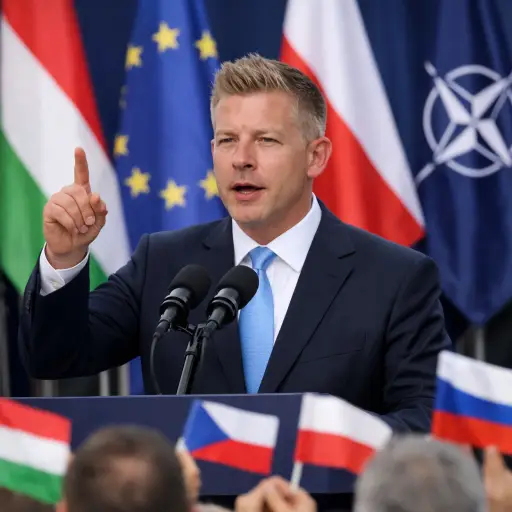
With elections framed as a turning point, Magyar promises renewed alliances in Central Europe and a stronger voice within Western institutions

As Hungary approaches a decisive political moment, opposition leader Péter Magyar has outlined an ambitious vision to recalibrate the country’s role within both the European Union and NATO. Positioning the upcoming parliamentary elections as “fateful,” Magyar has made clear that a victory for his Tisza party would mark a significant shift in Hungary’s foreign and regional policy direction.
At the heart of Magyar’s message is a pledge to restore Hungary’s standing among its Western allies while simultaneously deepening cooperation with key Central European partners, particularly the Czech Republic and Poland. The proposal signals not only a strategic realignment but also an attempt to redefine Hungary’s diplomatic tone after years of strained relations with Brussels and periodic tensions within NATO.
Magyar’s rhetoric has resonated with voters seeking a more predictable and cooperative foreign policy. Speaking at a series of campaign events, he emphasized that Hungary must “return to the center of European decision-making” and rebuild trust with its allies. According to him, this involves active engagement in EU policymaking, greater transparency in governance, and a commitment to shared democratic values.
His focus on NATO is equally pronounced. Magyar has underscored the importance of Hungary as a reliable security partner, particularly in a geopolitical environment marked by heightened tensions in Eastern Europe. He has called for increased defense cooperation, stronger alignment with NATO strategies, and a reaffirmation of Hungary’s obligations within the alliance.
Crucially, Magyar has identified regional cooperation as a cornerstone of his foreign policy agenda. By strengthening ties with Prague and Warsaw, he aims to revive a more cohesive Central European bloc capable of influencing broader EU policies. While the Visegrád Group has experienced internal divisions in recent years, Magyar believes that a renewed commitment to shared interests—particularly in energy security, defense, and economic development—could restore its relevance.
Political analysts note that Magyar’s proposals reflect both continuity and change. On one hand, the emphasis on regional alliances aligns with longstanding Hungarian priorities. On the other, his explicit commitment to closer EU integration and constructive engagement marks a departure from the confrontational approach often associated with the current government.
The elections themselves are widely seen as a referendum on Hungary’s future trajectory. For supporters of Magyar, the vote represents an opportunity to re-anchor the country firmly within Western institutions and rebuild its international credibility. For his opponents, however, the proposals raise questions about sovereignty and the balance of power between national and supranational authorities.
Public opinion appears increasingly polarized. While some voters welcome the prospect of renewed cooperation and stability, others remain cautious about potential compromises that may come with deeper integration. Economic concerns, including inflation and energy costs, also continue to shape the broader electoral landscape, intersecting with debates on foreign policy.
Magyar’s campaign has sought to connect these domestic challenges with his international agenda. He argues that stronger ties within the EU and NATO will translate into tangible benefits for Hungarian citizens, from improved economic opportunities to enhanced security guarantees. This framing aims to present foreign policy not as an abstract concept but as a practical tool for national development.
As the election approaches, the stakes are becoming clearer. A victory for Magyar could signal a recalibration of Hungary’s position within Europe and the transatlantic alliance, potentially easing tensions with Brussels and reinforcing cooperation within NATO. It could also reshape the dynamics of Central European politics, particularly if closer ties with the Czech Republic and Poland materialize.
Regardless of the outcome, the election is set to have far-reaching implications. Hungary stands at a crossroads, with competing visions for its future role on the international stage. Whether the country moves toward deeper integration and renewed alliances or maintains its current course will depend on the choices made by voters in what Magyar has described as a defining moment.
The coming days will reveal whether his message of strategic renewal and regional partnership resonates strongly enough to bring about the change he envisions.