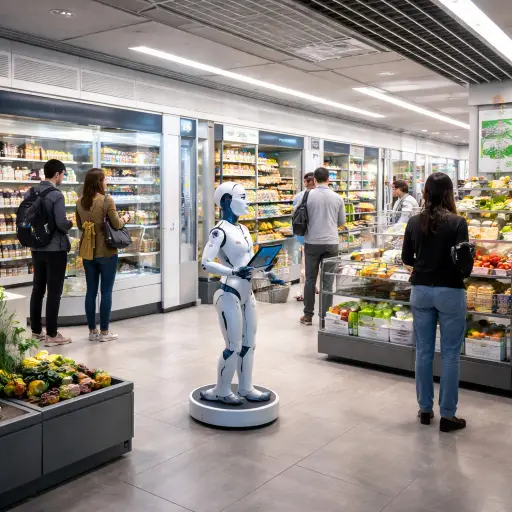
Andon Market opens a glimpse into a retail future where machines manage everything from shelves to checkout

In San Francisco, a city long accustomed to technological firsts, a new kind of storefront has quietly begun drawing attention. At first glance, Andon Market looks like any other neighborhood grocery store—bright aisles, neatly stacked produce, and customers moving at an unhurried pace. But beneath its familiar surface lies a radical departure from traditional retail: the entire operation is designed, managed, and run by artificial intelligence.
Opened recently in the heart of the city, Andon Market is being described by its creators as the first fully AI-operated physical store. There are no human cashiers, no stock clerks, and no floor managers. Instead, a network of machine-learning systems, sensors, and autonomous robots handles every aspect of the shopping experience.
From the moment customers step inside, the difference becomes apparent. Entry is seamless, guided by computer vision systems that recognize shoppers and initiate a personalized experience. There are no checkout lines. Shoppers simply take what they need and walk out, while AI systems automatically track selections and process payment in the background.
“It feels almost invisible,” said one visitor leaving the store with a bag of groceries. “You don’t think about the technology while you’re inside—it just works.”
The technology powering Andon Market operates on multiple layers. Overhead cameras and shelf sensors monitor inventory in real time, predicting demand and triggering restocking before items run out. Autonomous robots glide through the aisles after hours—or sometimes in plain sight—quietly replenishing shelves. Pricing, promotions, and product placement are adjusted dynamically based on purchasing patterns, time of day, and even subtle shifts in consumer behavior.
What sets Andon Market apart is not just automation, but autonomy. Unlike earlier “smart stores” that relied heavily on human oversight, this system is designed to make decisions independently. Algorithms determine supply orders, optimize energy usage, and even refine store layout over time without direct human intervention.
Developers behind the project say the goal is not simply efficiency, but adaptability. “Traditional retail systems are reactive,” one engineer involved in the project explained. “This store is predictive. It learns continuously from what happens inside it.”
The implications extend beyond convenience. Supporters argue that AI-operated stores could reduce operational costs, minimize waste, and streamline supply chains. Perishable goods, for example, are tracked with precision, allowing the system to discount or reposition items before they spoil. Energy consumption is also optimized, with refrigeration and lighting adjusting automatically based on activity levels.
Yet the concept raises broader questions about the future of work and human roles in everyday services. Retail remains one of the largest sources of employment in the United States, and a fully autonomous store inevitably prompts concerns about job displacement.
Some analysts suggest that rather than eliminating jobs entirely, such systems may shift labor demands toward maintenance, oversight, and data analysis. Others remain skeptical, warning that the transition could be uneven and disruptive.
Customers themselves appear divided. While many are intrigued by the novelty and efficiency, others express unease at the absence of human interaction. “It’s impressive,” said another shopper, pausing outside the store. “But it also feels a little strange. You realize how much you’re used to small conversations, even just at checkout.”
Privacy is another point of discussion. The same technologies that enable seamless shopping—cameras, sensors, and behavioral analytics—also collect large volumes of data. Developers insist that the system is designed with privacy safeguards, anonymizing user information and focusing on patterns rather than individuals. Still, the balance between convenience and surveillance remains an open question.
Despite these concerns, Andon Market is already being seen as a test case for the next phase of retail. Similar concepts have been explored in limited forms, but never with this level of integration and autonomy. Industry observers are watching closely to see whether the model proves scalable—and whether customers embrace it beyond the initial curiosity.
For now, the store stands as both a functioning business and a living experiment. Its success or failure may help determine how quickly AI-driven environments move from novelty to norm.
As shoppers continue to pass through its doors, one thing is clear: the experience of buying everyday goods is changing. Whether Andon Market represents the future of retail or simply one possible path forward, it offers a tangible glimpse of how artificial intelligence is beginning to reshape even the most routine aspects of daily life.