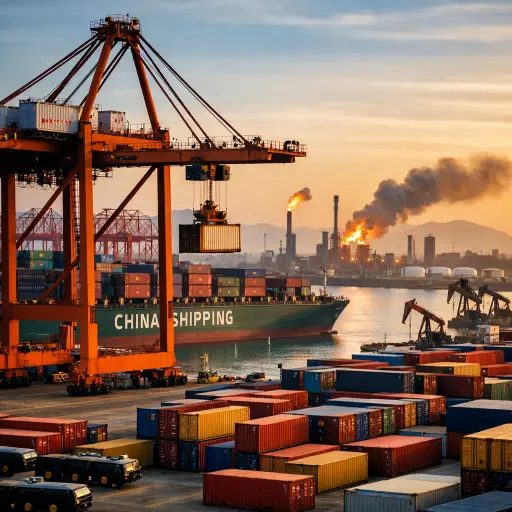
A record-breaking start to the year for China’s export machine has set an optimistic tone across global markets, but mounting geopolitical tensions are beginning to cast long shadows over that momentum.

In the opening stretch of the year, Chinese exports accelerated at a pace that exceeded expectations, driven largely by a powerful rebound in high-value technology goods. From advanced semiconductors to electric vehicles and renewable energy components, the country’s manufacturing base appeared not only resilient but increasingly dominant in sectors shaping the future of global industry. Analysts pointed to strong external demand, improving supply chain efficiency, and sustained state support as key drivers behind the surge.
The early figures suggested that China was on track to surpass its already historic trade surplus from the previous year, which stood at roughly 1.2 trillion dollars. Such a milestone would have reinforced the country’s position as the central hub of global manufacturing at a time when many economies are still grappling with uneven recoveries and structural inflation.
However, this trajectory is now facing a serious test.
The escalating conflict involving Iran has begun to ripple across global markets, introducing a level of uncertainty that directly challenges the foundations of China’s export growth. The immediate impact has been felt in energy markets, where prices have climbed sharply amid fears of supply disruptions. For a country heavily dependent on imported energy to sustain its industrial output, rising costs are translating into tighter margins for exporters.
Shipping and logistics have also been affected. Freight costs, which had stabilized after years of pandemic-related volatility, are once again under pressure. Insurance premiums for vessels navigating key trade routes have increased, while delays and rerouting have added complexity to already strained supply chains. These factors collectively threaten to erode the competitiveness of Chinese goods abroad.
Yet the more subtle, and potentially more damaging, consequence lies in weakening global demand.
As energy and transportation costs rise, consumers and businesses worldwide are beginning to feel the squeeze. In many markets, purchasing power is being eroded, forcing importers to reassess orders and inventory strategies. For China’s export-driven economy, this poses a significant risk: even the most efficient production systems cannot compensate for a slowdown in demand.
The technology sector, which has been the standout performer so far, may not be immune. While demand for cutting-edge products remains structurally strong, higher prices and tighter financing conditions could delay investment cycles, particularly in emerging markets. This could dampen the pace of export growth just as it was gaining momentum.
Chinese policymakers are closely monitoring the situation. There are indications that targeted support measures could be expanded if external conditions deteriorate further. These may include financial incentives for exporters, currency management to maintain price competitiveness, and continued investment in domestic innovation to move further up the value chain.
At the same time, there is a growing recognition that external shocks of this nature are becoming more frequent. The interplay between geopolitics and economics is increasingly shaping trade flows, forcing countries to adapt more rapidly than in the past.
For now, China’s export sector remains robust, supported by strong fundamentals and a diversified industrial base. But the events unfolding in the Middle East serve as a reminder that global trade does not operate in isolation. The path toward another record surplus, once seemingly assured, is now contingent on factors far beyond the control of any single economy.
The coming months will reveal whether China can sustain its early momentum or whether external pressures will force a recalibration. What is clear is that the global trade environment has entered a new phase—one where resilience is measured not only by output, but by the ability to navigate an increasingly unpredictable world.