Election winner pledges legal pathway for controversial handover while seeking to reset strained regional ties

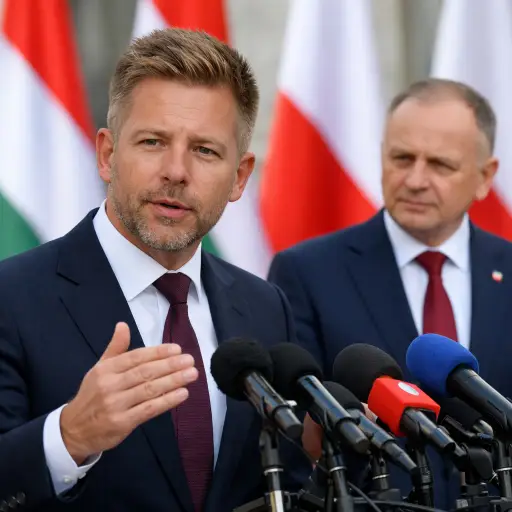
Hungary’s newly empowered political leader Péter Magyar has signaled a sharp turn in Budapest’s approach to contentious asylum cases, announcing his intention to find a legal pathway to hand over two opposition politicians wanted by Polish authorities. The statement, delivered shortly after his electoral victory, marks one of the clearest early indicators of how a Magyar-led government could recalibrate Hungary’s foreign and legal posture within Central Europe.
Speaking with measured firmness, Magyar emphasized that Hungary “must not serve as a refuge for internationally sought individuals,” while carefully adding a caveat that the two figures in question may no longer be on Hungarian territory. His remarks immediately drew attention in both Budapest and Warsaw, where the cases have long been a point of diplomatic friction.
The two Polish nationals, granted asylum under the previous Hungarian administration, had been portrayed by Warsaw as fugitives facing legitimate prosecution, while Budapest had framed the matter in political terms, citing concerns over judicial independence and potential persecution. Magyar’s willingness to revisit the issue suggests a departure from that stance, though significant legal and political hurdles remain.
Legal experts note that any extradition process would require a thorough review under both Hungarian and European legal frameworks, including asylum protections and human rights guarantees. “This is not a simple political decision,” said one regional analyst. “Even if there is political will, the judiciary and international obligations will play a decisive role.”
Magyar appears aware of these constraints. His language stopped short of a definitive commitment, instead focusing on the intention to “seek solutions within the rule of law.” This phrasing has been interpreted as an attempt to balance domestic expectations for change with the realities of legal procedure.
The announcement also carries broader diplomatic significance. Magyar confirmed that his first foreign trip would be to Poland, a move widely seen as an effort to reset relations between the two historically close allies. In recent years, ties between Budapest and Warsaw have cooled, particularly as their approaches to European Union policy and internal governance began to diverge.
For Poland, the issue of the two asylum recipients has been both symbolic and practical. Their presence in Hungary was viewed as a challenge to mutual legal cooperation within the EU framework. Magyar’s statement may therefore be received in Warsaw as a gesture of goodwill, though Polish officials have so far responded cautiously.
At home, reactions have been mixed. Supporters of Magyar’s reformist platform have welcomed the signal of a more pragmatic and law-centered foreign policy. Critics, however, warn that revisiting asylum decisions could set a controversial precedent and raise questions about the protection of political dissidents.
The broader European context adds another layer of complexity. The European Union has long emphasized the importance of judicial cooperation and mutual trust among member states. Any high-profile extradition case involving political figures is likely to attract scrutiny from Brussels, particularly regarding adherence to fundamental rights.
Observers suggest that Magyar’s approach reflects a broader strategic calculation. By addressing a sensitive bilateral issue early in his tenure, he may be seeking to demonstrate reliability as a partner and to reposition Hungary within the European mainstream. Whether this effort will translate into tangible policy shifts remains to be seen.
For now, the fate of the two Polish politicians remains uncertain. Their current whereabouts have not been publicly confirmed, and legal proceedings, if initiated, could take considerable time. What is clear, however, is that the issue has become an early test of Magyar’s leadership—one that will shape perceptions of his government both at home and abroad.
As Hungary stands at the threshold of political transition, the handling of this मामला will likely serve as a benchmark for the balance Magyar aims to strike between principle, pragmatism, and the pressures of regional diplomacy.