A public dispute between Washington and Rome exposes deeper divisions over diplomacy, religion, and global security

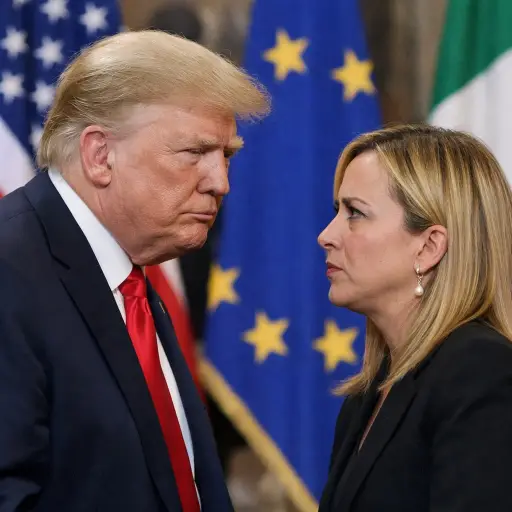
In a striking turn of rhetoric, U.S. President Donald Trump has acknowledged he “misjudged” Italian Prime Minister Giorgia Meloni, following a heated public exchange that has drawn attention across diplomatic and religious circles. The disagreement, sparked by remarks about Pope Leo XIV and escalating tensions surrounding Iran, has underscored a growing unease in transatlantic relations.
The dispute began when Trump criticized the Pope’s recent statements on international affairs, particularly those addressing the fragile geopolitical balance in the Middle East. The American president questioned the Vatican’s role in commenting on matters he described as “strategic and security-driven,” suggesting that religious leaders should refrain from influencing political discourse on volatile regions such as Iran.
Meloni responded swiftly and forcefully. In a statement that resonated widely across Europe, the Italian prime minister defended the Pope’s moral authority, calling Trump’s remarks “unacceptable” and warning against dismissing voices that advocate for dialogue and restraint. Her intervention marked a rare public rebuke of a U.S. president by a close European ally.
Trump, known for his combative communication style, rejected Meloni’s criticism outright. In a subsequent address, he insisted that it was her position—not his—that was “unacceptable,” framing the disagreement as a matter of national interest versus ideological overreach. The exchange quickly escalated into a broader debate about the boundaries between political leadership and moral influence.
However, in an unexpected shift, Trump later softened his stance. Speaking to reporters, he conceded that he may have “been wrong” about Meloni, acknowledging her leadership and reaffirming the importance of U.S.-Italy relations. While the statement stopped short of a full apology, it signaled a notable de-escalation and a recognition of the diplomatic stakes involved.
The episode has unfolded against a backdrop of heightened global tension. Iran remains a focal point of international concern, with ongoing disputes over its nuclear ambitions and regional influence. The Vatican, under Pope Leo XIV, has positioned itself as a voice for de-escalation, urging dialogue and caution in the face of rising hostilities.
Meloni’s defense of the Pope reflects Italy’s longstanding alignment with the Holy See, as well as her government’s broader emphasis on stability and multilateral cooperation. Analysts note that her response was not only a defense of religious authority but also a strategic assertion of Italy’s role as a mediator within Europe and beyond.
For Trump, the incident highlights the challenges of navigating complex alliances while maintaining a strong domestic posture. His initial criticism of the Pope may have resonated with segments of his political base, but the subsequent backlash from allies illustrates the limits of unilateral rhetoric in an interconnected world.
Observers suggest that the exchange reveals deeper fault lines in how Western leaders approach global crises. While the United States continues to prioritize security and deterrence, European leaders are increasingly emphasizing diplomacy and institutional engagement. The Vatican’s involvement adds another layer, blending moral advocacy with geopolitical relevance.
Despite the tensions, both Washington and Rome appear keen to prevent the dispute from causing lasting damage. Trump’s partial reversal and Meloni’s measured tone in subsequent remarks indicate a mutual interest in preserving cooperation, particularly within NATO and broader Western alliances.
As the international community watches closely, the incident serves as a reminder of the delicate balance between politics, religion, and diplomacy. In an era defined by rapid communication and public scrutiny, even long-standing partnerships can be tested by a few words and reshaped just as quickly by their reconsideration.