In Washington, EU Commissioner Valdis Dombrovskis seeks to unlock a landmark G7 loan backed by windfall profits, testing legal ingenuity and political unity

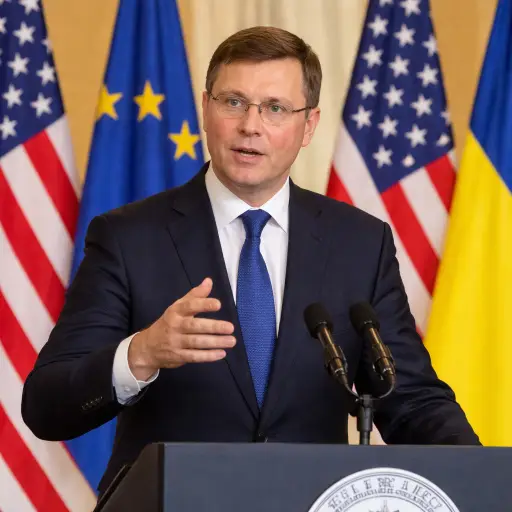
As transatlantic policymakers gather in Washington this week, the European Union is stepping up its efforts to accelerate a major financial lifeline for Ukraine. At the center of the discussions is Valdis Dombrovskis, the EU’s economy commissioner, who is pressing partners to fast-track the disbursement of a multibillion-euro loan agreed by the Group of Seven.
The initiative, structured around roughly €45–50 billion, represents a novel attempt to channel financial support to Kyiv without directly confiscating frozen Russian state assets. Instead, it relies on the profits generated by those immobilized reserves, a mechanism designed to navigate the legal and political sensitivities that have slowed more aggressive proposals.
For European officials, the urgency is clear. Ukraine’s fiscal needs remain acute as the war drags on, with budgetary pressures mounting alongside reconstruction demands. While Western governments have committed substantial aid, the challenge has increasingly shifted toward ensuring predictable, sustained funding flows.
Dombrovskis’ visit to Washington reflects a recognition that speed now matters as much as scale. The G7 loan framework has already been politically endorsed, but its implementation hinges on complex coordination between financial institutions, legal systems, and central banks across multiple jurisdictions.
At the heart of the plan are hundreds of billions of euros in Russian central bank assets frozen in the wake of the invasion of Ukraine. These reserves, largely held in European financial systems, generate investment income that has become the focal point of the current strategy. By leveraging these windfall profits rather than the principal itself, policymakers aim to sidestep accusations of outright expropriation while still making Russia, indirectly, contribute to Ukraine’s recovery.
Yet the approach is not without controversy. Legal experts continue to debate whether diverting profits from sovereign assets could set precedents that reverberate across global financial markets. Some countries remain cautious, wary of undermining the stability of reserve currencies or deterring foreign holdings.
Within the European Union, however, there is growing consensus that the balance between legal caution and geopolitical necessity has shifted. Officials argue that the extraordinary circumstances of the conflict justify equally innovative financial tools. For Dombrovskis, the task in Washington is to ensure that this consensus translates into coordinated action among G7 partners, including the United States, Japan, Canada, and the United Kingdom.
American officials have broadly supported the initiative, but operational details remain under negotiation. Questions persist over how quickly funds can be mobilized, how risks will be shared among participating countries, and how repayment mechanisms will function if the income stream from frozen assets fluctuates.
The structure under discussion resembles a loan backed by future revenue streams. In practice, this means Ukraine would receive immediate funding, while the servicing of that loan would be covered over time by the profits generated from the immobilized Russian reserves. The model seeks to provide both immediacy and sustainability, though it depends heavily on stable financial returns and continued political alignment.
Beyond the technicalities, the initiative carries symbolic weight. It signals a shift from reactive support toward a more structured, long-term financial commitment to Ukraine. It also underscores a broader effort by Western allies to ensure that the economic burden of the war does not fall solely on taxpayers.
For Ukraine, the stakes are significant. Reliable financing is essential not only for maintaining government functions but also for sustaining investor confidence and planning reconstruction. Delays or uncertainty in funding could ripple through the country’s fragile economic recovery.
European officials are keenly aware of these dynamics. In recent months, Brussels has worked to refine its own financial instruments while coordinating closely with international partners. The Washington meetings are seen as a critical moment to align timelines and finalize the operational framework.
Dombrovskis has emphasized the need for unity, framing the initiative as a test of the G7’s ability to deliver on its commitments. While political agreement has been strong in principle, translating that into swift disbursement requires overcoming bureaucratic hurdles and reconciling different legal interpretations.
The broader geopolitical context adds another layer of complexity. As the conflict continues, Western governments face competing priorities, from domestic economic concerns to shifting global alliances. Maintaining momentum on Ukraine support has required sustained diplomatic effort, particularly as public attention fluctuates.
In this environment, the proposed loan serves both practical and strategic purposes. It provides immediate financial relief while reinforcing the message that Western backing for Ukraine remains steadfast. By linking the funding to Russian assets, it also introduces an element of accountability, even if indirect.
Financial markets are watching closely. The use of profits from frozen assets is largely unprecedented at this scale, and its implementation could influence future approaches to sanctions and economic statecraft. For central banks and sovereign investors, the implications extend beyond the current conflict.
Despite these uncertainties, momentum appears to be building. European officials express cautious optimism that the remaining technical issues can be resolved, allowing for disbursement to begin in the near term. The tone in Washington has been described as constructive, with partners acknowledging both the urgency and the complexity of the task.
For Dombrovskis, the visit represents a pivotal step in turning political intent into tangible support. As discussions continue, the focus remains on ensuring that the mechanism is not only legally sound but also operationally effective.
The outcome will shape not only Ukraine’s immediate financial outlook but also the broader evolution of international economic policy in times of conflict. In seeking to unlock this unprecedented loan, Europe and its allies are testing the boundaries of what is possible within the existing financial system.
Whether that experiment succeeds will depend on the ability of policymakers to move from agreement to execution, and to do so with the speed that the current moment demands.