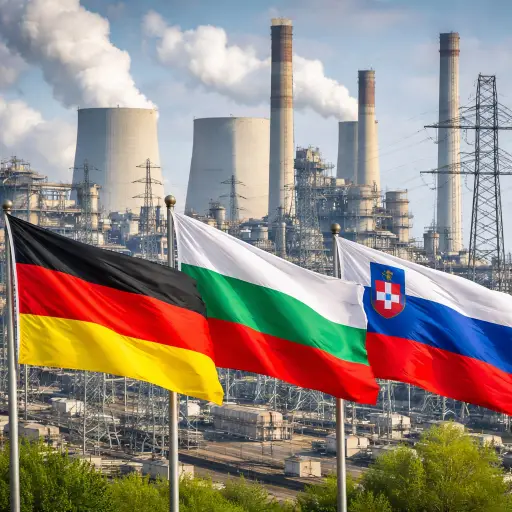
Germany, Bulgaria and Slovenia secure approval for targeted electricity relief as the EU balances competitiveness and market discipline

As Europe continues to grapple with volatile energy markets and the long tail of recent supply shocks, the European Commission has approved state aid schemes for Germany, Bulgaria and Slovenia aimed at easing electricity costs for energy-intensive industries. The decision underscores Brussels’ ongoing effort to protect industrial competitiveness while maintaining the integrity of the EU’s internal market.
The approved measures allow Berlin to allocate up to 3.8 billion euros to support companies facing high electricity prices. Bulgaria has been authorized to provide 334 million euros, while Slovenia will deploy 90 million euros under similar frameworks. The schemes are designed to temporarily reduce electricity costs for sectors such as chemicals, metallurgy, paper production and other industries heavily dependent on power consumption.
According to officials familiar with the decision, the Commission assessed the schemes under its Temporary Crisis and Transition Framework, which was introduced to help member states respond to energy price disruptions while accelerating the shift toward a greener economy. The framework permits targeted and proportionate support, provided it does not distort competition beyond what is necessary.
Germany’s program is by far the largest, reflecting both the scale of its industrial base and the pressure its manufacturers have faced from sustained high energy costs. Companies eligible for support are expected to demonstrate significant exposure to electricity expenses and international competition, a requirement intended to ensure that aid reaches firms most at risk of losing global market share.
In Bulgaria and Slovenia, the measures are more modest in absolute terms but carry significant weight for their domestic economies. Both countries have energy-intensive sectors that are particularly vulnerable to price swings, and policymakers have argued that temporary relief is essential to prevent production cuts, job losses and potential relocation of industry outside the European Union.
Brussels has emphasized that the aid must remain temporary and targeted. Member states are required to set clear limits on the duration of support and to include safeguards that encourage energy efficiency and decarbonization. Companies benefiting from the schemes may also be expected to commit to investments in cleaner technologies or energy-saving measures, aligning short-term relief with long-term climate objectives.
The approval comes at a delicate moment for European industry. While wholesale electricity prices have stabilized compared to peak crisis levels, they remain higher than in competing regions such as the United States. This gap has fueled concerns among business leaders about the risk of “deindustrialization,” particularly in sectors where energy costs account for a large share of total production expenses.
European officials have sought to strike a balance between allowing national governments to support their industries and preventing a subsidy race within the single market. Larger economies, with greater fiscal capacity, can potentially offer more generous aid, raising fears among smaller member states about uneven competition. The Commission’s oversight is intended to mitigate these risks by setting common rules and ensuring proportionality.
Industry groups have broadly welcomed the decision, viewing it as a necessary step to maintain production and investment within Europe. However, some analysts caution that temporary subsidies alone cannot address the structural challenges facing European energy markets. They argue that deeper reforms, including faster expansion of renewable energy, grid modernization and improved cross-border energy integration, will be essential to deliver lasting cost reductions.
Environmental organizations, meanwhile, have called for strict conditionality to ensure that public funds do not lock in carbon-intensive production. They stress that any support for industry should be tied to clear decarbonization pathways, consistent with the European Union’s climate targets.
The Commission has reiterated that the approved schemes are part of a broader strategy to navigate the energy transition while safeguarding economic resilience. By allowing targeted intervention under defined conditions, Brussels aims to provide breathing space for industry without undermining competition or delaying the shift to a low-carbon economy.
As member states implement the measures, attention will turn to their real-world impact. The effectiveness of the aid in preserving industrial activity, supporting jobs and encouraging investment in cleaner technologies will be closely watched across the bloc. The outcome may shape future decisions on how the European Union balances state support, market principles and climate ambition in an increasingly uncertain global landscape.