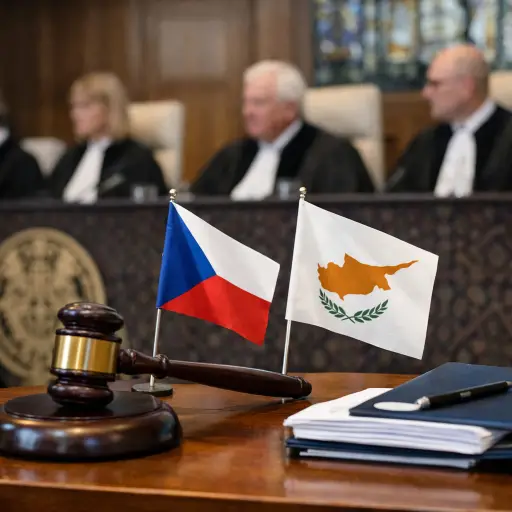
Hague ruling cancels €150 million award yet blocks Cypriot firms from reopening the case, reshaping the legal landscape of investment arbitration in Europe

A Dutch court in The Hague has delivered a complex and closely watched ruling that reshapes a long-running legal dispute between the Czech Republic and Cyprus-based companies from the Synot group. The court annulled a previous arbitration decision that had awarded the Czech state approximately €150 million, while at the same time preventing the companies from initiating a new arbitration against the country.
The decision introduces a rare dual outcome: the Czech Republic loses its formal victory in arbitration, yet avoids the prospect of renewed legal exposure from the same claim. Legal experts say the ruling reflects growing judicial scrutiny of international arbitration mechanisms within the European Union.
The dispute dates back several years and centers on claims by companies linked to the Synot group, a Czech-founded business with international operations in gaming and lottery services. The companies, registered in Cyprus, argued that regulatory changes and actions by Czech authorities had unfairly harmed their investments. They sought compensation through international arbitration, relying on investment protection agreements that allow foreign investors to bring claims against states.
In the earlier arbitration, the tribunal rejected the companies’ claims and ruled in favor of the Czech Republic. The outcome was seen as a significant legal and financial win for Prague, eliminating the risk of a payout that could have reached roughly €150 million.
However, the companies challenged the arbitration award before Dutch courts, as The Hague is a key jurisdiction for reviewing international arbitration decisions. Their argument focused on procedural and jurisdictional issues, including whether the arbitration itself was valid under European Union law.
The Dutch court ultimately agreed that the arbitration award could not stand. While the detailed reasoning highlights technical legal grounds, the broader context lies in evolving EU jurisprudence that questions the compatibility of certain investor-state arbitration mechanisms within the bloc.
In recent years, European courts have increasingly limited the use of arbitration clauses in bilateral investment treaties between EU member states. The concern is that such mechanisms may conflict with EU law, particularly the authority of European courts to interpret legal disputes involving member states.
The Synot case appears to fall within this shifting legal framework. By annulling the award, the Dutch court effectively confirmed that the arbitration process itself was flawed or lacked proper legal grounding under current interpretations of EU law.
Yet the ruling did not fully favor the companies. In a decisive second step, the court barred them from initiating a new arbitration against the Czech Republic on the same matter. This aspect of the decision carries major implications.
For the Czech government, the outcome is mixed but ultimately stabilizing. While it loses the formal arbitration victory, it is no longer under threat of renewed claims in this dispute. The financial risk tied to the original claim is effectively neutralized.
For the companies, the ruling closes the door on further legal action in arbitration, leaving them without a clear path to pursue compensation through the same mechanism. Their legal options may now be limited to domestic courts or other avenues, which are often less favorable to investors in such cases.
Legal analysts note that the judgment reflects a broader recalibration of investor-state dispute settlement in Europe. Arbitration, once a widely used tool for cross-border investment protection, is increasingly constrained by EU legal principles. Courts are asserting greater control over disputes that were previously handled largely outside the traditional judicial system.
The ruling also highlights the strategic importance of The Hague as a global center for arbitration and its oversight. Decisions made in Dutch courts can have far-reaching consequences for international business disputes, particularly those involving European parties.
From a policy perspective, the case underscores tensions between investor protections and state sovereignty. Governments seek to regulate sectors such as gambling and digital services in the public interest, while investors rely on legal safeguards to protect their assets from abrupt policy shifts.
The Synot dispute sits squarely at this intersection. It reflects not only a specific conflict between a state and private companies, but also a wider transformation in how such conflicts are resolved within the European legal order.
As the dust settles, both sides are left with a nuanced outcome. The Czech Republic avoids a costly legal battle moving forward, despite losing the symbolic arbitration win. The companies, meanwhile, succeed in overturning the unfavorable award but gain no practical route to revive their claim.
The decision is likely to resonate beyond this single case. It may influence how investors structure their holdings, how states draft regulations, and how legal advisers approach arbitration within the European Union.
In a landscape where legal certainty is increasingly shaped by overlapping national and supranational rules, the Hague ruling serves as a reminder that victories in arbitration are no longer final—and that even annulments may not reopen the door to further claims.