Political tensions ripple through international swimming as federations, athletes, and organizers clash over identity, neutrality, and the limits of sport

In the echoing halls of Europe’s aquatic arenas, a new kind of silence is taking hold—not the focused quiet before a race, but the uneasy pause of a sporting world grappling with politics it can no longer keep at bay.
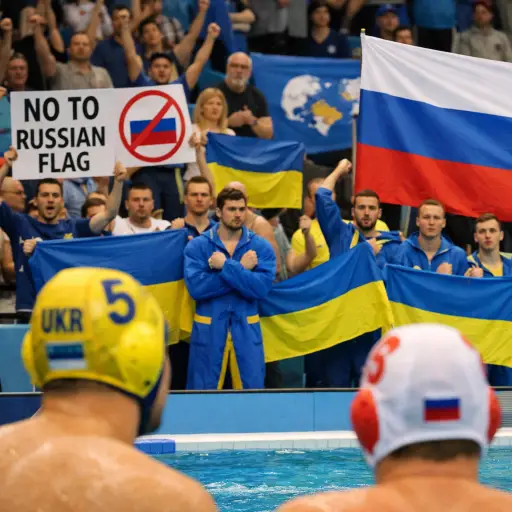
Several European countries have made it unmistakably clear: they are unwilling to host swimming competitions where the Russian flag is displayed or the national anthem is played. The stance reflects a broader discomfort that has steadily intensified as the war in Ukraine stretches into yet another year, reshaping not only geopolitics but also the moral boundaries of international sport.
At the center of the growing controversy stands World Aquatics, the global governing body for swimming disciplines. Its president, Husain Al-Musallam of Kuwait, has been a key advocate for allowing Russian athletes to return to competition under their national identity. His position has reignited a debate many thought had been temporarily settled—whether sport can truly remain neutral in times of war.
For critics, the answer is increasingly clear. Allowing athletes to compete under national symbols, they argue, risks legitimizing a state engaged in prolonged military aggression. For supporters of reintegration, however, the principle of separating athletes from political decisions remains paramount.
The divide is no longer theoretical. It has begun to shape real events, real schedules, and real participation. Ukrainian water polo players have already refused to compete against Russian teams, setting a precedent that could ripple across other aquatic disciplines. Their decision underscores a deeper reality: for many athletes, neutrality is not an option when the conflict is personal.
Behind closed doors, European organizers are facing mounting pressure—from governments, sponsors, and their own athletes. Hosting an event that includes Russian national representation is no longer a purely logistical decision; it is a political statement with potential diplomatic consequences. Some federations have quietly indicated they would rather withdraw from hosting duties than comply with conditions that include visible Russian symbols.
This evolving landscape places World Aquatics in an increasingly delicate position. The federation has sought to balance inclusivity with sensitivity, but its latest moves suggest a willingness to push forward with reintegration, even at the risk of fragmentation within the sport.
Observers note that the current tensions reflect a broader shift in international athletics. The long-held ideal that sport exists above politics is being tested more rigorously than at any point in recent memory. From Olympic committees to individual federations, governing bodies are being forced to define where neutrality ends and responsibility begins.
For athletes, the consequences are immediate and deeply personal. Competitors must now navigate not only the pressures of elite performance but also the expectations and judgments tied to their national identity. In some cases, participation itself becomes a statement—one that can attract both support and criticism.
Spectators, too, are being drawn into the debate. Public opinion across Europe has hardened in many quarters, with fans expressing discomfort at the prospect of celebrating victories accompanied by symbols they associate with ongoing conflict. The atmosphere in arenas, once defined by unified enthusiasm, risks becoming fractured and tense.
Yet amid the divisions, there are voices calling for restraint. Some argue that isolating athletes could deepen divides rather than bridge them, and that international competition remains one of the few spaces where dialogue—however indirect—can still occur. They caution against decisions driven solely by emotion, urging a more measured approach that considers long-term consequences for the integrity of sport.
As preparations continue for upcoming competitions, uncertainty lingers. Will events proceed as planned, or will boycotts and withdrawals reshape the calendar? Can governing bodies enforce policies that satisfy both ethical concerns and the principle of open competition?
What is clear is that the question facing aquatic sports is no longer confined to the pool. It extends into boardrooms, diplomatic channels, and the broader conscience of the sporting world. The decisions made now will likely set precedents far beyond swimming, influencing how international sport responds to conflict for years to come.
In the end, the water may remain the same—clear, measured, and indifferent. But everything around it has changed.