Péter Magyar’s dual message to Benjamin Netanyahu underscores a deepening clash between national politics, historical memory, and global legal obligations

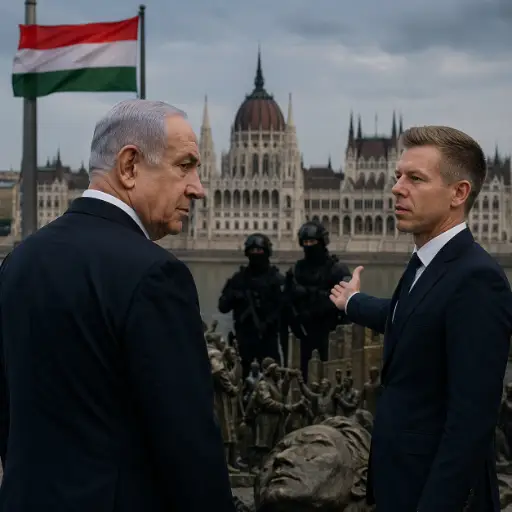
As Hungary prepares to commemorate the legacy of its anti-communist uprising, a striking political contradiction has emerged at the heart of Europe. Péter Magyar, widely seen as a leading contender for Hungary’s next premiership, has extended a symbolic invitation to Benjamin Netanyahu to attend the anniversary commemorations in Budapest. Yet, in the same breath, he has indicated that Hungarian authorities would be compelled to arrest the Israeli leader upon arrival.
The statement, delivered amid intensifying domestic and international scrutiny, reflects a growing tension between Hungary’s political ambitions and its legal commitments as a member of the International Criminal Court. It also raises broader questions about the limits of diplomacy in an era increasingly shaped by legal accountability mechanisms.
Magyar’s invitation is deeply rooted in the symbolic importance of the uprising, a defining moment in Hungary’s modern history. The commemoration is expected to serve not only as a tribute to those who resisted Soviet control, but also as a reaffirmation of national sovereignty and democratic values. By inviting Netanyahu, Magyar appears to be positioning Hungary as an active player on the global stage, willing to engage with controversial figures in pursuit of diplomatic visibility.
However, the parallel warning of arrest transforms the gesture into something far more complex. Hungary, as a signatory to the ICC, is bound by international law to comply with arrest warrants issued by the court. While Magyar did not explicitly reference any specific legal proceedings, his remarks signal a readiness—at least rhetorically—to uphold these obligations, even at significant political cost.
This dual stance has triggered a wave of reactions across Europe and beyond. Legal experts note that Hungary would indeed face pressure to act in accordance with ICC rulings should a situation arise. Yet the enforcement of such obligations has historically been inconsistent, with several member states navigating similar dilemmas by delaying or avoiding decisive action.
Diplomats, meanwhile, interpret Magyar’s position as a calculated move. By issuing both the invitation and the warning, he may be attempting to appeal simultaneously to different audiences: domestic voters who value strong leadership and international partners who expect adherence to legal norms. The approach reflects a broader trend in European politics, where leaders increasingly balance national interests against the expectations of multilateral institutions.
Within Hungary, the announcement has fueled debate about the country’s future direction. Supporters argue that Magyar is demonstrating a principled commitment to international law, even in politically sensitive circumstances. Critics, however, question whether such a stance risks undermining Hungary’s diplomatic relationships and creating unnecessary tensions.
The situation also highlights the evolving role of the ICC in global politics. Once seen primarily as a distant legal body, the court now finds itself at the center of high-stakes geopolitical decisions. Its influence extends beyond courtrooms, shaping the actions and rhetoric of political leaders in ways that were once unthinkable.
For Netanyahu, the implications are equally significant. Any decision to travel under such conditions would carry considerable risk, both legally and politically. It remains unclear whether the invitation will be accepted, or whether it serves primarily as a symbolic gesture within Hungary’s domestic political landscape.
As preparations for the commemoration continue, the controversy underscores a broader reality: the intersection of history, law, and politics is rarely straightforward. Hungary’s attempt to honor its past has become entangled with present-day challenges, revealing the complexities of navigating a world where national sovereignty and international accountability are increasingly intertwined.
In the coming months, the situation will be closely watched by governments, legal institutions, and observers across the globe. Whether Magyar’s approach proves to be a bold assertion of principle or a risky political gamble remains to be seen. What is clear, however, is that Hungary has placed itself at the center of a debate that extends far beyond its borders, touching on fundamental questions about the balance between power and responsibility in the modern international order.