Industrial leaders warn of collapsing demand, failed import substitution, and unreliable data as pressure builds beneath the surface

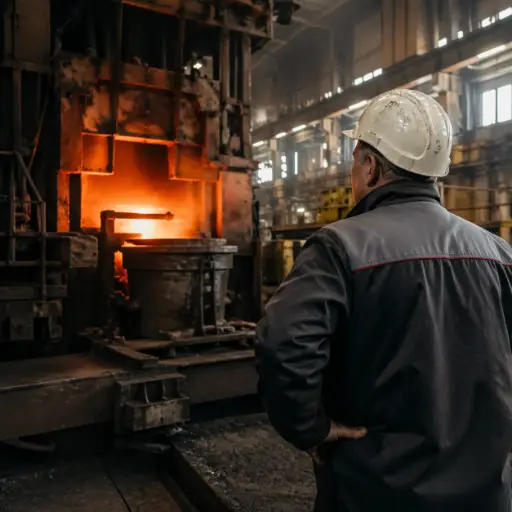
A growing sense of unease is spreading across Russia’s industrial heartland as signs mount that the country’s economy is losing momentum more sharply than official narratives suggest. One of the clearest warnings has come from Vladimir Bogaljov, director of a major foundry and mechanical plant in Cherepovets, who has publicly raised the alarm about what he describes as a deep and potentially fundamental crisis taking shape.
Bogaljov’s concerns center on a combination of weakening demand, faltering industrial policy, and a widening gap between economic reality and reported data. His remarks reflect a broader frustration among business leaders who, after years of adaptation to sanctions and shifting trade patterns, are now confronting a more difficult phase defined less by external shocks and more by internal stagnation.
At the core of the problem lies the failure of import substitution, a strategy heavily promoted by Moscow to replace foreign goods with domestically produced alternatives. While initially framed as an opportunity to strengthen economic sovereignty, the policy is now showing signs of strain. According to Bogaljov, the anticipated surge in demand for locally manufactured products has not materialized. Instead, many enterprises are facing shrinking orders, idle capacity, and increasing financial pressure.
This downturn in demand appears to be linked to broader economic fatigue. After a period of relative resilience driven by state spending and reoriented exports, consumption and investment are now cooling. Industrial firms, particularly those outside the defense sector, are finding it harder to secure stable contracts. The result is a growing imbalance between production capabilities and actual market needs.
Bogaljov has also expressed skepticism about the reliability of official economic data, a concern that resonates with analysts both inside and outside the country. He suggests that the absence of transparent and accurate statistics makes it difficult for businesses to plan effectively. Without a clear picture of market conditions, companies are forced to operate in an environment of heightened uncertainty, increasing the risk of misallocation and financial losses.
This issue of data credibility is particularly sensitive. Over recent years, access to detailed economic information has become more limited, with some indicators no longer published or significantly delayed. While authorities argue that such measures are necessary under current geopolitical conditions, critics contend that the lack of transparency undermines confidence and distorts decision-making.
The industrial sector, long considered a backbone of the Russian economy, is now at a crossroads. Enterprises that once benefited from stable export markets and predictable supply chains are adapting to a more fragmented and constrained environment. In some cases, companies have successfully redirected trade flows and developed new partnerships. In others, however, the transition has exposed structural weaknesses that were previously masked by stronger external demand.
For regions like Cherepovets, where heavy industry plays a central role in local employment and economic stability, the stakes are particularly high. A sustained decline in industrial activity could have ripple effects across communities, affecting jobs, incomes, and public finances. Local leaders are increasingly aware that the challenges facing large plants are not isolated but part of a broader national trend.
Despite these concerns, there is no clear consensus on how to address the emerging crisis. Some policymakers advocate for increased state support, including subsidies and targeted investment programs. Others argue for structural reforms aimed at improving efficiency, competitiveness, and integration into global markets. However, such reforms are complicated by geopolitical constraints and the current policy environment.
Bogaljov’s warning stands out not only for its content but also for its tone. As a senior figure within a major industrial enterprise, his public acknowledgment of systemic risks signals a shift in discourse. It suggests that concerns once confined to private discussions are now becoming more openly expressed, reflecting a growing recognition that the challenges facing the economy are both serious and deeply rooted.
Whether these warnings will translate into policy changes remains uncertain. What is clear, however, is that the Russian economy is entering a more complex and less predictable phase. The combination of declining demand, policy limitations, and uncertain data creates a difficult landscape for businesses and policymakers alike.
As the situation evolves, the coming months will be critical in determining whether the current slowdown stabilizes or deepens into a more profound crisis. For now, voices like Bogaljov’s serve as an early signal that beneath the surface of resilience, significant pressures are building.