How a woman living with ALS returned to the stage through digital technology — and why her story is inspiring audiences far beyond the world of dance

Breanna Olson spent most of her life moving. Growing up in the American state of Washington, she immersed herself in dance from an early age, exploring modern dance, jazz and classical ballet with the determination of someone who felt most alive on stage. Movement became her language, a way to express emotion long before words were needed.
For years, dance shaped her identity. Friends remember her as energetic and disciplined, the kind of performer who stayed behind after rehearsals long after others had gone home. But everything changed when she was diagnosed with amyotrophic lateral sclerosis, better known as ALS — a progressive neurodegenerative disease that gradually weakens muscles and eventually leads to paralysis.
The diagnosis forced Olson into a reality she could never have imagined. Step by step, movement became more difficult. Routines that once seemed effortless turned exhausting. Eventually, dancing was no longer physically possible.
“It felt as if a part of me disappeared,” she said during a recent public discussion connected to the performance project that has now drawn international attention.
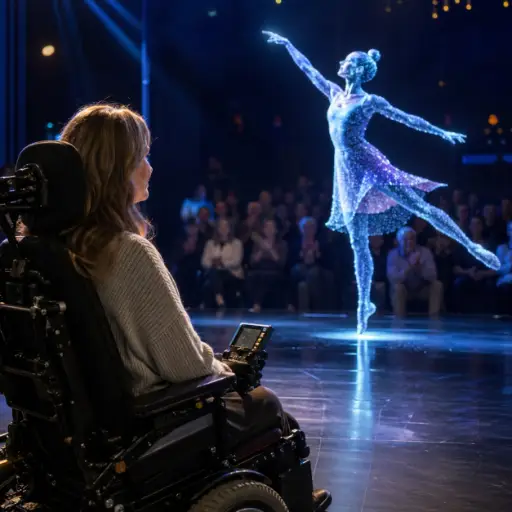
Yet in recent months, Olson has returned to the stage in a way few could have predicted. Through advanced motion-capture technology and a highly detailed digital avatar, she was able to perform before a live audience once again. The project, combining art and artificial intelligence, has become a powerful symbol of how technology is increasingly intersecting with healthcare, creativity and personal identity.
The performance took place in a packed theater where spectators watched a luminous digital figure move gracefully across the stage. Every gesture and sequence was inspired by Olson own choreography, memories and artistic style. While the physical limitations of ALS remain, the avatar recreated movements she can no longer perform herself.
Audience members described the experience as emotional and deeply human rather than technological. Many were visibly moved as the virtual dancer spun beneath the lights while Olson watched from the front rows.
For researchers and digital artists, projects like this represent more than visual innovation. They highlight a growing effort to preserve personal expression for people living with degenerative illnesses. Specialists involved in similar initiatives say digital avatars may eventually become therapeutic tools, helping patients maintain emotional connection to activities they once loved.
ALS remains one of the most challenging neurological diseases. It affects nerve cells responsible for controlling voluntary muscles, progressively limiting movement, speech and eventually breathing. Despite years of research, there is still no cure. Public awareness of the illness increased globally after the viral “Ice Bucket Challenge,” but experts say many patients still struggle with isolation and loss of identity after diagnosis.
That emotional dimension is central to Olson story.
“She did not want to be remembered only through illness,” one member of the creative team explained after the performance. “She wanted people to remember the artist she always was.”
The project required months of collaboration between choreographers, programmers and medical consultants. Old rehearsal footage, photographs and recordings were analyzed to reconstruct Olson characteristic movements and posture. Dancers also worked closely with the team to help translate her artistic vision into digital form.
The result was not intended to create an illusion that the disease had disappeared. Instead, the performance openly embraced the contrast between physical limitation and artistic freedom. On stage, the avatar danced with fluidity and confidence, while Olson herself remained present as the emotional center of the production.
The story has resonated strongly online, where clips of the performance have spread rapidly across social media platforms. Many viewers described the performance as hopeful without becoming sentimental. Others saw it as a glimpse into how future technology could help preserve memory, creativity and individuality for people facing life-altering conditions.
Medical ethicists are also paying attention. While digital replicas and AI-generated representations raise complex ethical questions, experts say Olson participation demonstrates how such technology can be empowering when controlled by the individuals themselves.
For Olson, the moment was less about innovation and more about reconnection.
After years spent mourning the loss of dance, she found herself once again hearing applause in a theater — the place where she had always felt most complete.
Her return did not erase the realities of ALS. But for one evening, technology allowed movement to transcend the limitations of the body. And in doing so, it reminded audiences that art, identity and human expression can survive even when illness attempts to silence them.