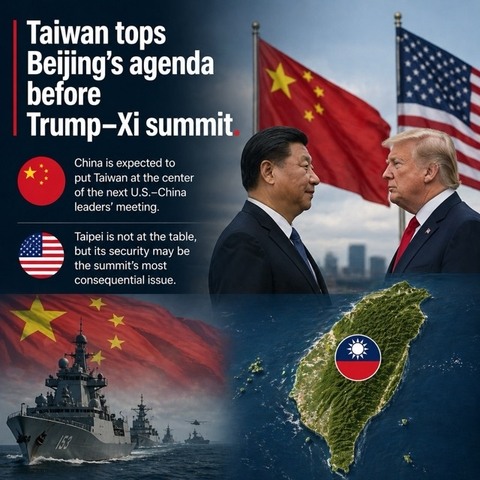
Beijing is expected to make the island the most sensitive issue in the next U.S.-China leaders’ meeting, while Taipei watches from outside the room.

BEIJING/TAIPEI/WASHINGTON, May 2, 2026
For Taiwan’s 23 million people, the most important diplomatic meeting of the year may be one in which they have no seat. As President Donald Trump prepares to meet Chinese President Xi Jinping in Beijing next month, Beijing is signaling that Taiwan will not be a side issue, a closing paragraph or an awkward topic to be deferred. It will be central.
The shift matters because summit language can become strategic reality. China has long claimed Taiwan as its own and has never ruled out the use of force. The United States maintains a one China policy, acknowledges Beijing’s position without accepting its sovereignty claim, does not support Taiwan independence and is legally committed to help Taiwan maintain the ability to defend itself. That careful wording has underpinned decades of strategic ambiguity.
Beijing now appears intent on testing whether Trump will keep that formula intact. Chinese officials and policy advisers have pushed a sharper line: Washington should say it opposes Taiwan independence, not merely that it does not support it. To a casual reader, the difference may sound semantic. To diplomats, military planners and investors across Asia, it is anything but.
A shift from does not support to opposes would be read in Beijing as movement toward China’s preferred red line, and in Taipei as a weakening of American reassurance. Taiwan’s government is not asking for a formal declaration of independence; President Lai Ching-te argues that Taiwan already functions as an independent country under its official name, the Republic of China. Beijing describes him as a separatist and illegitimate leader.
Trump’s approach gives the issue added volatility. Allies across Asia have been unsettled by his transactional style, especially when security commitments are discussed alongside trade deals, aircraft purchases, agriculture, technology controls and market access. Taipei’s fear is not necessarily that Washington will abandon Taiwan in a dramatic statement. It is that a small rhetorical adjustment, offered as part of a broader bargain with Xi, could change how Beijing calculates American resolve.
The White House and senior U.S. officials have repeatedly said there has been no change in Taiwan policy. They point to arms sales, routine condemnation of Chinese pressure and public reassurances from U.S. representatives in Taipei that commitments under the Taiwan Relations Act remain strong. Still, the politics of reassurance are harder when the summit partner is absent from the room.
Beijing’s strategy is not limited to diplomatic wording. China has paired military pressure with incentives, warning against separatism while emphasizing the economic benefits it says unification would bring. Taiwan has rejected those appeals, saying its future can be decided only by its people. The island’s major political parties remain opposed to Beijing’s preferred one country, two systems model, especially after Hong Kong’s experience damaged confidence in Chinese autonomy promises.
The summit also comes at a moment when Taiwan’s strategic value is unusually visible. The island is central to global semiconductor supply chains and sits at a key point in the western Pacific, near sea lanes and intelligence positions that matter to U.S. and allied defense planning. Any change in the perceived strength of U.S. backing would reverberate from Tokyo to Manila, and from boardrooms dependent on chips to military commands responsible for contingency planning.
For Xi, putting Taiwan at the center of the meeting serves several purposes. Domestically, it reinforces a nationalist message that reunification is a core mission of the Chinese state. Diplomatically, it seeks to narrow the space for U.S. support by framing Taiwan as the core of China’s core interests. Strategically, it probes whether the Trump administration is willing to trade precision in Taiwan language for progress on other files.
For Trump, the calculus is different. He wants leverage in a broad relationship that includes trade, technology, fentanyl controls, supply chains, energy, defense spending and regional stability. Taiwan is both a bargaining chip that cannot safely be treated as one and a potential flashpoint that could overshadow any economic deliverable. Even an ambiguous phrase intended to preserve flexibility could be interpreted as a signal by one side and a warning by the other.
Taipei’s options are limited. It can lobby Washington, brief allies, accelerate defense reforms and avoid actions that give Beijing an excuse to claim provocation. But it cannot control what the leaders of the United States and China say behind closed doors or how they describe their conversation afterward. That is why the post-summit readout may matter almost as much as the meeting itself.
If Washington repeats existing language and Beijing claims no new concession, Taipei will breathe easier, even if tensions remain. If the communique, press conference or leaked account suggests a shift toward opposing Taiwan independence, the consequences could be immediate: political alarm in Taipei, concern among U.S. allies and a possible adjustment in Chinese military pressure. The summit is being framed as a major U.S.-China encounter, but Taiwan may be its most consequential test.