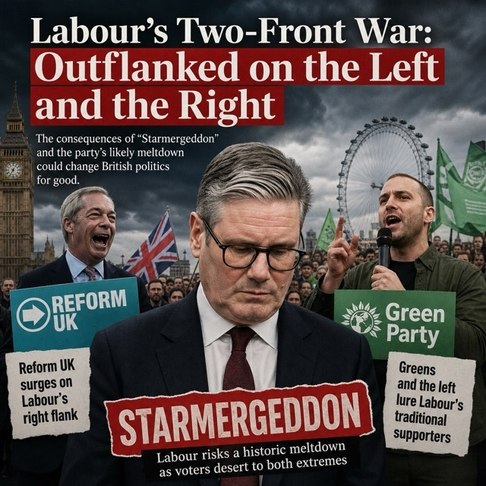
The joke has curdled. “Starmergeddon” was once a Conservative scare word and, after Labour’s 2024 landslide, a Westminster punchline for the scale of Keir Starmer’s victory.

Today, it has acquired a darker meaning: not the arrival of Starmerism, but the possible collapse of its electoral coalition. Labour is not merely facing a bad mid-term. It is being squeezed simultaneously by Nigel Farage’s Reform UK on the right, by the Greens and new left formations on the left, and by a volatile electorate no longer behaving as though British politics has two natural parties of government.
The numbers explain the panic. Labour won the 2024 general election with 411 seats and 33.7% of the vote — a landslide in seats, but a brittle mandate in votes. That disparity mattered less when the Conservatives were shattered and Reform and the Greens looked like protest vehicles. It matters now because the protest vehicles are becoming electoral machines. Recent polling has shown a fragmented political landscape in which Labour risks slipping into third place, barely ahead of insurgent challengers.
This is the structural nightmare behind the local-election forecasts. Voters across England are set to elect thousands of councillors, alongside devolved and mayoral contests. Forecasts suggest Labour could lose a significant share of the seats it is defending. Such losses would be unprecedented for a governing party in modern British politics.
The danger for Starmer is not simply arithmetical. It is geographical and cultural. Reform is advancing where Labour once assumed its “red wall” credentials still meant something: post-industrial towns, Leave-voting areas, and places where voters prioritise migration, housing, crime and wages. If Reform can win not only former Conservative areas but symbolic Labour heartlands, it will have crossed from insurgency into replacement politics.
On Labour’s other flank, the Greens have ceased to be a polite repository for environmental concern. They are pitching themselves as the angry progressive alternative: rent controls, wealth taxes, nationalisation, Palestine, climate and public services. Recent by-election results have shown Labour losing voters both to Reform on one side and to the Greens on the other — a clear signal of a fragmented electorate.
Nor are the Greens Labour’s only problem on the left. New political formations and independent candidates are attracting voters who see Starmerism as overly cautious and technocratic. This matters because Labour’s large parliamentary majority is built on constituencies that may appear safe but could become vulnerable if opposition votes consolidate.
The immediate Labour response has been to denounce “shortcuts” offered by rivals. Starmer has criticised both left and right populists for offering easy answers. Yet this message has struggled to resonate with voters who feel economically insecure and politically ignored.
The risk is that Labour’s 2024 majority begins to look less like a durable settlement and more like an anti-Conservative reaction. Once the Conservatives ceased to be the sole focus of public frustration, Labour has had to generate its own political enthusiasm — and it has struggled to do so.
The consequences could extend beyond England. In Wales and Scotland, Labour faces significant challenges from nationalist parties and insurgent movements. If Labour loses ground in these regions, the implications would go beyond a mid-term setback and point toward a deeper political realignment.
Inside Westminster, the practical question is what Labour MPs do after a major electoral setback. Leadership speculation has already begun, with several prominent figures mentioned as potential successors. However, any leadership change carries risks, including economic uncertainty and market reactions.
There are still caveats. Local elections are not general elections, and insurgent parties remain largely untested in government. Britain’s electoral system can still reward larger parties. However, the trend is clear: the traditional two-party system is under strain.
That is why “Starmergeddon” has become more than a meme. It is shorthand for the potential end of the Labour–Conservative duopoly. If Labour suffers heavy losses, the question will not simply be whether it can recover, but whether British politics has entered a new, more fragmented era.