Russia has expanded security protocols around Vladimir Putin as the war in Ukraine deepens fears of assassination, sabotage and elite instability.

MOSCOW — Vladimir Putin’s presidency has long depended on the projection of control: choreographed meetings, staged displays of military strength, and the image of a leader permanently above the turbulence he helped unleash. But as the war in Ukraine grinds into its fifth year and Ukrainian drones reach deeper into Russian territory, the Kremlin’s security architecture around Putin appears to be hardening into something more claustrophobic.
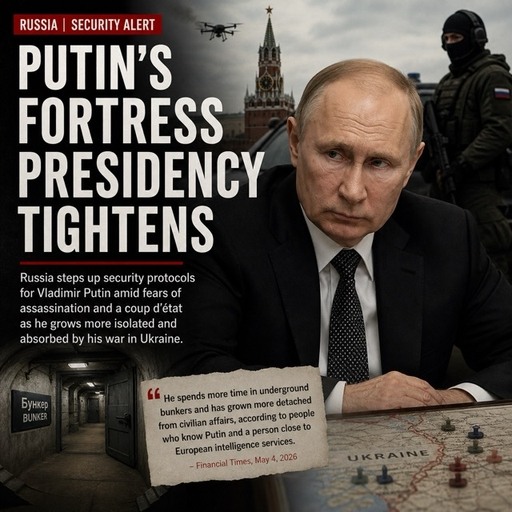
Russia has stepped up personal security protocols for the president amid fears of assassination and possible internal plotting, according to recent reporting by the Financial Times, which cited people who know Putin and a person close to European intelligence services. The report described a leader spending more time in underground bunkers, absorbed by military decisions and increasingly detached from civilian affairs.
The claims are difficult to independently verify, as nearly every detail of Putin’s personal security regime is treated as a state secret. But they fit a broader pattern visible in recent months: intensified protection for senior military officials, new restrictions around presidential staff, reduced public exposure and a Kremlin increasingly preoccupied with the possibility that the war’s violence could penetrate the inner sanctum of power.
Reports citing a European intelligence assessment obtained by CNN say the Kremlin has installed surveillance systems in the homes of staff close to Putin, barred cooks, bodyguards and photographers from using public transportation, limited phones near the president to devices without internet access, and required visitors to pass through two screenings before meeting him. The same assessment said Putin has spent weeks at a time in upgraded bunkers since the 2022 invasion, often in Krasnodar, far from Moscow.
The anxiety is no longer theoretical. In March, Russia’s FSB chief said protection for high-ranking military officials would be increased after a series of assassinations and attempted killings blamed by Moscow on Ukraine. One of the most serious incidents was the February shooting of Lt. Gen. Vladimir Alexeyev, deputy head of Russia’s GRU military intelligence service, who was attacked in a Moscow apartment building and survived. Ukraine denied involvement.
Late last month, another strike underscored the vulnerability of Russia’s military elite. An explosion in a closed military town in Russia’s far east killed a subordinate officer in what sources told The Guardian appeared to be a failed attempt to target Maj. Gen. Azatbek Omurbekov, the Russian commander associated with the occupation of Bucha in 2022. The attack took place inside a restricted garrison community where access is controlled, raising fresh questions about the reach of clandestine operations inside Russia.
For Putin, the danger is twofold. The first is external: Ukraine’s expanding drone and sabotage capability. The second is internal: the possibility that Russia’s political and security elite, exhausted by war and fearful of blame, could become a source of threat rather than protection.
That is the fear now shadowing the Kremlin. According to reports citing European intelligence, Moscow has grown especially concerned since March 2026 about leaks, drone-enabled assassination attempts and a possible coup plot involving members of Russia’s elite.
The timing matters. Ukraine has dramatically expanded long-range strikes against Russian infrastructure, especially energy targets that help fund the war. On Sunday, May 3, Ukrainian drones hit Russia’s Baltic Sea oil port of Primorsk, one of the country’s largest export gateways, and struck vessels including an oil tanker, a missile ship and a patrol boat, according to Reuters and Ukrainian President Volodymyr Zelenskyy. Russian officials said fires were extinguished and dozens of drones were intercepted.
The same wave of strikes showed how far the battlefield has stretched. AP reported that Primorsk lies more than 1,000 kilometers from Ukraine, while Russian and Ukrainian officials each reported civilian casualties from drone attacks on both sides. Russia said hundreds of Ukrainian UAVs were downed overnight over Russia and occupied Crimea, while Ukraine said Russia had launched one of its largest drone and missile barrages against Ukrainian targets.
Even the Kremlin’s most sacred annual military ritual has been scaled back. Russia’s May 9 Victory Day parade in Red Square will proceed without armored vehicles or missile systems for the first time in nearly two decades, a change the Russian Defense Ministry attributed to the “current operational situation.” The Kremlin blamed “Ukrainian terrorist activity,” while analysts said Moscow likely feared drone strikes against military hardware during preparation or the parade itself.
The symbolism is stark. For more than two decades, Putin has used Victory Day to bind his rule to the Soviet victory over Nazi Germany, presenting himself as guardian of Russian historical memory and military grandeur. This year, the absence of tanks may speak louder than the parade itself: the war Putin launched to restore Russian power has made the Russian capital more vulnerable, not less.
The security measures around Putin also suggest a leader increasingly governing through filters. Former FSO officer Gleb Karakulov, who defected in 2022 and later spoke to the Associated Press and the Dossier Center, described Putin as isolated from ordinary information flows, saying he did not use a mobile phone or the internet and received information only from people close to him. Karakulov also said Putin preferred an armored train because aircraft could be tracked, used strict quarantine procedures, and maintained identical offices in multiple locations to obscure his whereabouts.
That older testimony now looks less like an eccentric portrait and more like the foundation of a wartime system. The president’s mobility, information intake and physical exposure all appear to be narrowing at precisely the moment the war requires broader political judgment. A leader who once cultivated the image of command from the Kremlin’s gilded rooms is increasingly associated with bunkers, duplicated offices, decoys and carefully controlled appearances.
The Kremlin still projects normality. Putin continues to issue orders, hold televised meetings and speak in the language of confidence. Russian forces continue to push in eastern Ukraine, including around Kostiantynivka in Donetsk, according to Ukrainian officials cited by Reuters. But the performance of control is now competing with evidence of strain: assassinations of military figures, drone strikes on strategic infrastructure, scaled-back public rituals and tighter monitoring of the people closest to the president.
There is no public evidence that a coup attempt is imminent. Russia’s coercive institutions remain powerful, the opposition has been crushed, and the elite still has strong incentives to avoid open confrontation. But authoritarian systems can become brittle when trust collapses inward. The more Putin relies on a shrinking circle, the more information reaches him through loyalists with reasons to flatter, conceal or deflect. The more security tightens, the more it signals that the Kremlin itself sees vulnerability.
For Ukraine, the logic is clear: bring the war home to the Russian state, raise the cost of aggression and erode the aura of impunity around Moscow’s military leadership. For Putin, the response has been to deepen the walls around the presidency.
The result is a paradox of power. Putin has built one of the most centralized political systems in the world, yet that centralization has made his personal security a strategic vulnerability. The Russian state may still look formidable from the outside. From within the bunker, it may look far less secure.