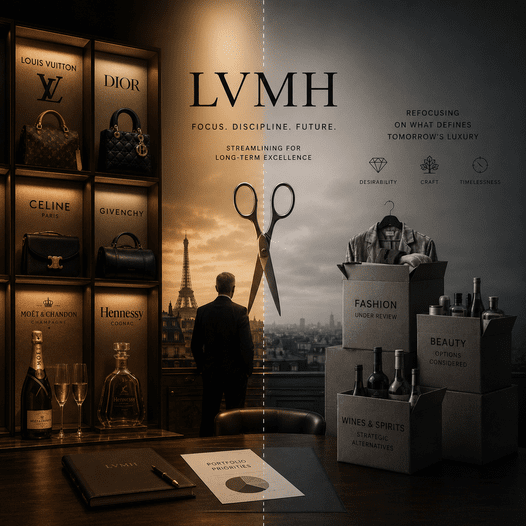
As luxury demand cools, the world’s most powerful luxury group is weighing disposals of fashion, beauty and drinks assets in a rare act of portfolio discipline.

PARIS, MAY , 2026 — For nearly four decades, LVMH’s corporate grammar was acquisition. Bernard Arnault built the world’s dominant luxury group by adding maisons, categories, geographies and myths. Now, in a colder luxury market, the verb has changed: sell.
The French luxury group is exploring disposals of several fashion, beauty and drinks assets, including Marc Jacobs, its stake in Rihanna’s Fenty Beauty and U.S. wine producer Joseph Phelps Vineyards, according to reports citing people familiar with the matter. Other assets under review reportedly include Make Up For Ever, Fresh and parts of Moët Hennessy’s drinks portfolio. If completed, the sales could raise billions of euros and would mark one of the most visible portfolio retreats in LVMH’s modern history.
The timing is telling. LVMH, created in 1987 from the merger of Moët Hennessy and Louis Vuitton, has long presented scale as a virtue: 75 brands, six business sectors, more than 6,280 stores and a global architecture designed to turn craftsmanship into financial power. But scale is no longer automatically rewarded when luxury demand slows and smaller labels require capital, creative oxygen and management attention.
LVMH’s latest quarterly figures show why the review has taken on urgency. First-quarter 2026 revenue came in at €19.1 billion, down 6 percent on a reported basis but up 1 percent organically. Fashion & Leather Goods, the division that houses Louis Vuitton and Dior and remains the engine of the group, fell 2 percent organically. Perfumes & Cosmetics was flat. The company also pointed to weaker tourist spending in Europe and Japan and said conflict in the Middle East had trimmed organic growth by about one percentage point.
That backdrop changes the arithmetic. In the boom years, LVMH could carry promising but less central names because Louis Vuitton, Dior, Sephora and Tiffany generated the cash and prestige to sustain experimentation. In the current market, the question becomes sharper: does each brand strengthen the group’s core, or dilute attention from it?
Marc Jacobs is the most symbolic fashion name in the reported review. The American label, founded in 1984, has a storied connection to LVMH: Jacobs became Louis Vuitton’s creative director in 1997, the same year LVMH took a stake in his own brand. In 2025, Reuters reported that LVMH had held talks with potential buyers including Authentic Brands Group and WHP Global, while earlier market reports put a possible valuation around $1 billion.
Fenty Beauty is a different case. Launched in 2017 with Rihanna through LVMH’s Kendo Brands incubator, it became one of the most culturally resonant beauty launches of the past decade by making inclusivity a commercial proposition. Reuters reported in October 2025 that LVMH was exploring a sale of its 50 percent stake, working with Evercore, and that the brand generated about $450 million in net sales in 2024. Its potential valuation was put in the range of $1 billion to $2 billion.
Selling Fenty would not necessarily be an admission of failure. It could be a recognition that celebrity-led beauty behaves differently from heritage luxury. It moves faster, faces fiercer product cycles and depends heavily on founder heat, distribution discipline and social-media relevance. For LVMH, cashing out of a high-profile minority position may be more attractive than continuing to compete in a crowded beauty market where even successful brands must keep spending to stay visible.
The drinks assets point to a more classic restructuring logic. LVMH’s Wines & Spirits division has been under pressure, with recurring operating profit falling from €2.11 billion in 2023 to €1.36 billion in 2024 and €1.02 billion in 2025. Reported assets under review, including Joseph Phelps Vineyards and rum label Eminente, sit in a division where management is already seeking sharper discipline.
The broader industry explains why Arnault’s group is acting now. Bain and Altagamma estimated that overall luxury spending declined in 2025, while forecasting only a cautious recovery for personal luxury goods in 2026. The warning behind those numbers is that repeated price increases have alienated younger and aspirational customers, leaving the sector more dependent on its wealthiest clients and on truly iconic products.
That matters because the post-pandemic luxury boom was driven not only by the very rich, but also by consumers stretching into handbags, sneakers, perfumes and logo goods. As inflation, interest rates, geopolitical shocks and China’s uneven recovery have weighed on confidence, the aspirational buyer has become more selective. The result is a more Darwinian luxury market: true icons still command pricing power; peripheral brands must prove they deserve investment.
LVMH has already begun pruning. The group sold Off-White to Bluestar Alliance, while Stella McCartney repurchased LVMH’s minority stake in her brand. Those moves now look less like isolated transactions than the early stages of a portfolio reset.
The shift is especially striking because LVMH’s identity has been built around patience. The company often says luxury brands need long horizons, not quarterly reflexes. But patience is not the same as sentimentality. A house may have heritage, fame or cultural capital and still fail the internal test of scale, margin and strategic relevance.
For investors, the message is pragmatic. LVMH is not dismantling its empire; it is trying to protect the engines of it. Louis Vuitton, Dior, Tiffany, Sephora, Guerlain and other high-performing maisons remain the capital-allocation priority. The potential disposals suggest that, in a slower market, the world’s largest luxury group would rather be more concentrated than merely bigger.
For the industry, the signal is sharper. If LVMH — the consolidator that defined modern luxury — is now willing to sell, the era of easy conglomerate expansion is over. The new luxury discipline is not just about desirability on the runway or scarcity in the boutique. It is about whether a brand earns its place inside the machine.
As of today, none of the reported sales should be treated as completed. LVMH has not publicly confirmed the full portfolio review, and earlier processes around Marc Jacobs and Fenty were described by Reuters as confidential and subject to change. But the direction is hard to miss: the house that taught luxury how to accumulate is now showing the industry how to edit.