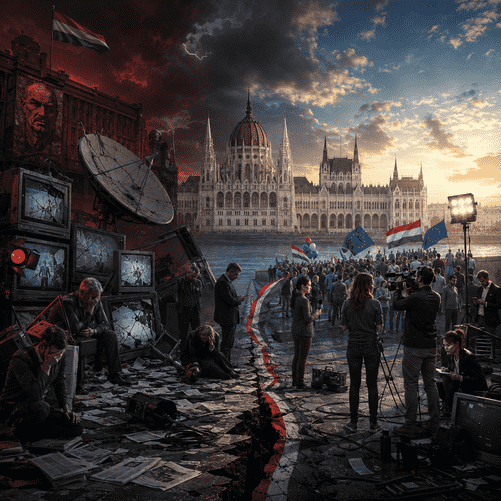
The collapse of Hungary’s long-ruling nationalist government is triggering a rapid shake-up of the country’s pro-government media ecosystem, with implications for press freedom and EU politics.

Hungary’s political transformation is moving from parliament into the media sphere, as the powerful communications network built around former Prime Minister Viktor Orbán begins to fracture following his election defeat.
According to Reuters, the media empire that supported Orbán’s government during his 16 years in power is “swiftly unravelling” after last month’s election, which was won in a landslide by the centre-right opposition led by Péter Magyar. Senior figures at prominent pro-Orbán outlets have reportedly been pushed out, while a flagship news programme has been scrapped.
The shift marks one of the most consequential political changes in Central Europe in years. Orbán had been one of the European Union’s most durable nationalist leaders, frequently clashing with Brussels over rule-of-law issues, media freedom, migration, Ukraine policy and relations with Russia. His defeat has removed a major obstacle from EU decision-making and weakened one of the most visible models of illiberal governance in Europe.
For years, Hungary’s media environment was central to Orbán’s political dominance. Supportive television channels, newspapers and online outlets amplified government messaging while critics accused the ruling party of concentrating media ownership among loyal business allies. The rapid post-election changes suggest that the network’s strength depended heavily on continued political power.
Magyar’s victory has also raised expectations in Brussels. Hungary had been under pressure over EU funding and rule-of-law reforms, and the new leadership is expected to face intense scrutiny over how quickly it can restore institutional independence, improve transparency and rebuild trust with European partners. Earlier in the campaign, Magyar said he wanted to reform state media, though press-freedom groups warned that any intervention must avoid simply replacing one form of political control with another.
The stakes extend beyond Hungary. Orbán’s government had become a reference point for populist and nationalist parties across Europe, offering a blueprint for centralizing power, challenging liberal institutions and resisting EU pressure. Its fall has therefore been interpreted as a setback for Europe’s far right, even as nationalist parties remain influential in countries including France, Italy, Austria, the Netherlands and Germany.
The coming months will test whether Hungary’s political reset becomes a genuine democratic restoration or merely a change in governing personnel. The dismantling of Orbán’s media architecture may create space for a more pluralistic public debate, but it also poses a delicate challenge: rebuilding institutions without politicizing them again.
For the European Union, Hungary’s transition offers both an opportunity and a warning. If Magyar’s government successfully restores institutional credibility, Brussels could regain a more cooperative partner in Central Europe. But if the media shake-up turns into a new partisan struggle, Hungary’s post-Orbán era may begin with the same unresolved question that defined the previous one: who controls the public narrative?