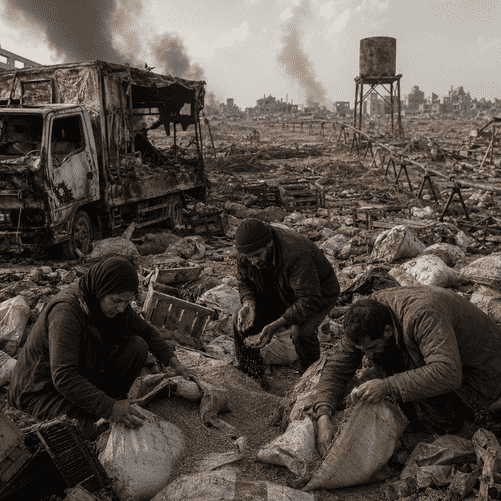
New analysis documents more than 20,000 incidents of “food-related violence” since 2018, exposing how markets, farms, aid convoys and water systems are increasingly being targeted in modern conflicts.

Hunger is no longer only a consequence of war. In many of the world’s most violent conflicts, it is becoming one of its weapons.
A new analysis by Insecurity Insight has documented 21,403 incidents of food-related violence across 15 countries since 2018, the year the UN Security Council unanimously adopted Resolution 2417 condemning the starvation of civilians as a method of warfare. The findings point to a disturbing pattern: food systems are being attacked not as collateral damage, but as strategic targets.
The recorded incidents include 1,261 attacks on markets, 863 attacks on food distribution systems, 1,909 military strikes on farmland and 563 attacks on water infrastructure essential for agriculture. Together, they show how violence is spreading across every stage of survival: production, transport, distribution and access.
The countries and territories most affected include the occupied Palestinian territory, with more than 9,000 recorded incidents, followed by Yemen, Sudan, Syria and Mali. In Sudan, where war has devastated civilian life, a recent drone attack on a crowded market in West Kordofan reportedly killed 28 people, underlining how ordinary spaces of daily survival have become military targets.
The rise in food-related violence is especially alarming because it turns hunger into a long-term instrument of control. Bombing markets does not only kill civilians in the moment; it destroys local commerce. Striking farmland does not only eliminate crops; it undermines future harvests. Blocking aid convoys does not only delay relief; it forces civilians into desperation, displacement and dependency.
Humanitarian groups warn that these attacks are part of a broader erosion of protections for civilians in conflict zones. Markets, bakeries, farms, water systems, livestock and aid routes are increasingly exposed to violence, even though international humanitarian law protects objects essential to civilian survival. UN Security Council Resolution 2417 explicitly condemns the use of starvation as a method of warfare and demands that parties to conflict protect such civilian infrastructure.
The human cost is severe. Researchers found that between late 2023 and the end of 2025, more than 10,300 people were killed or injured while trying to access aid. This means civilians are not only being deprived of food; in some places, they are being attacked while attempting to obtain it.
Women and children are among the most exposed. In insecure areas, women often travel longer distances to find food, increasing the risk of violence, exploitation or detention. Many also reduce their own food intake to feed children or elderly relatives. For children, prolonged hunger can damage physical growth, education and cognitive development, creating consequences that last far beyond the battlefield.
The analysis also reinforces a wider global trend: conflict remains the leading driver of acute hunger. The World Food Programme estimates that 363 million people are at risk of acute hunger in 2026, with an additional 45 million people at risk because of the Middle East conflict.
Experts argue that the issue is not the absence of international law, but the failure to enforce it. Resolution 2417 created a framework for identifying and condemning starvation tactics, but accountability has remained limited. Without stronger political pressure, investigations and sanctions, attacks on food systems risk becoming normalized features of modern war.
The latest findings reveal a brutal evolution in conflict: the battlefield is no longer limited to military positions, roads or cities. It now extends to wheat fields, water pumps, livestock routes, food warehouses and market stalls.
For civilians trapped in war zones, survival increasingly depends not only on whether food exists, but on whether armed actors allow it to reach them. That is what makes the weaponization of hunger so devastating: it transforms the most basic human need into a tool of pressure, punishment and control.