Tankers turning off tracking signals highlight the risks facing global oil flows — and the pressure Tehran can exert at the negotiating table

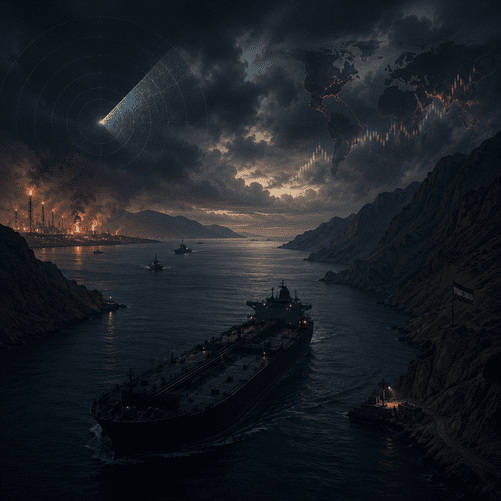
Ships are quietly attempting to slip through the Strait of Hormuz with their tracking systems switched off, a sign of how dangerous and politically charged the world’s most important energy chokepoint has become.
The tactic, known in the shipping industry as sailing “dark,” involves disabling a vessel’s Automatic Identification System, or AIS, which normally broadcasts its identity, location, speed and direction. In peacetime, AIS helps prevent collisions and allows ports, insurers and maritime authorities to monitor traffic. In a crisis, however, it can also make ships easier to track — and potentially easier to target.
Now, with tensions around Iran placing the Strait of Hormuz at the centre of global energy concerns, some tankers and commercial vessels appear willing to accept the risks of reduced visibility in order to move through the waterway more discreetly. The result is a murkier shipping picture, where official traffic data may understate the number of vessels actually moving through the Gulf.
The Strait of Hormuz is not just another maritime route. It is the narrow passage connecting the Persian Gulf to the Gulf of Oman and the wider Indian Ocean, and it carries a significant share of the world’s seaborne oil and liquefied natural gas. Any disruption there quickly becomes a global issue, affecting energy prices, insurance rates, shipping schedules and the economic calculations of governments far beyond the Middle East.
For Iran, the strait is also a source of strategic leverage. Tehran has long understood that its ability to threaten, slow or complicate traffic through Hormuz gives it bargaining power in moments of confrontation. The more uncertain the flow of ships becomes, the more pressure builds on energy-importing countries, oil markets and diplomatic negotiators.
That leverage is now being tested in real time. If Iran can make shipping through Hormuz feel unsafe or commercially unviable, it can influence global energy prices without fully closing the waterway. Even a partial slowdown can be enough to unsettle markets, force rerouting decisions and raise the cost of moving crude and gas.
The practice of sailing dark reflects that new risk environment. Shipowners and charterers must weigh the danger of being visible against the danger of becoming invisible. Turning off AIS may reduce exposure to hostile monitoring, but it also increases the risk of accidents, complicates rescue operations and may raise legal or insurance questions. In a crowded and strategically sensitive waterway, invisibility is not a simple solution.
The uncertainty is already being felt across the maritime industry. War-risk insurance premiums have climbed, crews face more dangerous assignments, and energy traders are watching vessel movements with unusual intensity. When ships disappear from public tracking platforms, analysts must rely on satellite imagery, naval reports, port data and delayed reappearances to reconstruct what has happened.
For oil markets, the problem is not only whether barrels are moving today, but whether they can continue moving reliably. Energy prices respond not just to physical shortages, but to fear — and Hormuz is one of the few places where fear can travel from the sea lanes to petrol stations, factories and central banks within days.
The crisis also exposes the limits of modern transparency. Global trade has become accustomed to being trackable in near real time, with ships, cargoes and supply chains visible across digital platforms. But in conflict zones, that visibility can disappear suddenly. The return of dark shipping shows that the global economy still depends on fragile physical routes that can be obscured, threatened or militarized.
Diplomatically, the flow of ships through Hormuz has become a measure of Iran’s negotiating strength. If vessels continue moving, even cautiously, Tehran’s leverage may be limited. If traffic remains depressed, insurers hesitate and energy markets stay nervous, Iran’s position at the table becomes stronger.
The United States and its partners are likely to keep trying to reassure markets and support safe passage, but the challenge is not only military. It is commercial and psychological. Shipping companies must believe the route is safe enough. Insurers must be willing to cover it. Buyers must trust that cargoes will arrive. Without that confidence, the strait can remain effectively constrained even if it is not formally closed.
For now, the darkened ships leaving Hormuz tell a larger story: global energy security is being decided not only in diplomatic rooms, but also on radar screens, satellite images and the silent movements of tankers trying to avoid detection.
The Strait of Hormuz has always been narrow. In this crisis, it has become narrower still — a passage where every voyage carries economic, military and political weight.