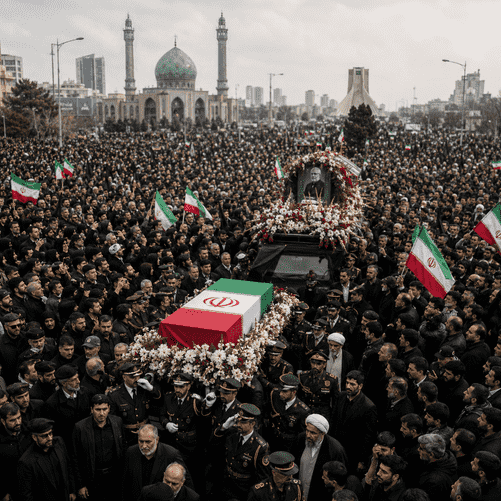
Millions are expected to take part in days of ceremonies across Iran and Iraq, as Tehran seeks to transform mourning for the slain supreme leader into a message of unity, resistance and political continuity.

TEHRAN — Massive crowds gathered in Tehran as Iran opened days of funeral ceremonies for Ayatollah Ali Khamenei, the former supreme leader whose death in a U.S.-Israeli strike has become a defining moment in the country’s escalating confrontation with the West.
The ceremonies began at Tehran’s Grand Mosalla mosque, where mourners lined up to pay their respects before the coffin is moved through a series of religiously significant cities. Iranian authorities expect between 15 million and 20 million people to attend events connected to the funeral, a turnout that officials have described as potentially the largest state funeral in the country’s history.
The funeral is scheduled to continue across several days, with processions planned in Tehran, Qom, Najaf and Karbala before Khamenei is buried in Mashhad, his birthplace and one of Iran’s most important religious centers.
For Iran’s leadership, the funeral is more than a national act of mourning. It is a carefully staged political event intended to project unity after months of war, domestic strain and uncertainty over the future of the Islamic Republic. State media and senior officials have framed Khamenei’s death as a martyrdom, linking the ceremonies to Iran’s long-standing narrative of resistance against Israel and the United States.
The atmosphere in Tehran reflected that message. Crowds carried flags, portraits and religious banners, while chants against America and Israel echoed through the funeral site. Al Jazeera reported that top Iranian officials and foreign dignitaries attended the ceremonies, with Western governments notably absent.
Khamenei’s death has left Iran at a sensitive political crossroads. He ruled the Islamic Republic for decades, shaping its security doctrine, nuclear policy, regional alliances and conservative political order. His supporters portray him as a guardian of Iranian sovereignty, while critics inside and outside the country remember his tenure for repression, economic hardship and the crushing of dissent.
That divide has not disappeared during the funeral. Opposition figures abroad have dismissed the ceremonies as state propaganda, arguing that official mourning does not reflect the views of many Iranians who suffered under Khamenei’s rule.
Still, the scale of the funeral gives Iran’s leaders an opportunity to demonstrate organizational strength and public loyalty at a time when the country faces intense external pressure. The presence of foreign delegations from allied and friendly states also signals that Tehran is seeking to reinforce its diplomatic position, even as tensions with Washington and Israel remain unresolved.
Security and crowd control are major concerns. Iran’s modern history includes massive funerals that overwhelmed authorities, most notably the 1989 funeral of Ayatollah Ruhollah Khomeini. With millions expected again, officials have prepared extensive road closures, transport plans and emergency measures to manage the crowds.
The funeral also comes amid fragile diplomatic maneuvering. Reports indicate that the war has paused or shifted into a tense ceasefire period, but negotiations remain uncertain and calls for revenge continue to dominate public messaging.
As Khamenei’s coffin moves from Tehran toward Iran’s holy cities, the ceremonies are likely to serve two audiences at once. For supporters, they are a final tribute to a leader who defined the Islamic Republic for a generation. For the state, they are a declaration that Iran’s political system remains intact — wounded, defiant and determined to survive the crisis that follows him.