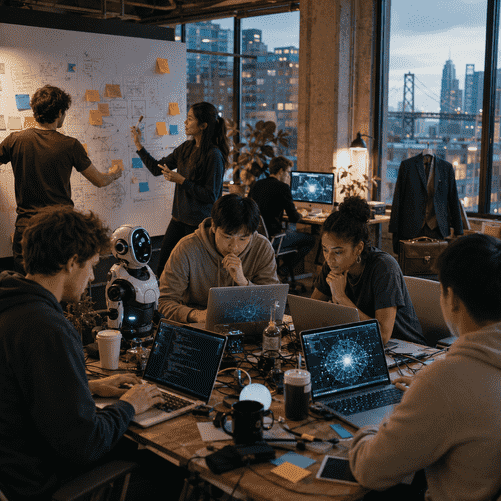
For generations of elite college students, a summer internship at a Wall Street bank, consulting firm or major technology company was treated as the safest route to prestige, income and long-term career security. This year, a growing number are choosing a different path: crowded San Francisco hacker houses, startup incubators and AI ventures built at high speed.

The shift reflects a changing view of opportunity among ambitious students at top universities. As artificial intelligence reshapes white-collar work and weakens confidence in traditional entry-level jobs, some students are deciding that the better bet is not to join an established institution, but to build a company before someone else does. The Wall Street Journal reported that students are leaving or pausing conventional summer tracks to join programs such as TekTrek and Yale Hacker House, where they receive housing, mentorship and access to investors while developing AI-focused startups.
The appeal is partly economic and partly cultural. AI has lowered the cost of building early products, allowing small teams of students to create tools in law, biotech, coding, education and enterprise software with fewer employees and less infrastructure than earlier startups required. At the same time, venture capitalists are eager to find young founders who understand the technology natively and can move faster than larger companies.
San Francisco has become the center of this summer migration. Hacker houses, once associated with scrappy coders sleeping near laptops and whiteboards, have evolved into structured communities offering shared housing, founder networks, demo days and direct paths to venture funding. The Atlantic recently described these houses as a new hub of the AI boom, with young builders packing into co-living spaces where work, social life and startup ambition merge almost completely.
For many students, the traditional internship looks less certain than it once did. Banks, consulting firms and technology companies are all experimenting with AI tools that can automate parts of the junior work once assigned to interns and entry-level analysts. Business Insider reported that Wall Street internships themselves are changing, with firms training interns to use and verify generative AI outputs rather than simply perform the routine spreadsheet and research tasks that long defined the job.
That change has created both anxiety and ambition. Some students worry that waiting to enter the job market may leave them behind, especially if AI compresses the number of junior roles available. Others see the disruption as permission to take bigger risks. In their view, spending a summer building an AI company can offer more practical experience, stronger networks and potentially far greater financial upside than a corporate internship.
The trend is especially visible around Stanford and other elite schools with deep ties to the technology industry. Business Insider reported earlier this year that some students are pausing degrees to pursue AI startups, with Stanford economist Nicholas Bloom comparing the moment to a modern gold rush. Students may see the risk as manageable: if the startup fails, they can often return to school with experience and connections; if it succeeds, they may have entered a once-in-a-generation market early.
Investors are helping make that choice easier. Some venture firms and startup programs now provide housing, workspace and stipends, reducing the immediate financial pressure on young founders. Previous reporting from The Wall Street Journal described investors backing college dropouts not only with capital but also with living arrangements and operational support, allowing founders to focus almost entirely on building.
Still, the startup path carries obvious risks. Many student-led companies will fail, and the speed of the AI boom can encourage unrealistic expectations. A summer spent chasing investors may produce less durable training than a demanding corporate internship or a completed degree. Some students also worry that the culture of constant building can blur the line between ambition and burnout, especially in environments where roommates, co-founders and competitors are often the same people.
Universities are now caught between encouraging entrepreneurship and keeping students engaged in formal education. Some schools are expanding AI courses, startup fellowships and leave-of-absence policies to stay relevant. But the pace of the market is difficult for academic institutions to match, particularly when students believe that the most important learning is happening outside the classroom.
The result is a broader redefinition of elite career success. Wall Street and big tech have not lost their appeal, but they no longer command the same automatic loyalty from the most ambitious students. In the AI era, the most prestigious summer plan may no longer be wearing a badge at a bank or corporate campus. It may be sleeping in a crowded house in San Francisco, pitching investors by day and building a company through the night.