Iran’s state funeral for former Supreme Leader Ayatollah Ali Khamenei turned into a highly charged display of mourning, political defiance and calls for revenge, as crowds gathered in Tehran while the country’s new supreme leader, Mojtaba Khamenei, remained absent from public view.

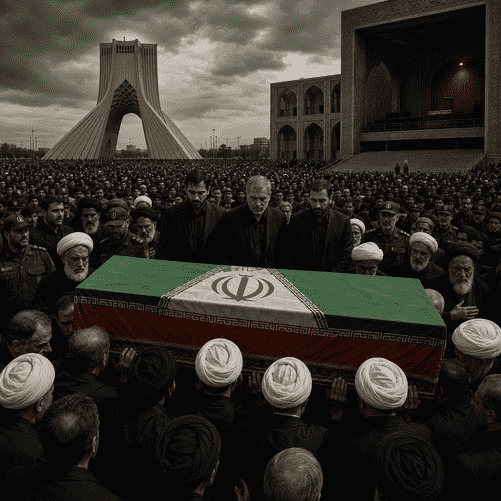
The ceremony at Tehran’s Imam Khomeini Grand Mosalla brought together senior Iranian officials, commanders and members of Khamenei’s family. Three of his sons — Mostafa, Meysam and Masoud — appeared beside their father’s coffin during funeral prayers, but Mojtaba, who has been named as his successor, did not attend. His absence has intensified speculation about his health, security situation and ability to consolidate authority after months out of sight.
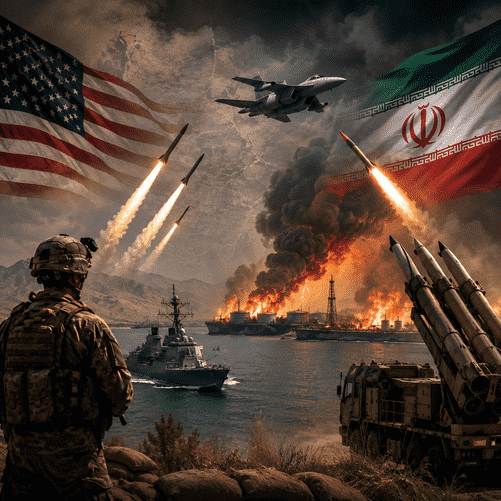
The funeral followed Khamenei’s death in a U.S.-Israeli strike on February 28, an event that reshaped Iran’s political landscape and deepened tensions with Washington and Israel. Iranian authorities used the ceremony to project unity and resilience, presenting the leadership as stable despite war, internal pressure and uncertainty over succession.
The event also became a platform for inflammatory anti-American and anti-Israeli rhetoric. During the ceremony, a performer called for Donald Trump’s death, while mourners and speakers repeated slogans against the United States and Israel. Posters and graffiti also targeted Israeli Prime Minister Benjamin Netanyahu, underscoring the intensity of public anger among regime supporters.
Mojtaba Khamenei’s absence was one of the most closely watched elements of the funeral. He has not made a confirmed public appearance since the February attack, and only written statements have been issued in his name. Iranian state-linked explanations have pointed to security concerns, while outside observers have questioned whether injuries, political caution or internal power struggles may be keeping him hidden.
The appearance of other senior figures appeared designed to offset those doubts. President Masoud Pezeshkian, Parliament Speaker Mohammad Bagher Ghalibaf and Revolutionary Guard officials were among those present, signaling continuity at the top of the Islamic Republic. Their public participation suggested that Iran’s leadership wanted to reassure supporters that the state remains intact despite foreign attacks and domestic unrest.
For Iran’s government, the funeral served several purposes at once. It honored the late leader, rallied loyalists around the Islamic Republic and sent a message to adversaries that the regime remains capable of mobilizing large crowds. Authorities also framed the event as a moment of national resistance, with mourners presenting Khamenei’s death as part of a broader confrontation with the United States and Israel.
But beneath the spectacle, the succession question remains unresolved in public perception. Mojtaba Khamenei may have formally inherited the office, but his failure to appear during one of the most symbolic moments in the Islamic Republic’s history has created a vacuum of visibility. In Iran’s highly personalized political system, absence can carry political weight.
The funeral therefore highlighted both the strength and fragility of Iran’s ruling order. The state was able to stage a massive ceremony, fill it with loyal officials and channel grief into defiance. Yet the missing figure at the center of the transition — the new supreme leader himself — ensured that questions about Iran’s future leadership remained unanswered.