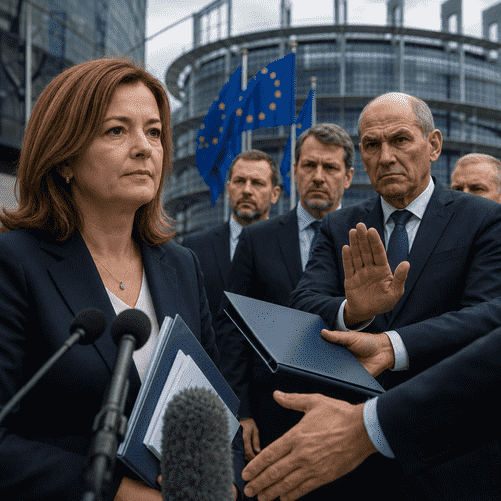
The European Commission has defended the selection process for Tanja Fajon after Slovenia’s government blocked her appointment and filed a criminal complaint linked to her nomination.

Brussels has defended the nomination of former Slovenian foreign minister Tanja Fajon for a senior European Union diplomatic post, rejecting claims that the selection process for the EU’s special representative to the Sahel was irregular.
The dispute has become a sharp political confrontation between EU institutions and Slovenia’s government, led by Prime Minister Janez Janša. Fajon, a Social Democrat and former foreign minister, had been considered for the role of EU special representative for the Sahel, a strategically important position focused on one of Africa’s most unstable regions.
The European Commission has dismissed accusations of procedural wrongdoing, saying there were no irregularities in the way Fajon was selected. The defence from Brussels came after Slovenia’s new government objected to her appointment, raising questions over the validity of her nomination and turning what would normally be a diplomatic personnel decision into a domestic political dispute.
Fajon’s appointment was ultimately blocked, and EU foreign policy chief Kaja Kallas withdrew her nomination. The Council later appointed Danish diplomat Birgitte Nygaard Markussen as the new EU special representative for the Sahel.
The controversy escalated further when Slovenia’s Ministry of Foreign and European Affairs reportedly filed a criminal complaint against Fajon and former ministry secretary-general Bojana Žvokelj over the nomination procedure. The complaint was submitted to the specialised state prosecutor’s office, according to Slovenian reports. Fajon has not been convicted of wrongdoing, and the legal process remains at the allegation stage.
Slovenia’s foreign ministry has insisted that current Foreign Minister Tone Kajzer did not propose Fajon for the post, did not support her candidacy, and did not participate in any procedure connected to it. The ministry said the nomination was submitted while Fajon was serving in a caretaker capacity after the change of government.
For Janša’s government, the case appears to centre on questions of authority, procedure, and political legitimacy: whether a former minister could be advanced for a major EU post without the full backing of the incoming administration. For Fajon and her supporters, however, the affair looks like a politically motivated effort to block a Slovenian from taking up an influential Brussels role because of partisan rivalry.
The episode has also raised broader concerns about how national politics can interfere with EU appointments. Special representatives are meant to serve the Union’s foreign policy interests, not act as extensions of party competition at home. Yet the Fajon case shows how domestic disputes can spill into Brussels and complicate the EU’s effort to project unity abroad.
The Sahel role itself is highly sensitive. The EU representative is expected to coordinate with governments, regional organisations, the United Nations, the African Union, and other international partners on security, governance, humanitarian crises, terrorism, and conflict prevention across the region.
For Slovenia, the fallout may be larger than the fate of one appointment. The dispute risks damaging the country’s influence inside EU institutions at a time when smaller member states often rely on senior diplomatic postings to strengthen their voice in Brussels.
For Brussels, the message is equally delicate. By defending the process while moving ahead with another candidate, EU officials appear to be trying to close the institutional crisis without deepening the confrontation with Ljubljana. But the political damage has already been done: a European foreign-policy appointment has become another battleground in Slovenia’s internal political war.